

Click the photo to view the full-size version
| Name | Manning Railroad Bridge Chicago, Milwaukee, St. Paul & Pacific Railroad Bridge #Z-1334 |
| Built By | Chicago, Milwaukee & St. Paul Railway |
| Currently Owned By | BNSF Railway |
| Superstructure Contractor | Unknown |
| Substructure Builder | Chicago, Milwaukee & St. Paul Railway Company Forces |
| Design Engineer | Charles Frederick Loweth |
| Length | 750 Feet Total, 125 Foot Main Span |
| Width | 2 Tracks, 1 In Use |
| Height Above Ground | 30 Feet (Estimated) |
| Superstructure Design | Pratt Through Truss, Deck Plate Girder and Concrete Arch Skeleton Abutment |
| Substructure Design | Concrete |
| Date Built | 1913 |
| Traffic Count | 1 Train/Day (Estimated) |
| Current Status | In Use |
| Chicago, Milwaukee, St. Paul & Pacific Railroad Bridge Number | Z-1334 |
| BNSF Railway Bridge Number | 412.44 |
| Significance | Regional Significance |
| Documentation Date | 10/16/2015; 3/2/2021 |
In 1870, the Sabula, Ackley & Dakota Rail Road (SA&D) constructed a 21-mile railroad line, extending from the Mississippi River at Sabula, Iowa to Preston, Iowa. The following year, an additional 12 miles were completed to Delmar, Iowa. In 1872, an additional 54 miles were completed to Marion, Iowa. In 1872, the SA&D was conveyed to the Milwaukee & St. Paul Railway (M&StP), which reorganized as the Chicago, Milwaukee & St. Paul Railway (Milwaukee Road) in 1874. In 1882, the Milwaukee Road completed an additional 257 miles between Marion and Council Bluffs, Iowa; completing a mainline from the Mississippi River to the Missouri River. The same year, a bridge across the Mississippi River was completed at Sabula, which connected to the existing Milwaukee Road system in Illinois. By the late 19th Century, the Milwaukee Road had developed a large railroad network throughout the Midwest. This line quickly became a principal mainline for the Milwaukee Road, and allowed for the connection and construction of other branch lines throughout Iowa.
In 1901, a short 12-mile cutoff was completed between Green Island, Iowa and Browns Junction, Iowa; which shortened the distance and provided better grades. The original line was retained as a second track. In the early 20th Century, the Milwaukee Road was aware of the importance of this line, and a massive construction project was planned to modernize the line. Between 1912 and 1915, the line between Green Island and Manilla, Iowa was extensively rebuilt, with a second track constructed and large sections of line relocated. The result was one of the most modern double track lines in Iowa, complete with smooth curves, gentle grades and new bridges. After completion of the project, some short sections of the original line were retained as spurs, which were abandoned by the early 1920s. The Milwaukee Road failed to accurately project the level of traffic over this line, and traffic never reached the threshold that required a double track line. The Milwaukee Road was often in financial trouble, especially after the costly Pacific Extension was completed in 1909. In 1925, the company declared bankruptcy, and reorganized as the Chicago, Milwaukee, St. Paul and Pacific Railroad in 1928. Despite the financial strain, this line remained an important mainline for the Milwaukee Road. Segments between Marion and Covington, Iowa; Newhall, Iowa and Collins, Iowa; and Madrid, Iowa and Templeton, Iowa were reduced to a single track in 1934. The segment between Green Island and Paralta, Iowa was reduced to a single track in 1950; the segment between Paralta and Marion in 1954; the segment between Collins and Madrid, Iowa in 1956 and the segment between Covington and Newhall in 1964. In addition, the original line east of Browns Junction was abandoned in 1950. Financial hardship continued through the 20th Century for the Milwaukee Road, and the railroad again filed bankruptcy in 1977. In 1980, the Milwaukee Road decided to abandon the entire Iowa Division mainline. The segment between Bayard, Iowa and Council Bluffs was sold to Burlington Northern Railroad (BN). Segments between Perry, Iowa and Bayard and between Slater, Iowa and Woodward were sold to the Chicago & North Western Railway (C&NW). A short segment at Marion was sold to the Chicago Central & Pacific Railroad (CC).
In 1985, the segment between Herndon and Bayard was abandoned by the C&NW. In 1995, the C&NW was purchased by Union Pacific Railroad (UP). In 1996, BN merged with the Atchison, Topeka & Santa Fe Railway to form BNSF Railway. The CC was purchased by Illinois Central Railroad (IC) in 1996, and the IC was purchased by Canadian National Railway (CN) in 1998. In 1999, the segment between Dawson, Iowa and Herndon was abandoned by UP. In 2002, most of the segment at Marion was abandoned by CN. Between 2003 and 2004, the remaining portions between Slater and Woodward and between Perry and Dawson were abandoned by UP. Today, BNSF operates the Bayard to Council Bluffs segment as the Bayard Subdivision, and CN still operates a short segment of line in Hiawatha. Linn County has developed large sections around Marion into the Grant Wood Trail. A section west of Rhodes, Iowa has been reused as a trail; and segments between Collins and Slater have been reused as the Heart of Iowa Nature Trail. Much of the line between Slater and Perry has been reused as the High Trestle Trail; and the line between Perry and Herndon has been reused as the Raccoon River Valley Trail. Remaining segments have been abandoned, with much of the right-of-way still intact. In addition, large segments of the original right-of-way that was replaced in the early 20th Century remain intact.
View historic articles discussing the double tracking of this line (digitized by Google)
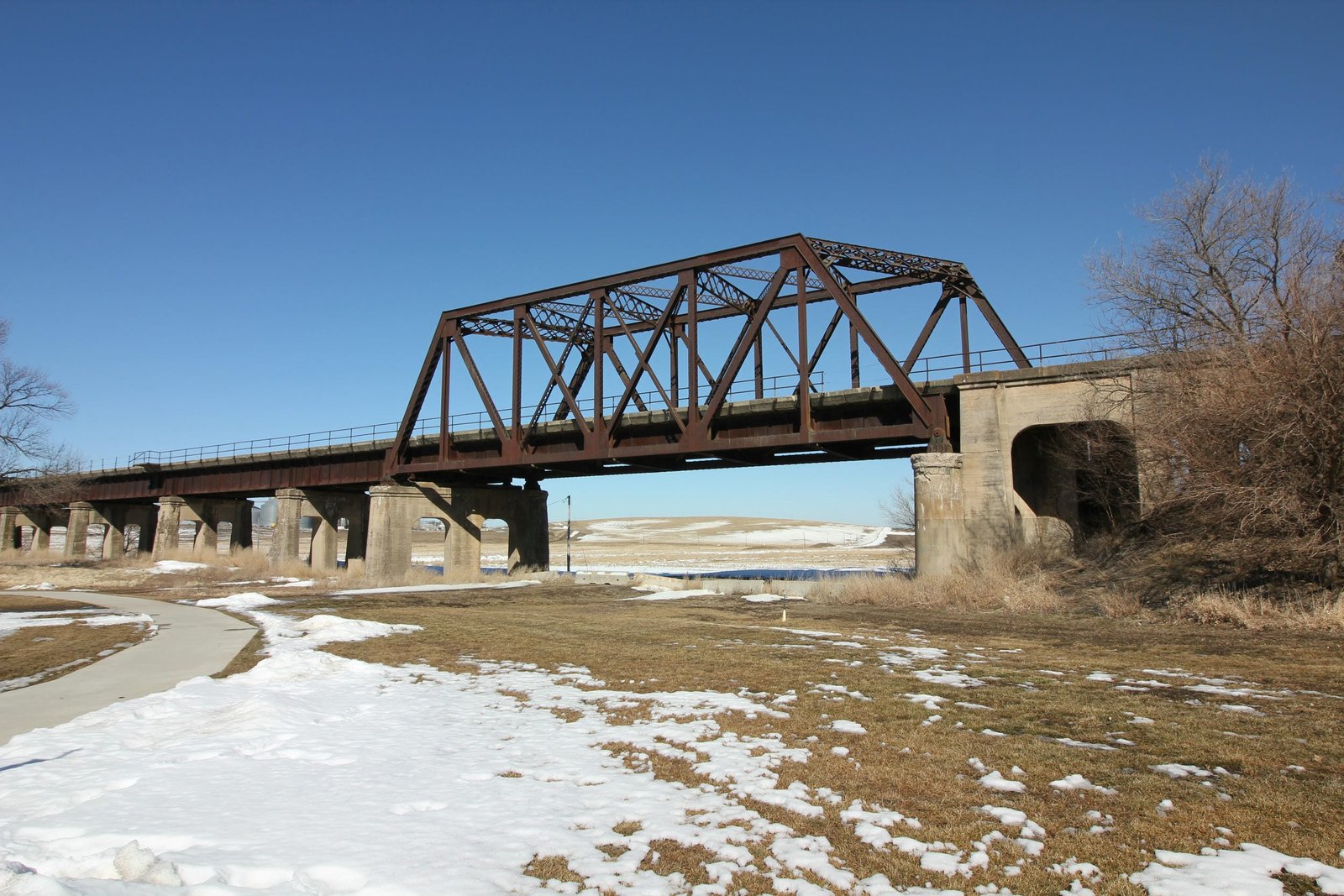
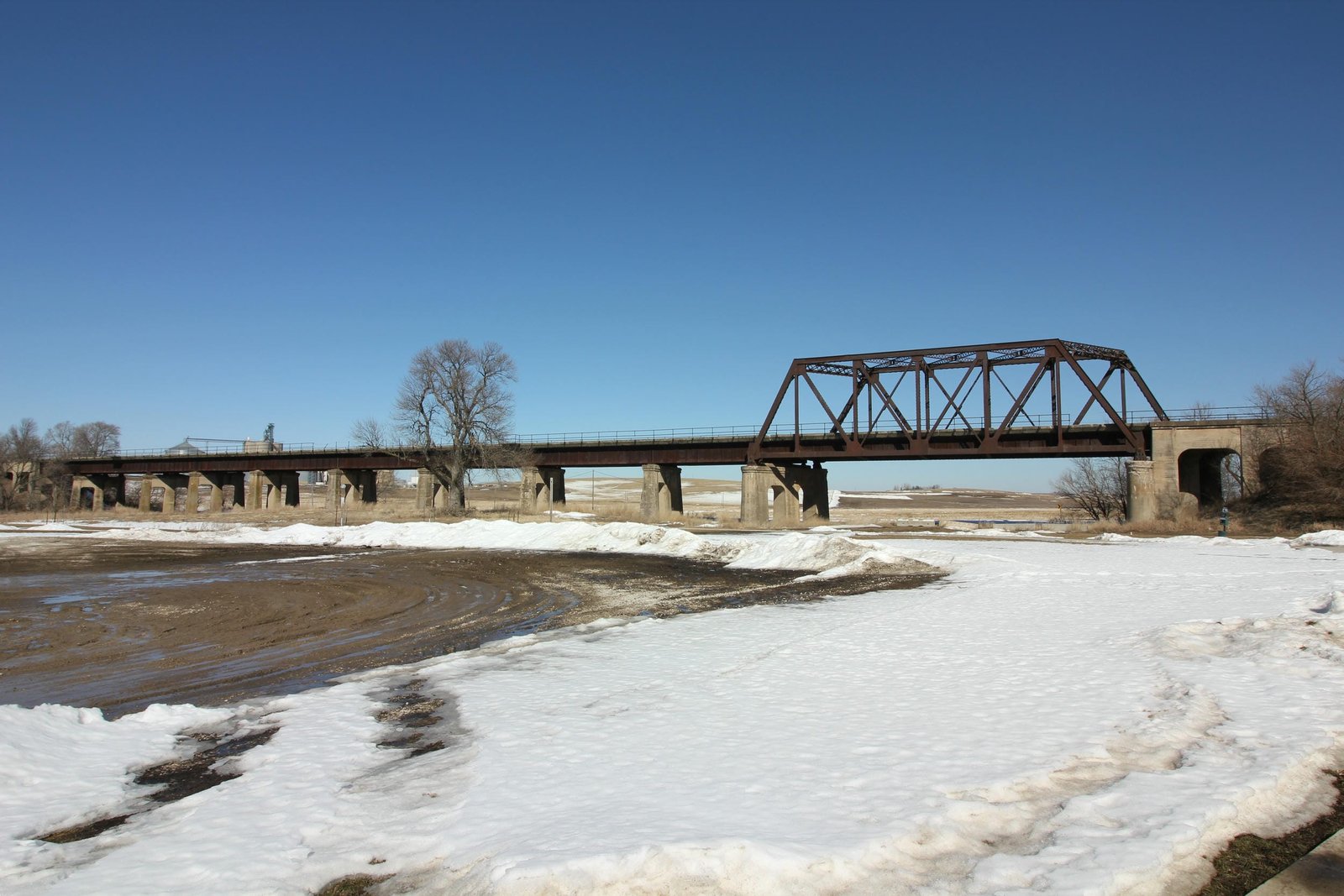
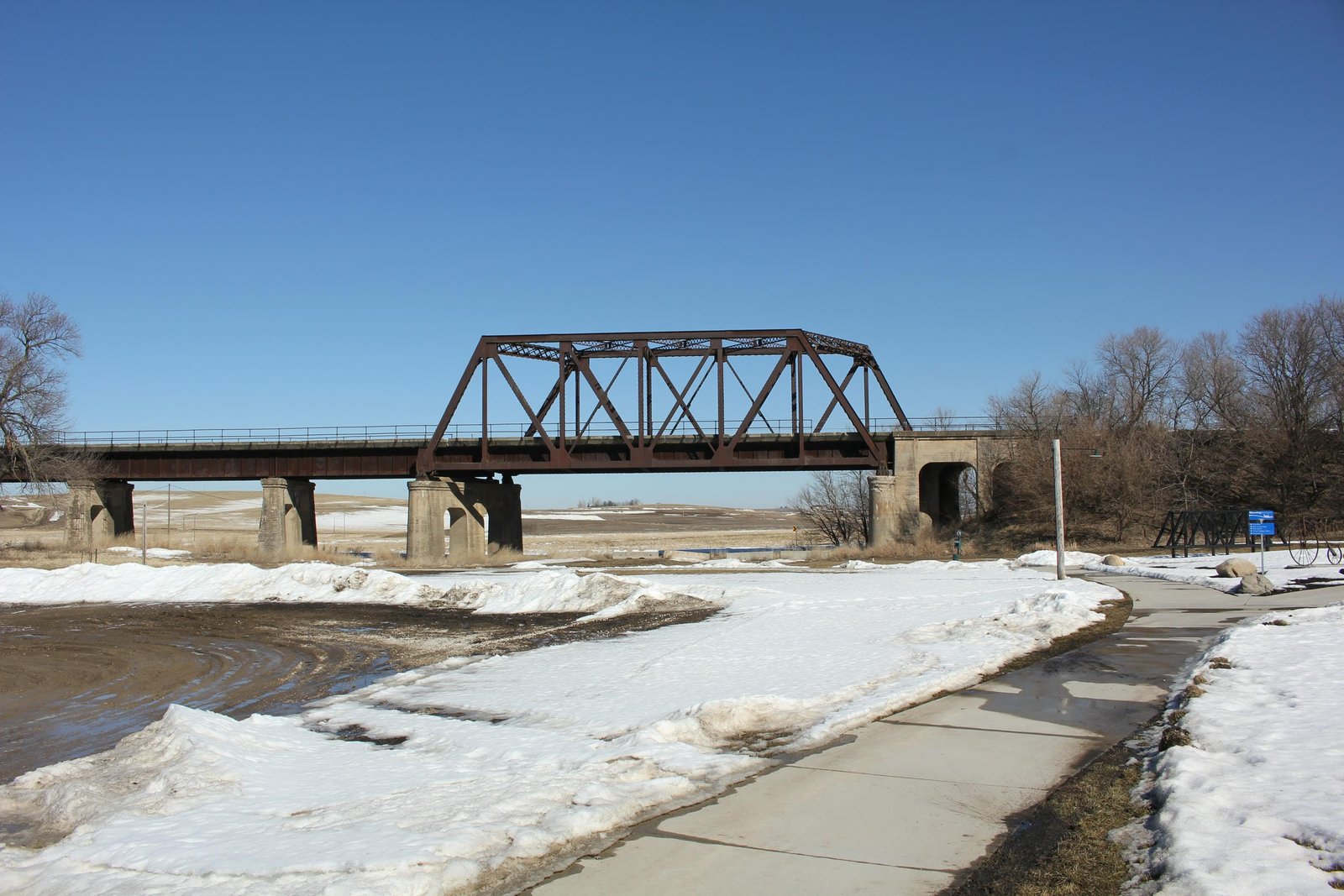
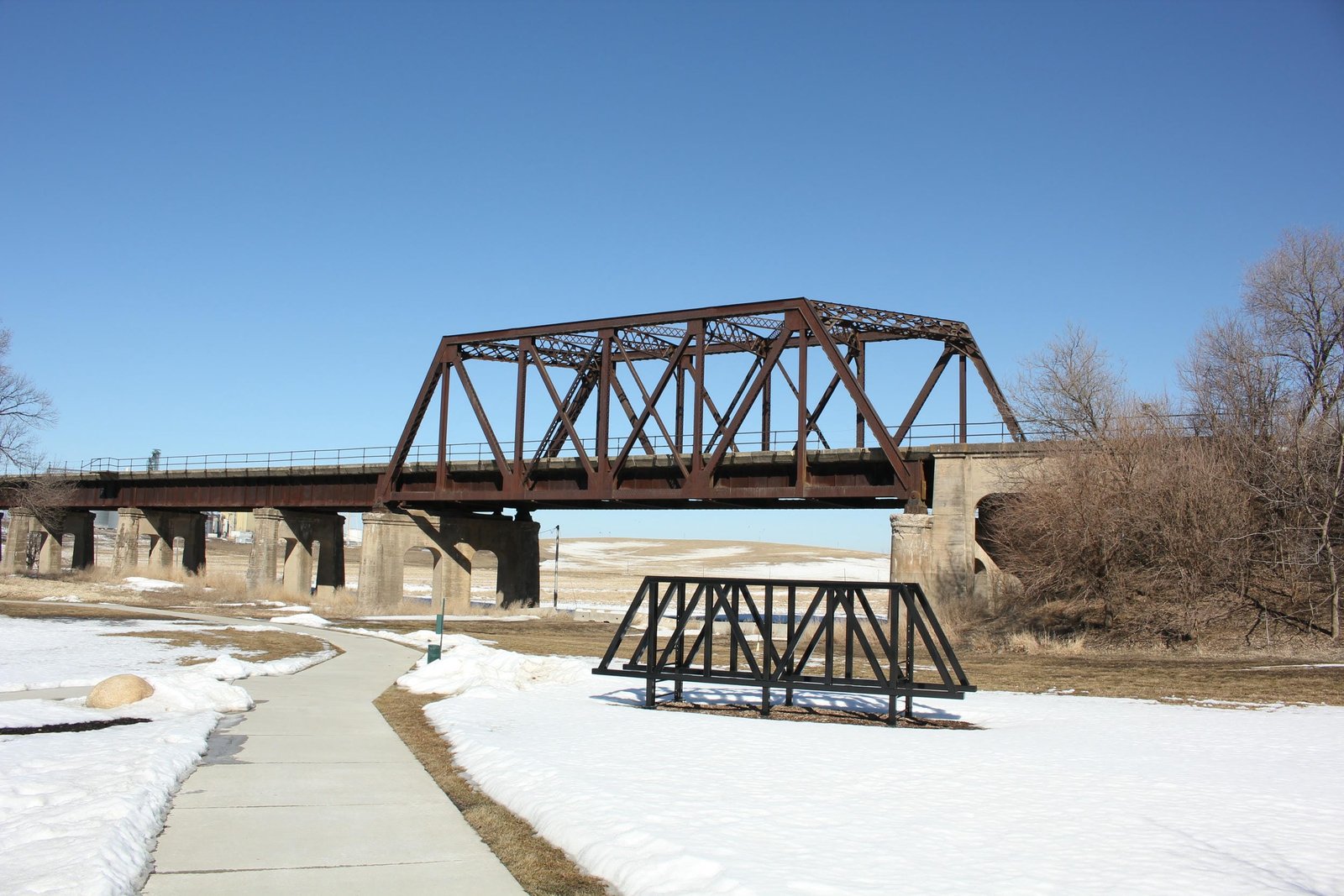
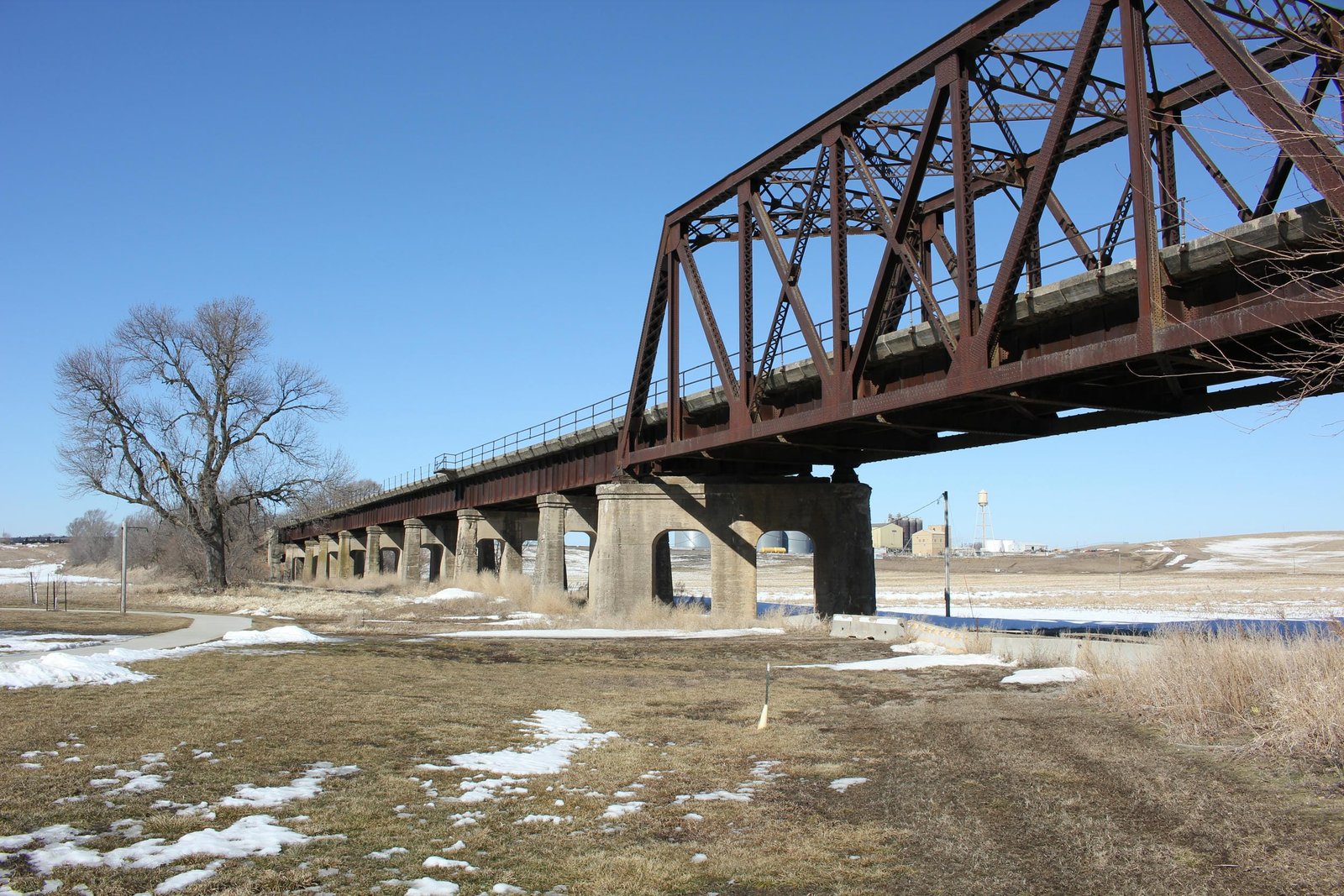
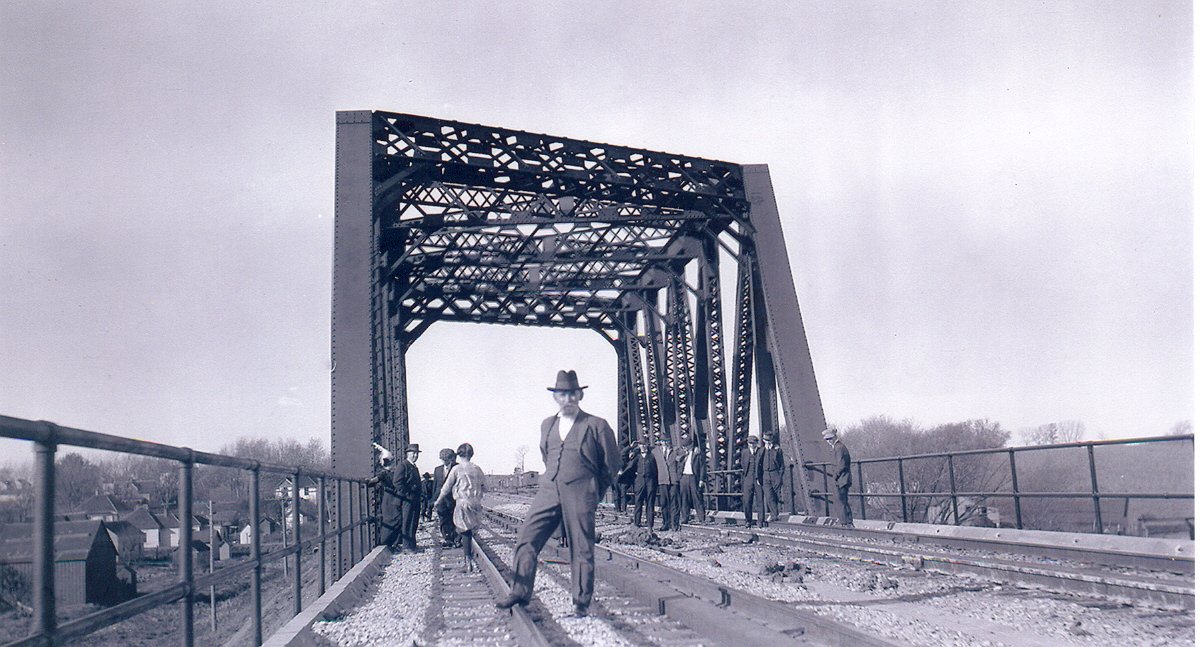
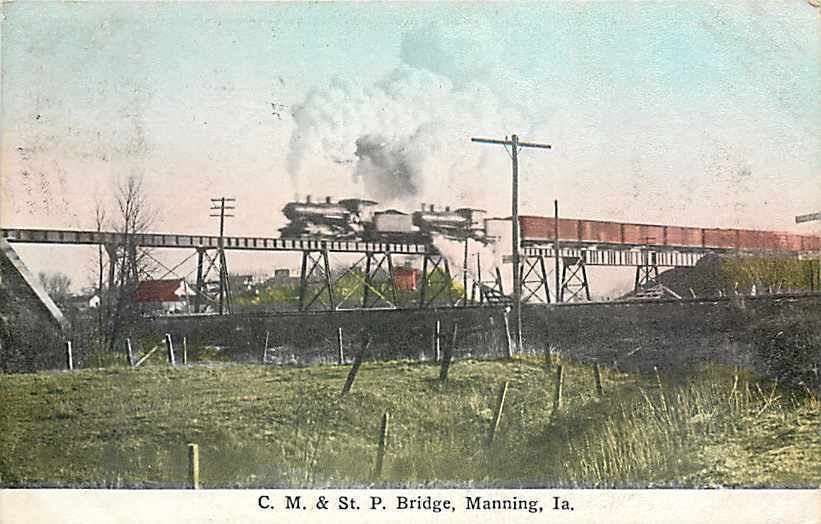
Located in Manning, this iconic through truss and deck plate girder bridge carries a former Chicago, Milwaukee, St. Paul & Pacific Railroad (Milwaukee Road) mainline over the West Nishnabotna River and Railroad Street. Originally, the Milwaukee Road mainline ran through the southern part of Manning on a more indirect route with several curves and harsher grades. At Manning, the Milwaukee Road also intersected a Chicago & North Western Railway branch line and a Chicago Great Western Railway mainline. The first trestle in Manning was located north of present day Iowa Highway 141, and likely consisted of a lengthy timber pile trestle bridge. In 1889, the bridge was rebuilt with several short and light deck plate girder spans and two larger 63-foot spans, set onto steel towers and concrete footings. Between 1912 and 1915, the Milwaukee Road reconstructed the mainline across Iowa, improving the alignment and grades, constructing new bridges and adding a second track. In 1913, a new bridge was constructed on a new alignment located at the north edge of town. The original viaduct was removed in 1914, and one of the spans was reused at Bridge #Y-22 at Clive, Iowa.
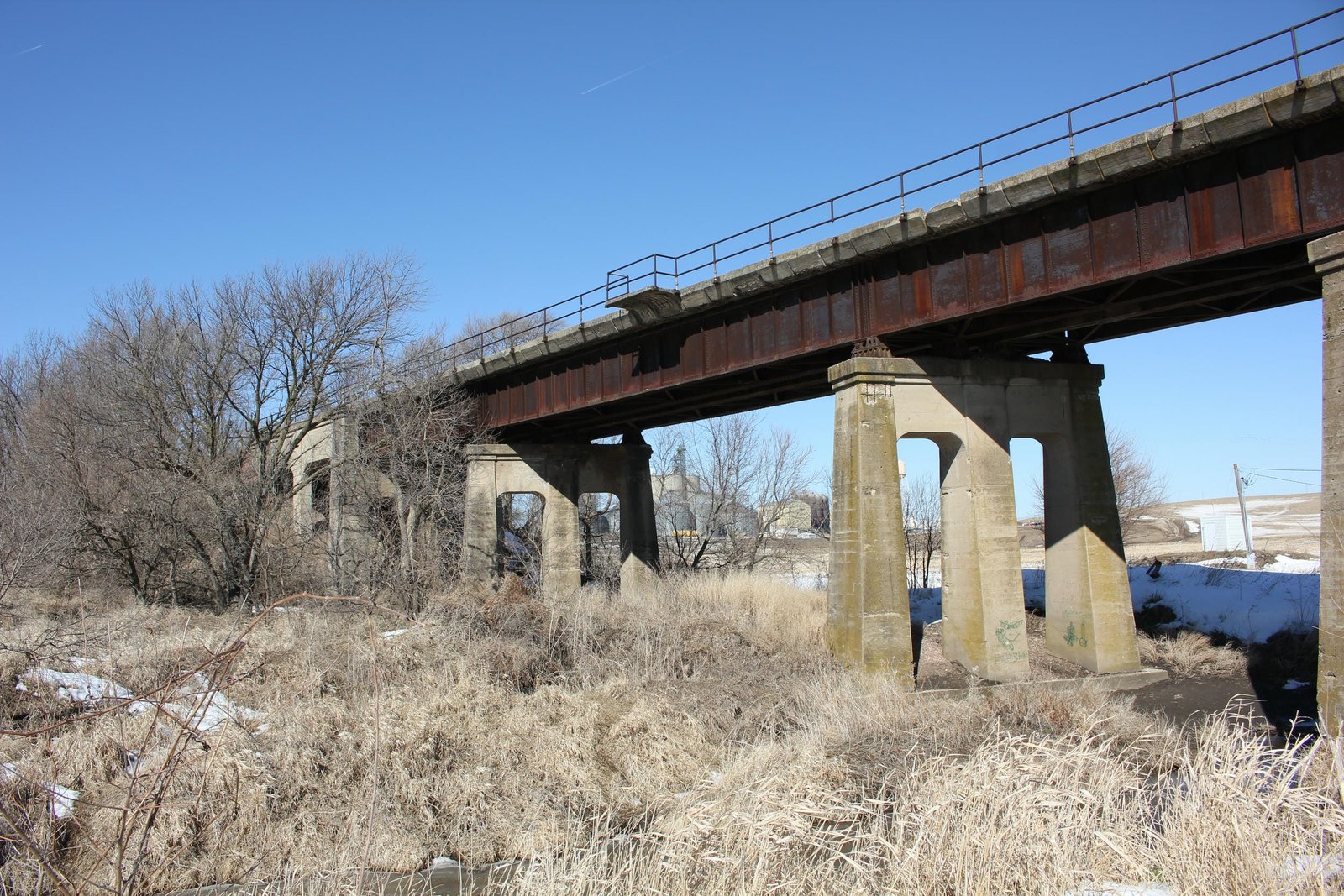
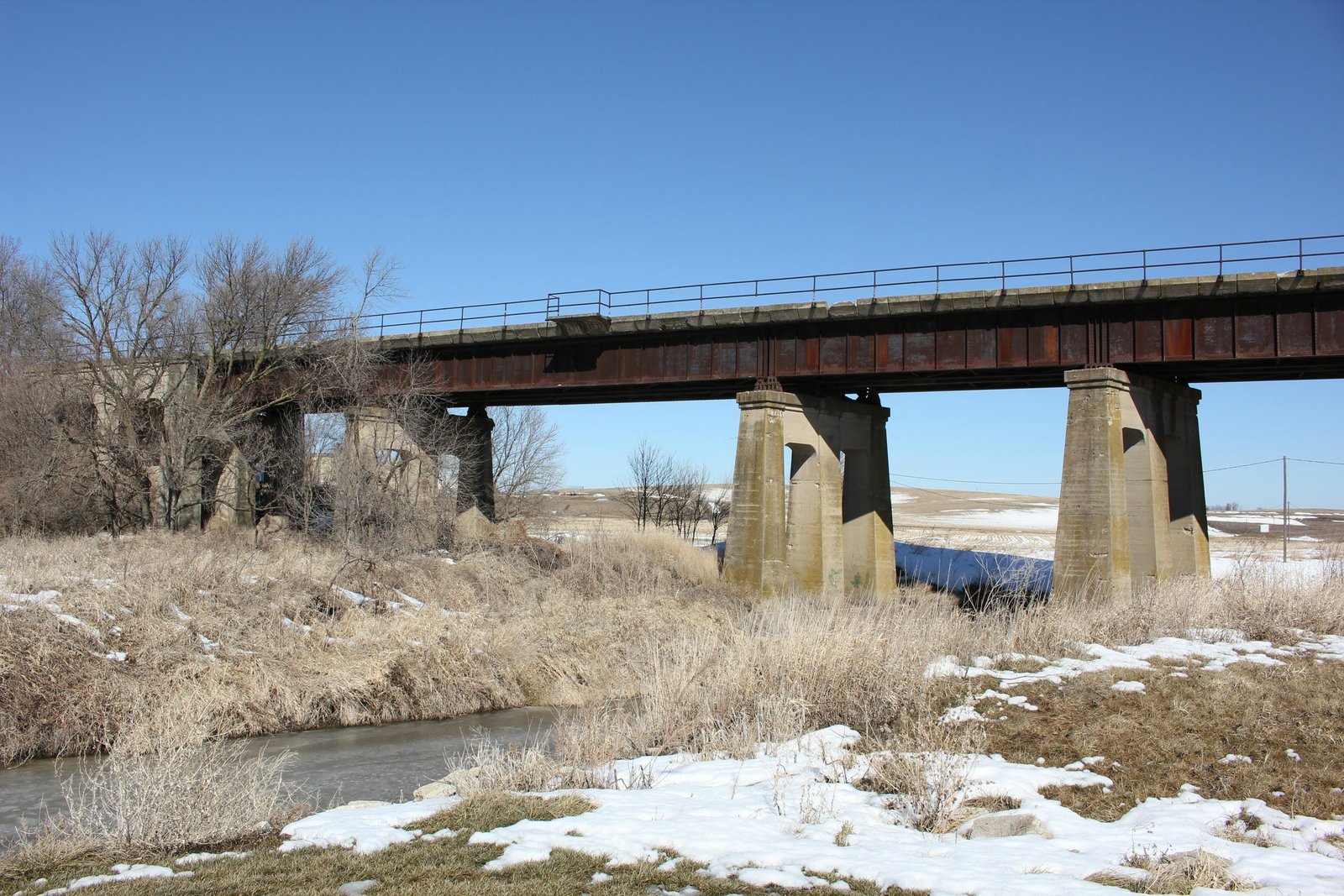
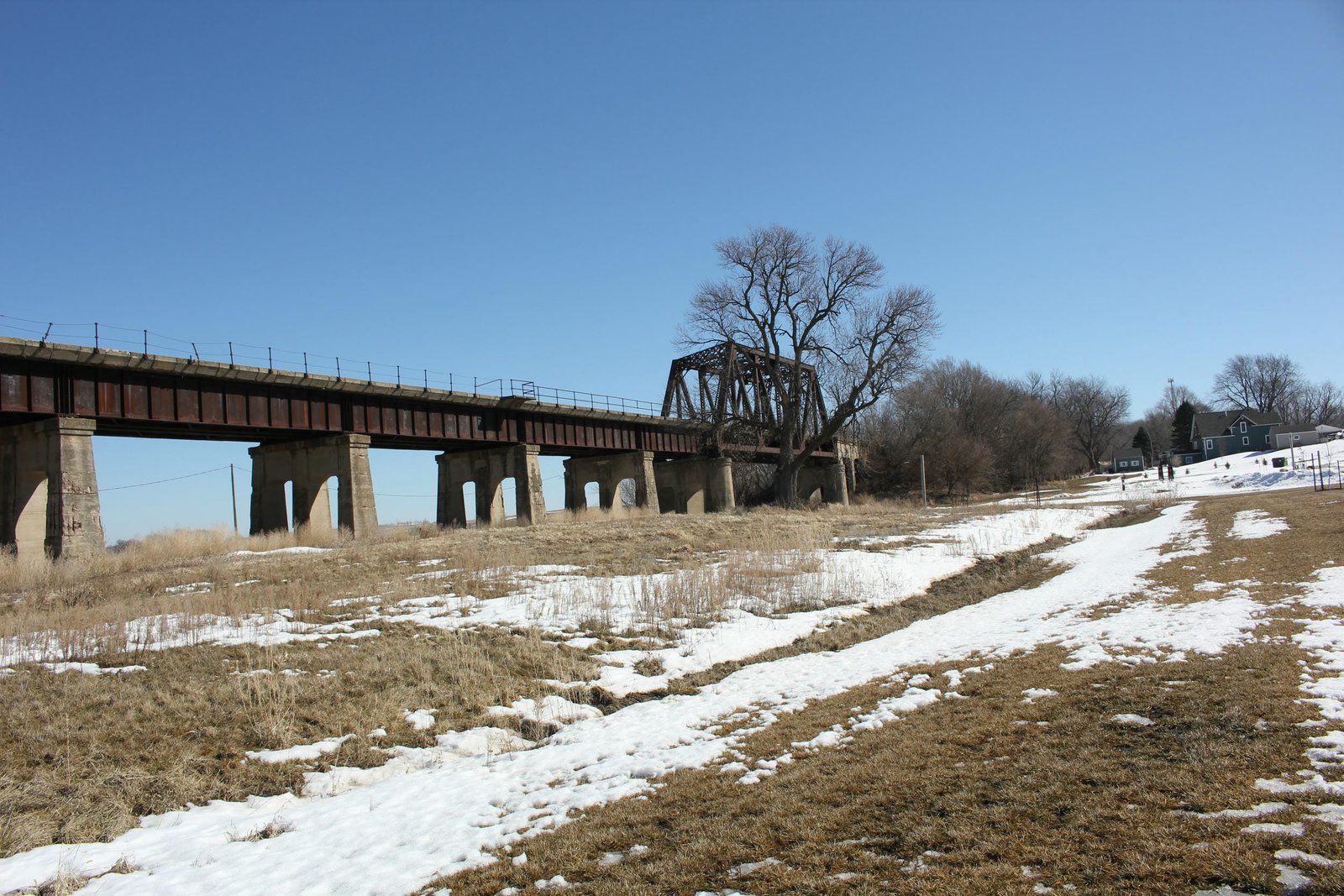
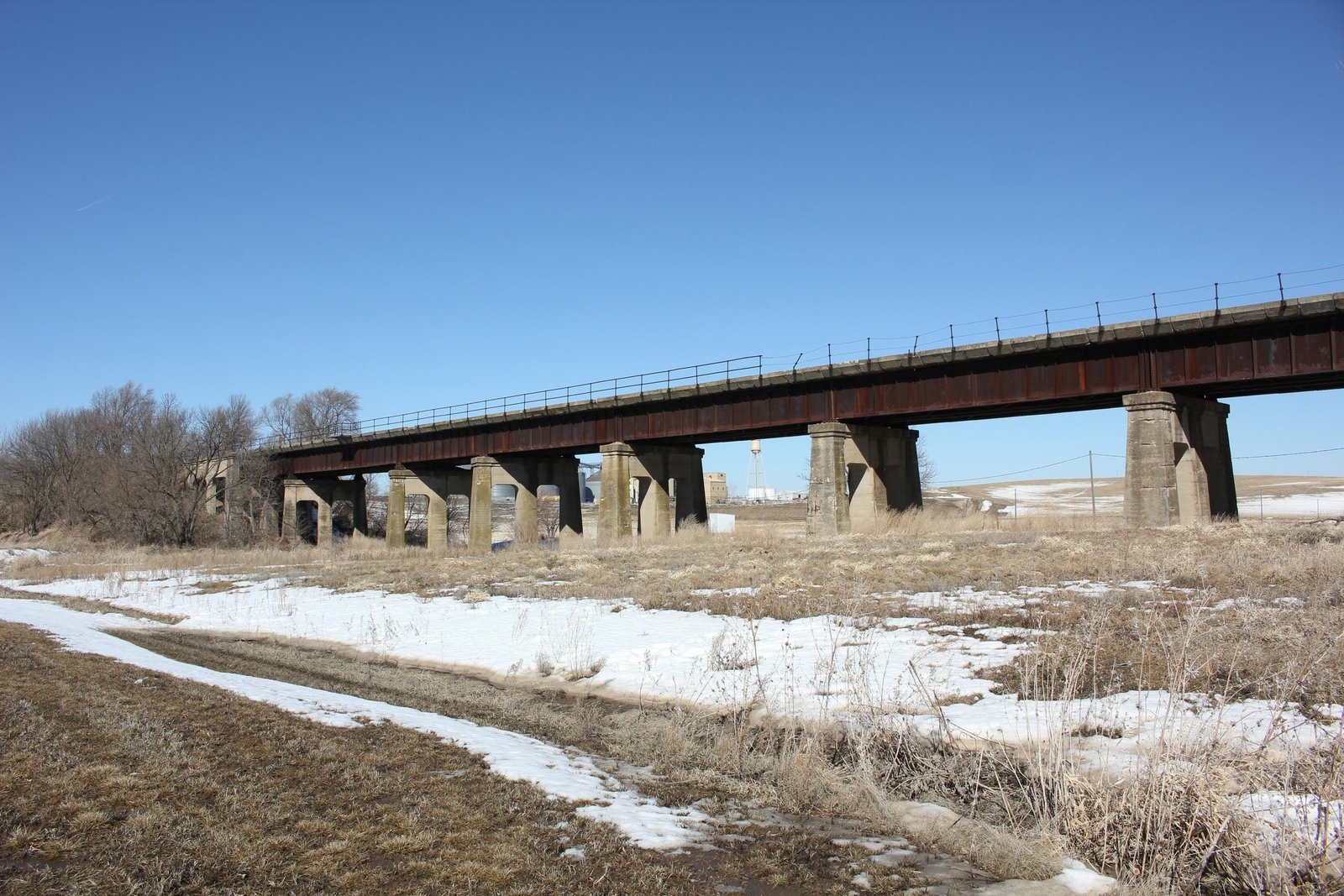
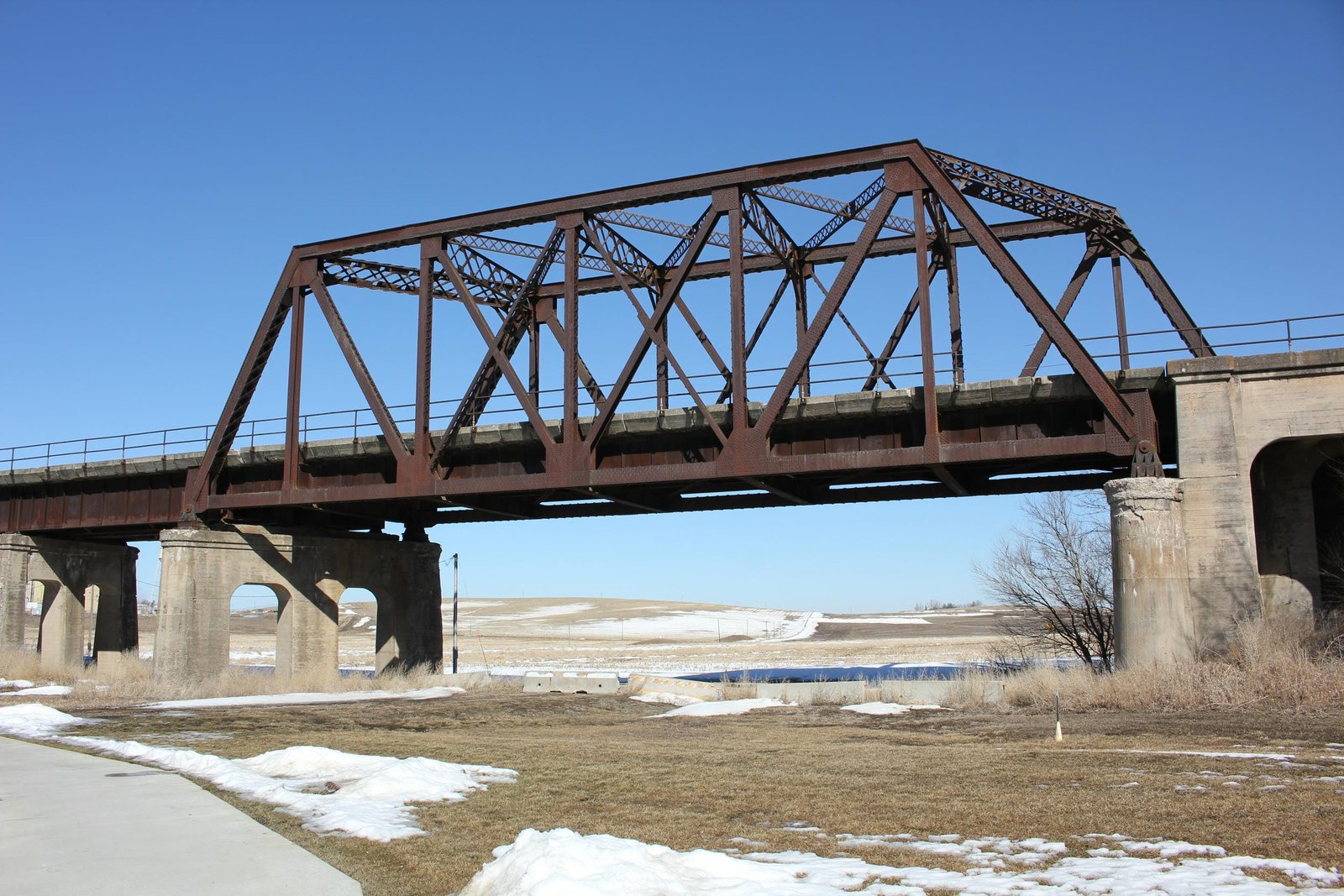
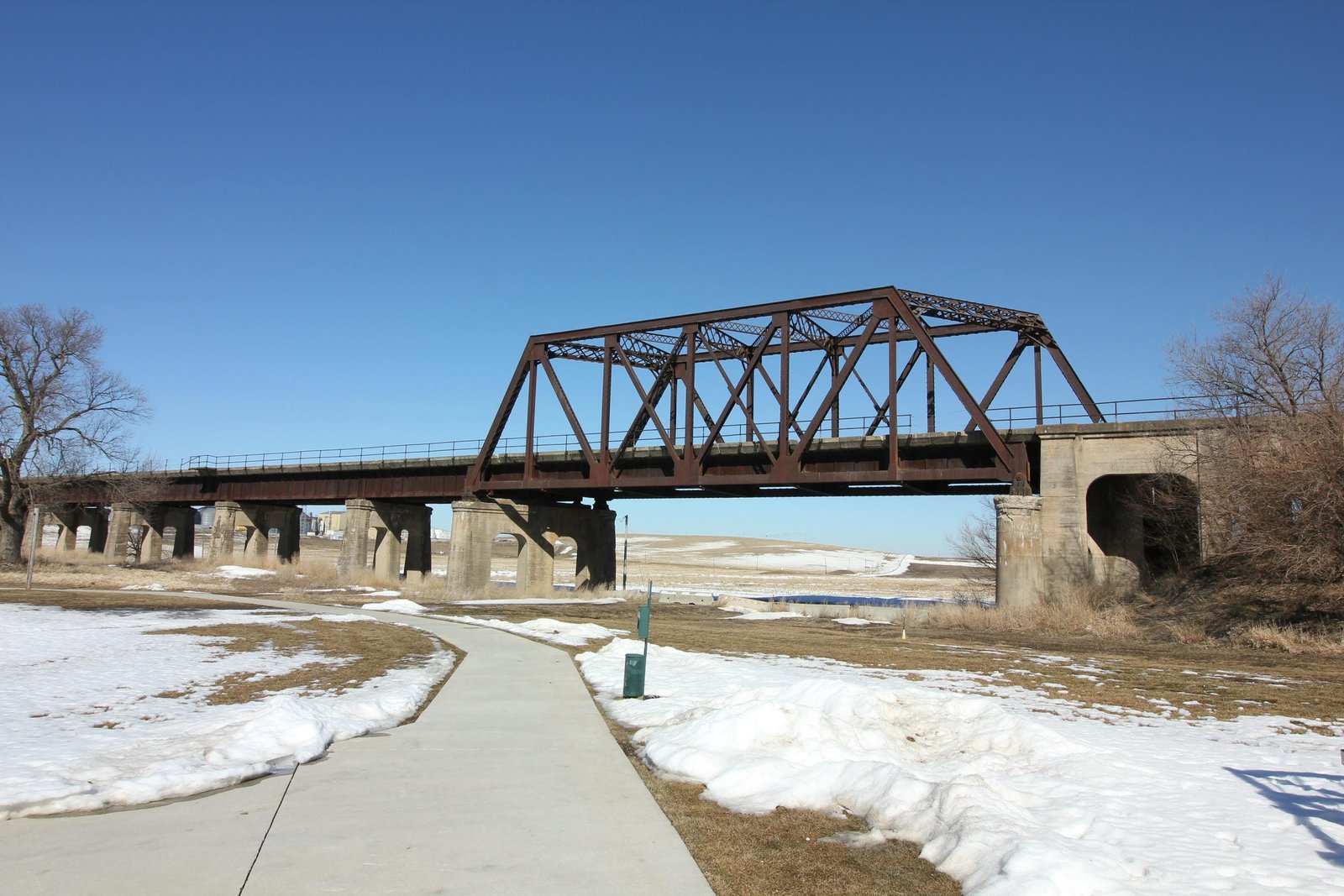
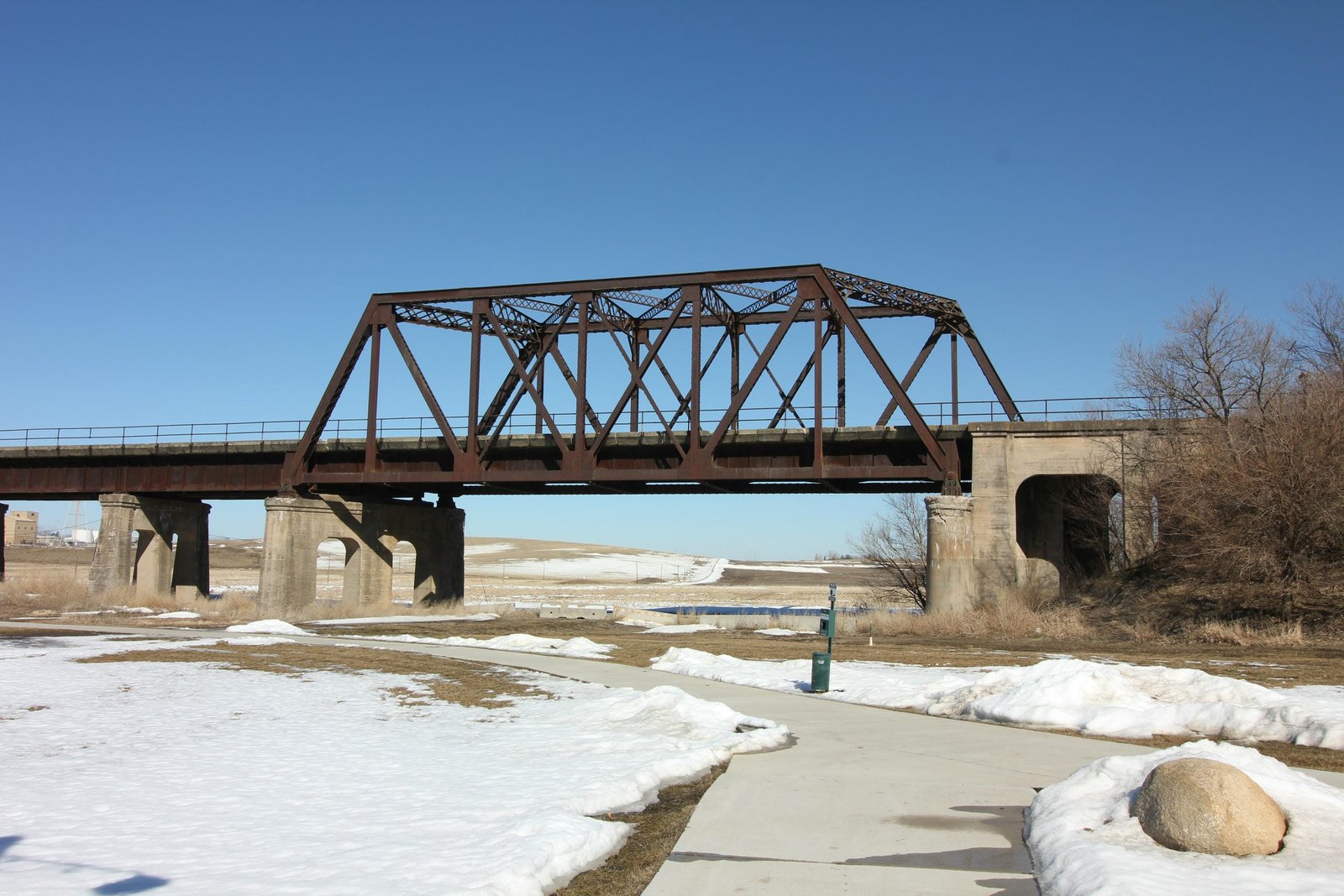
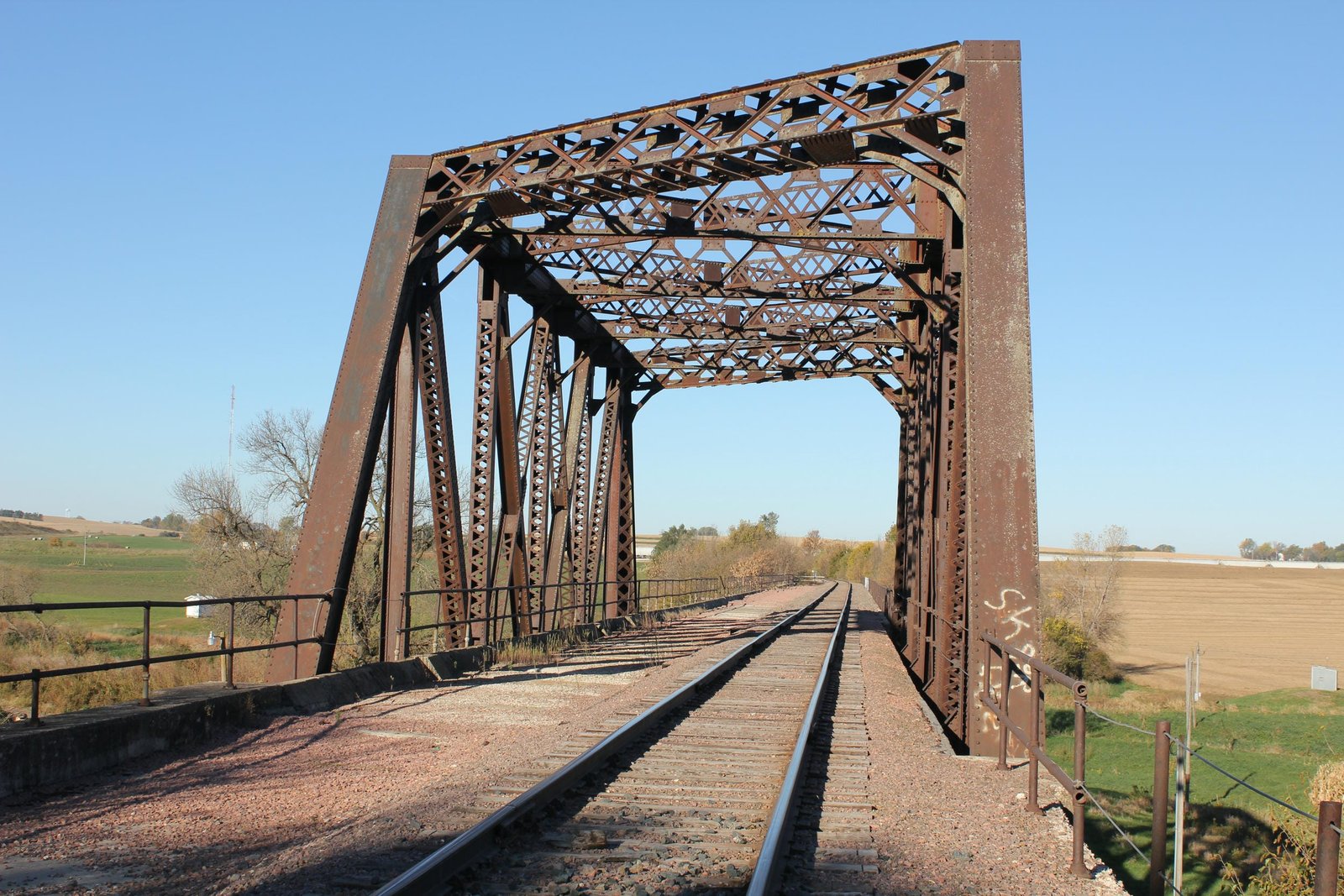
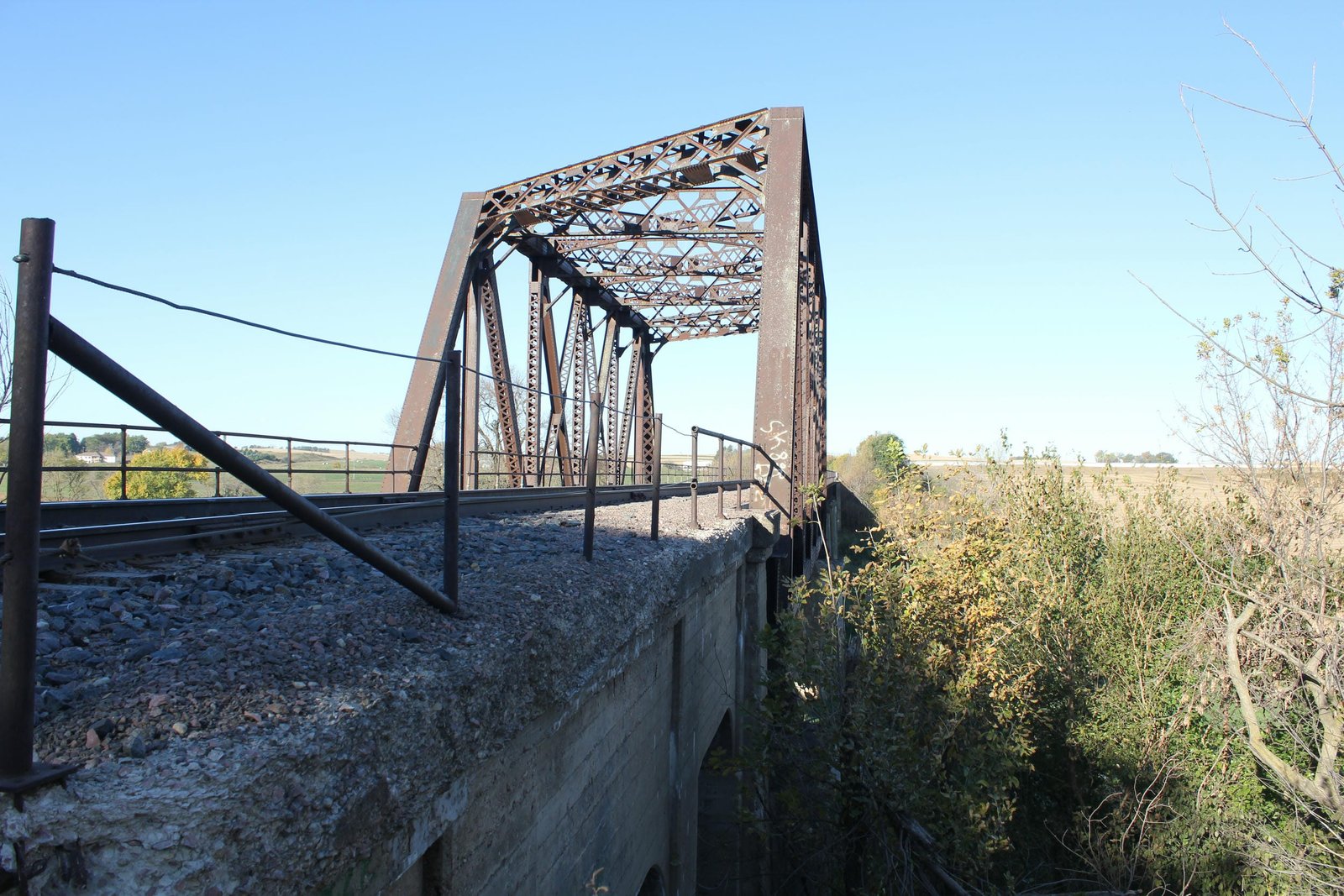
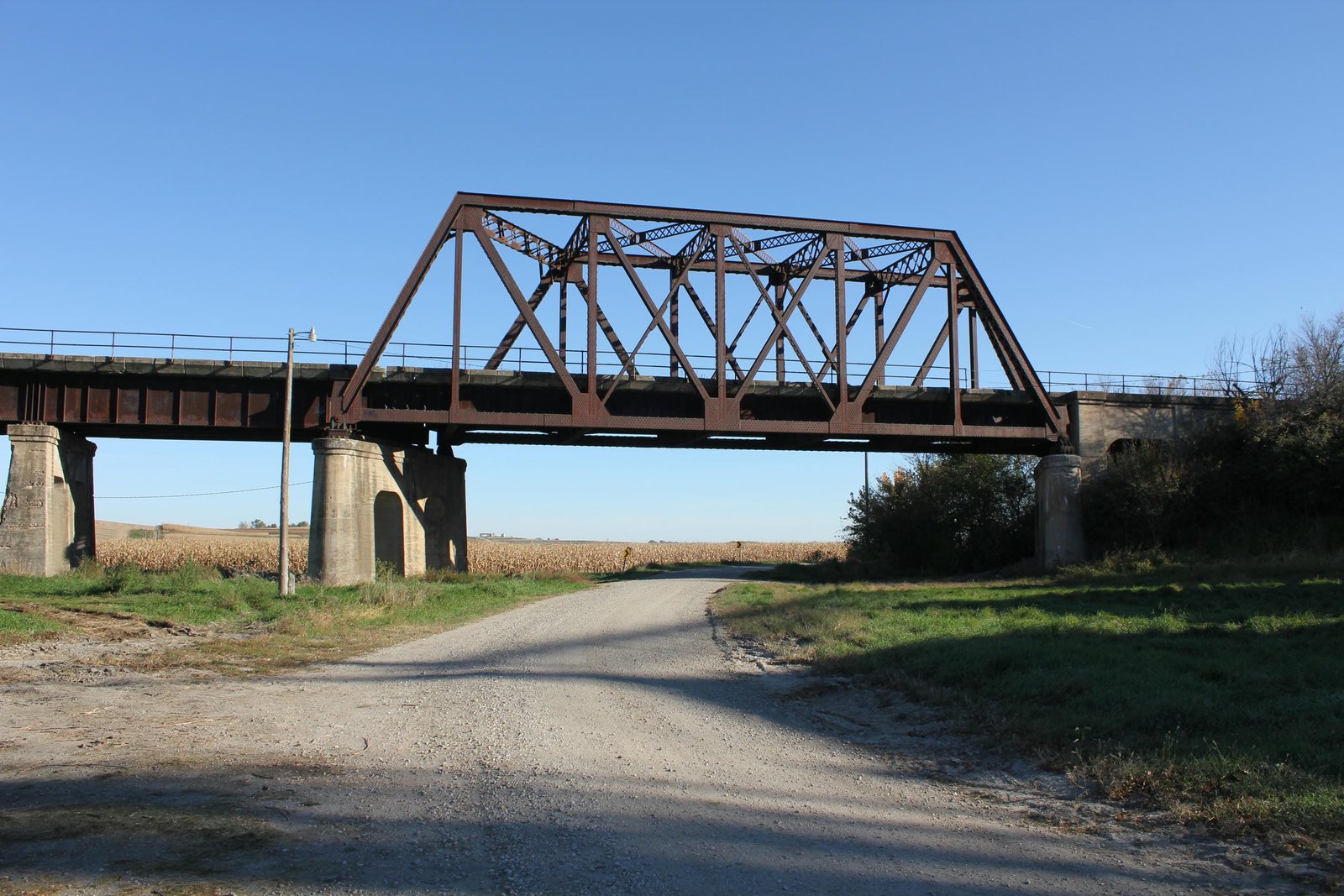
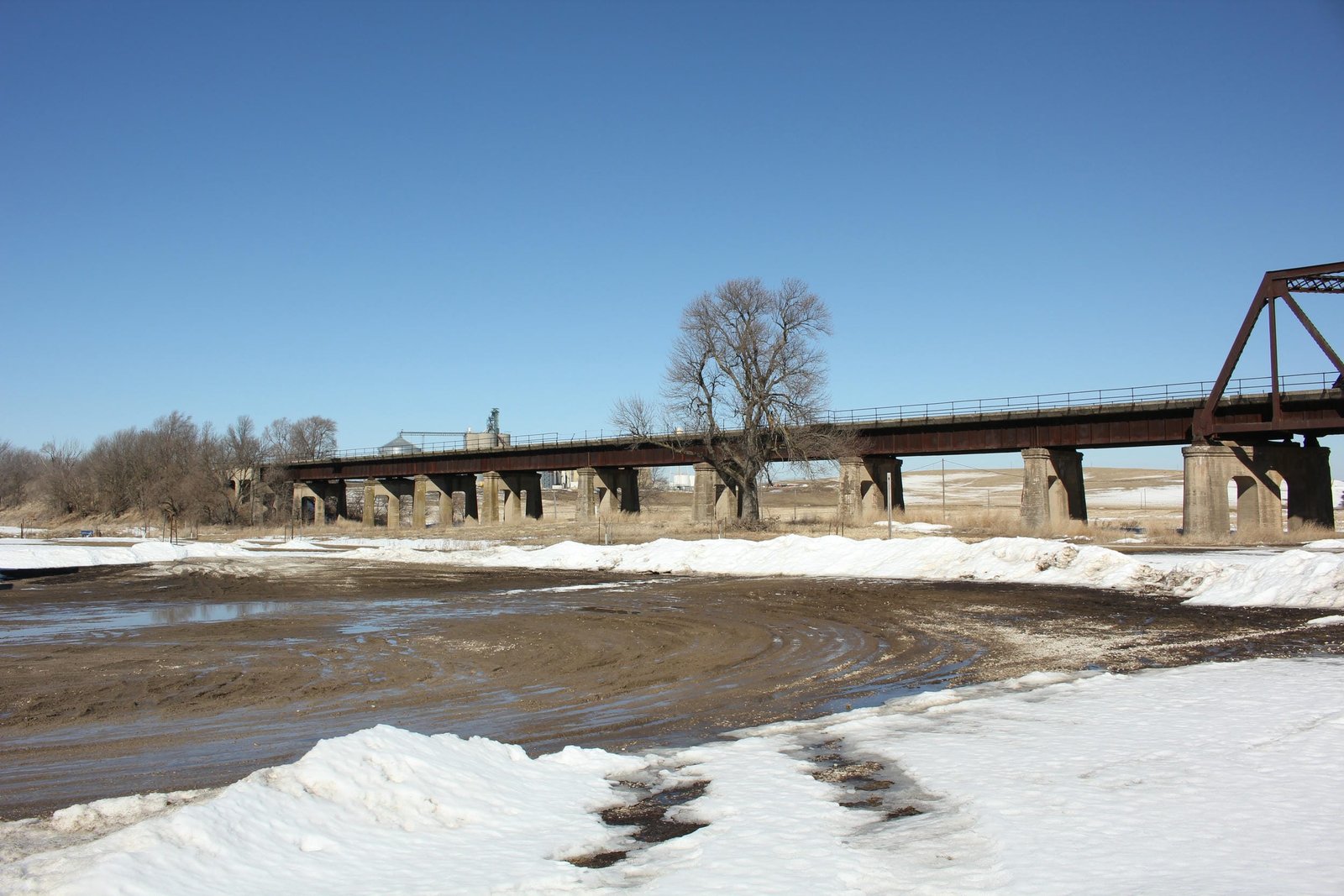
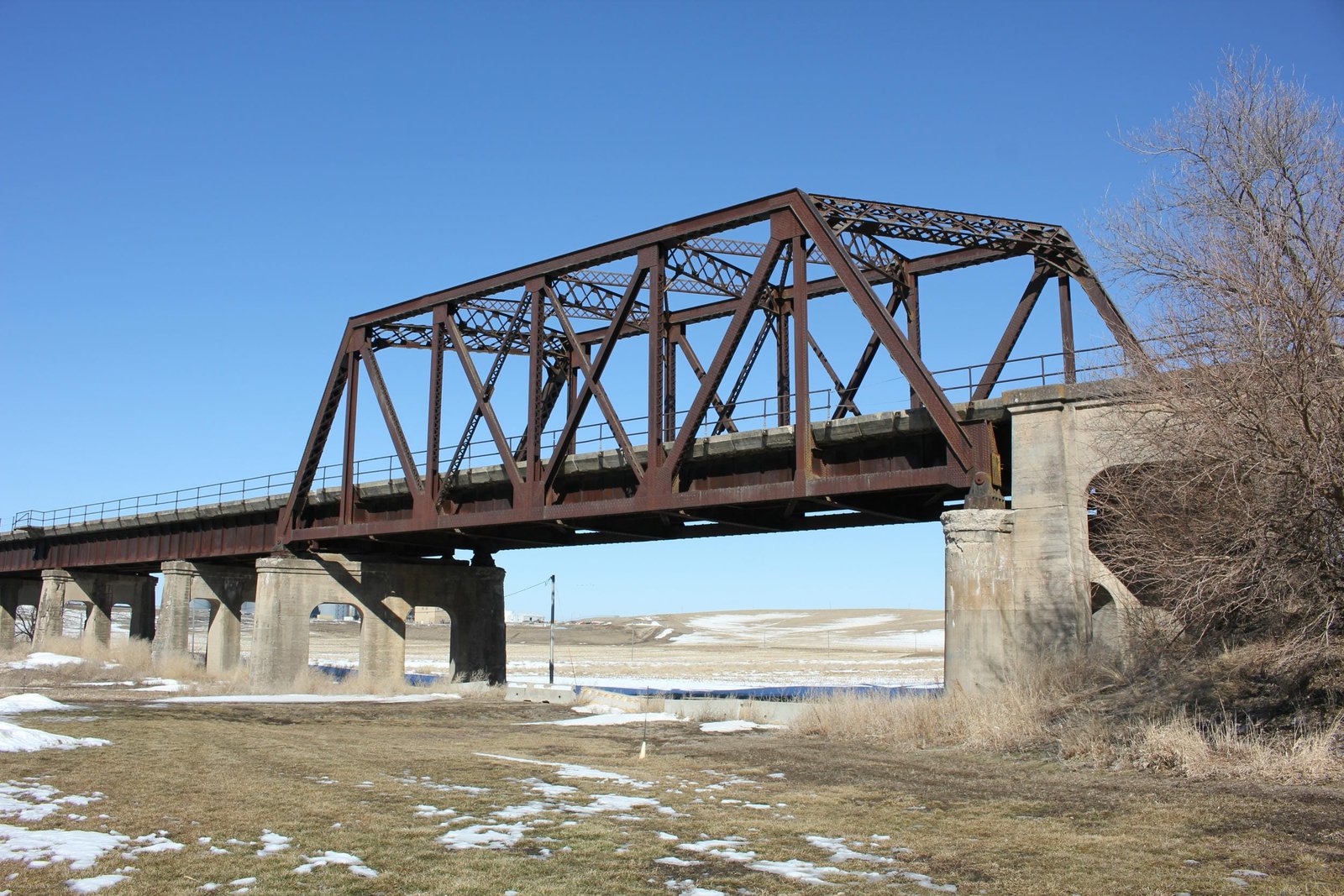
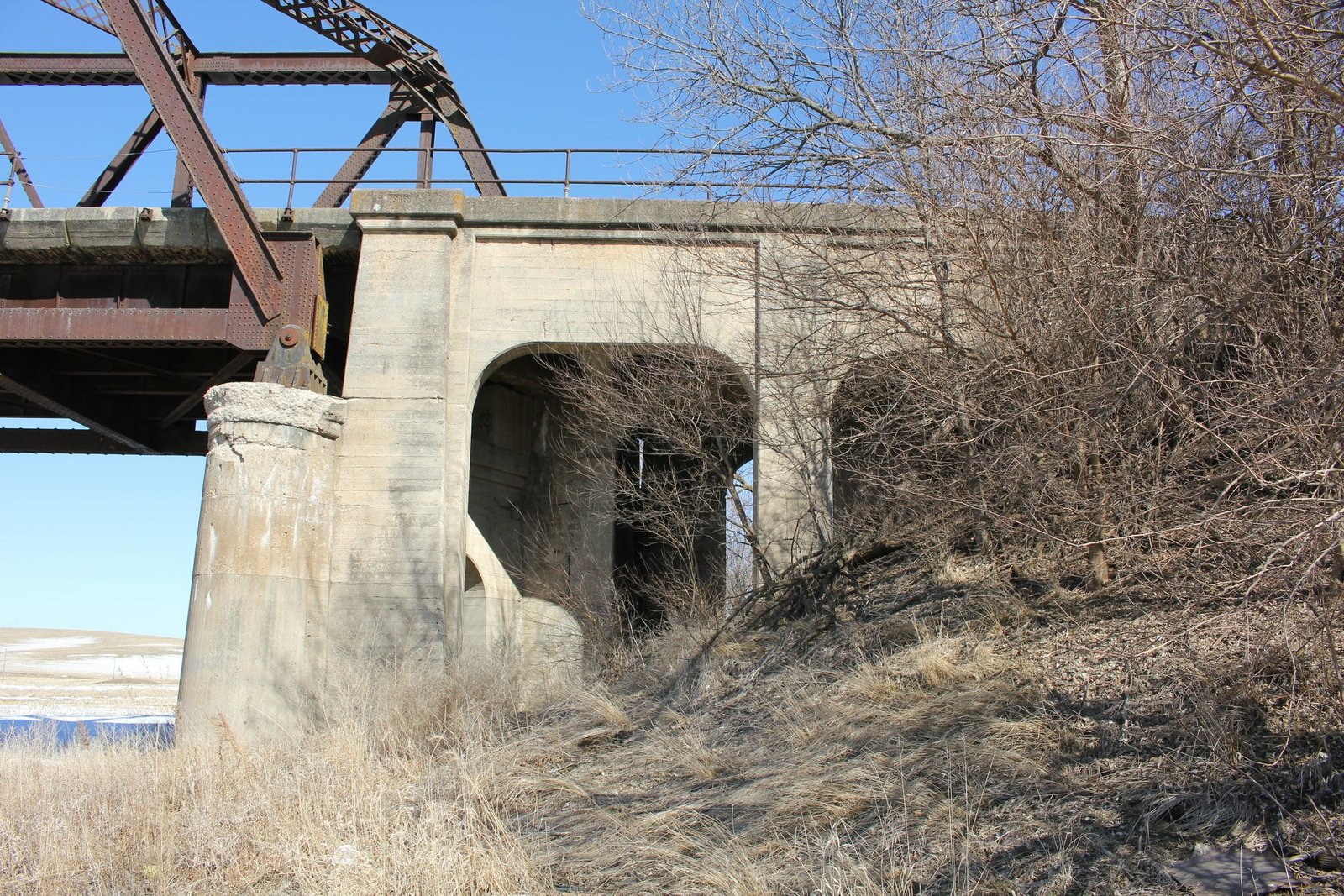
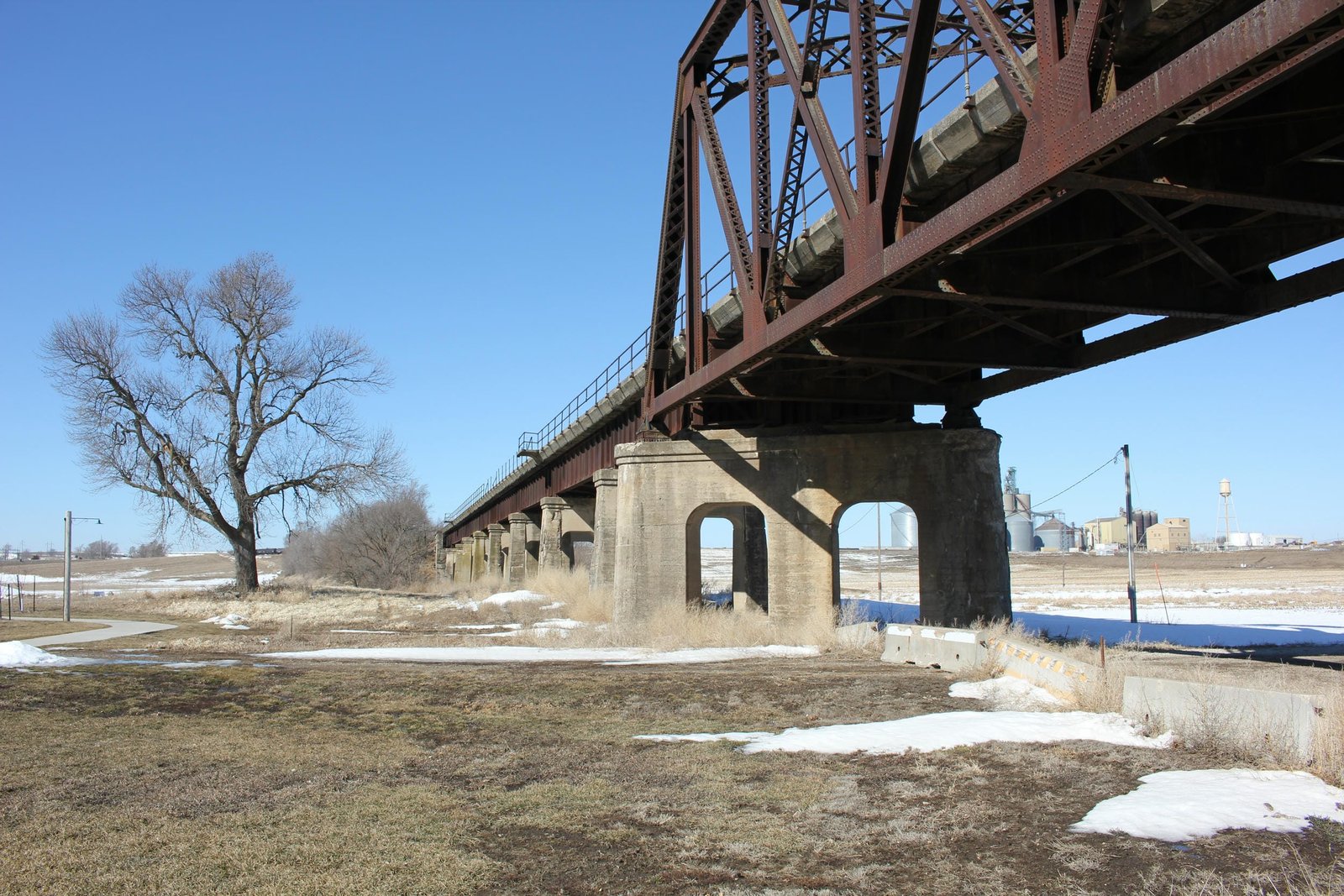
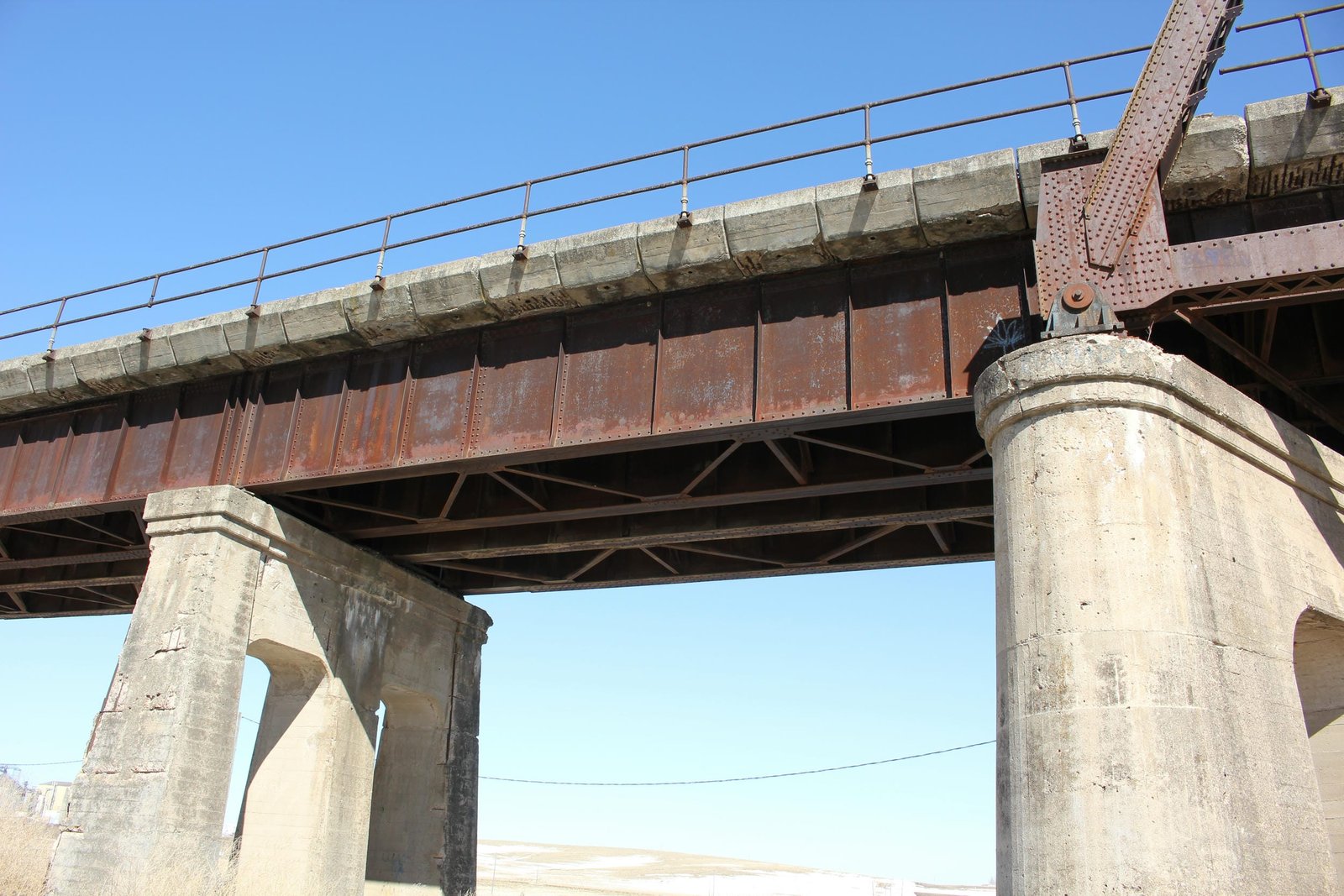
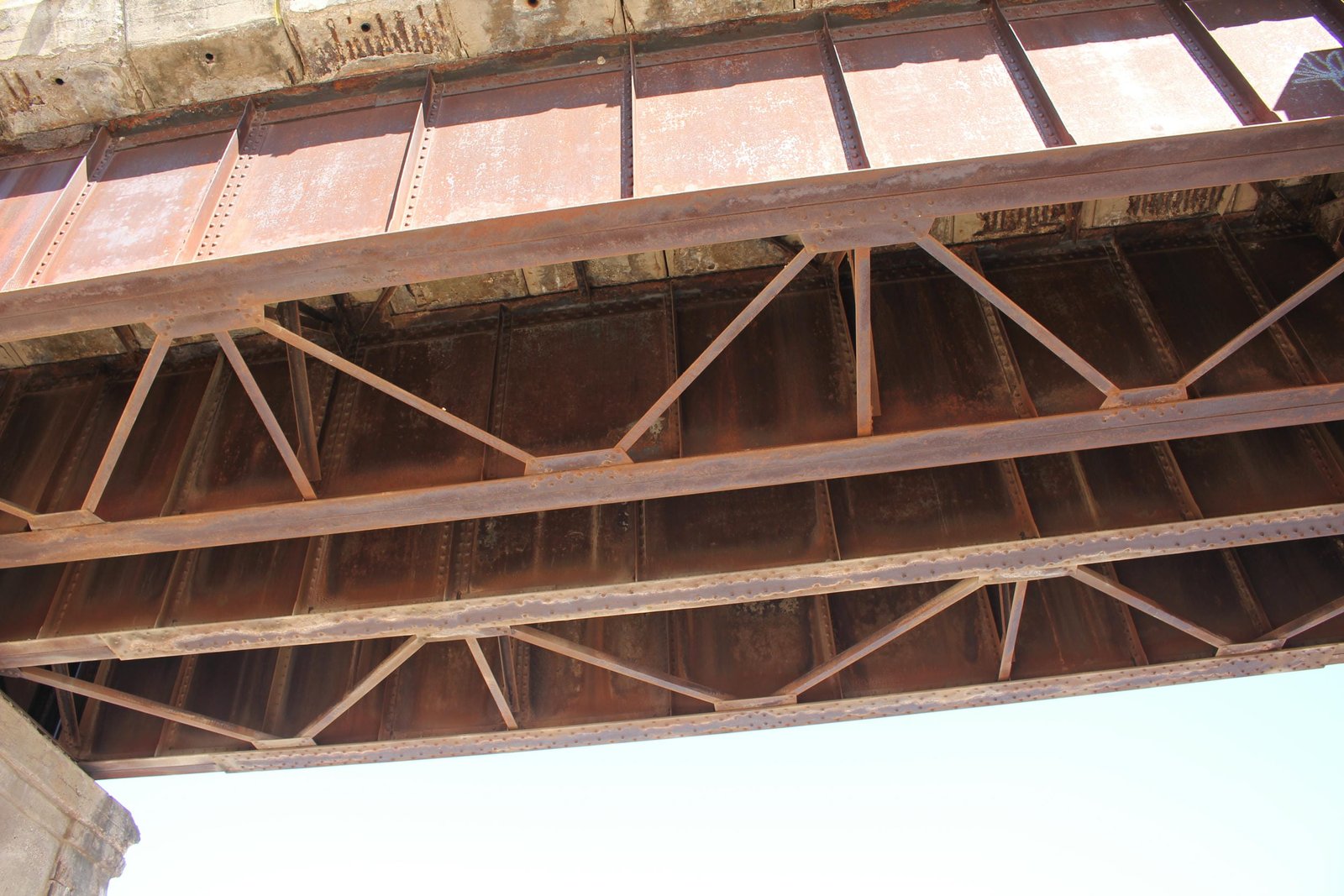
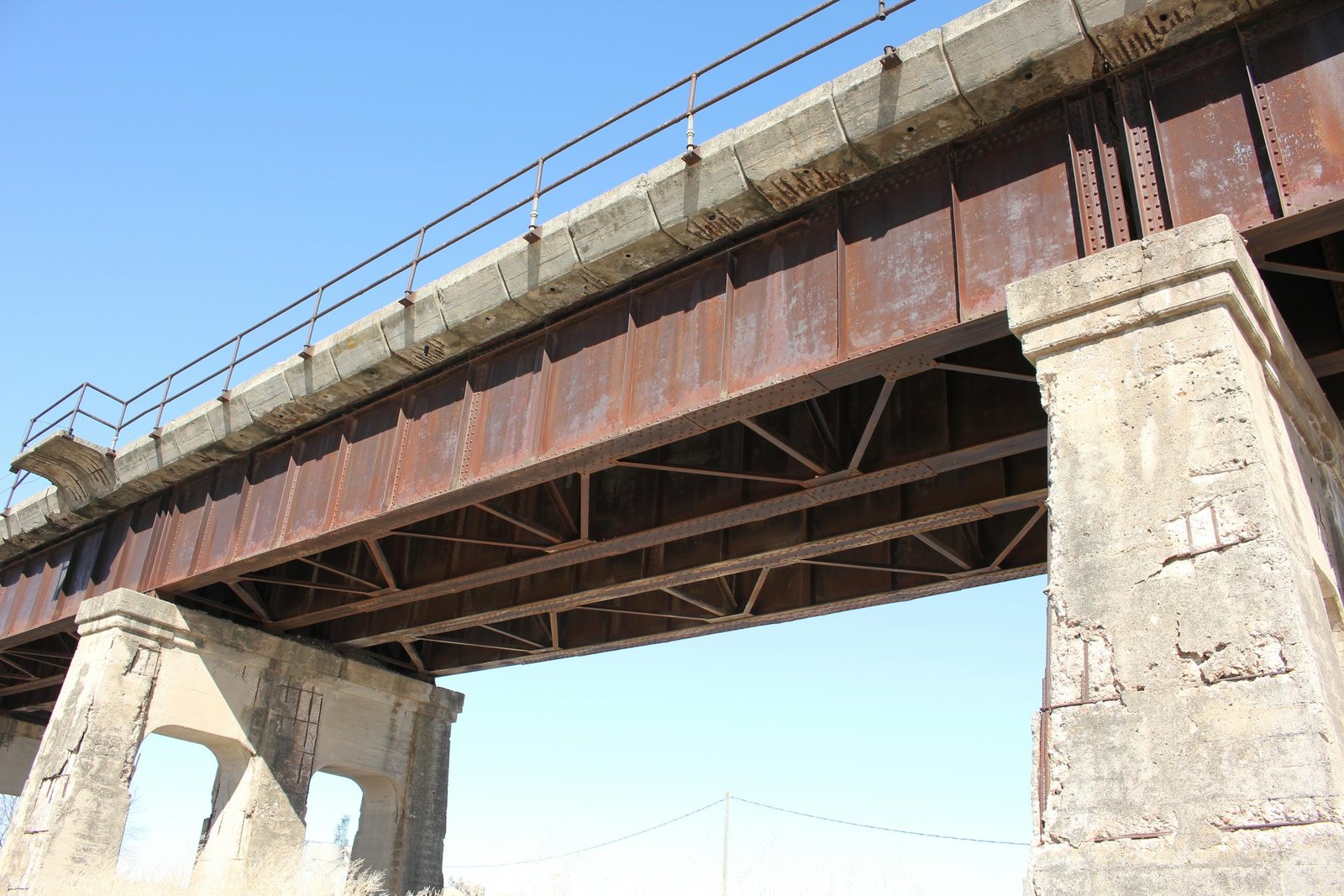
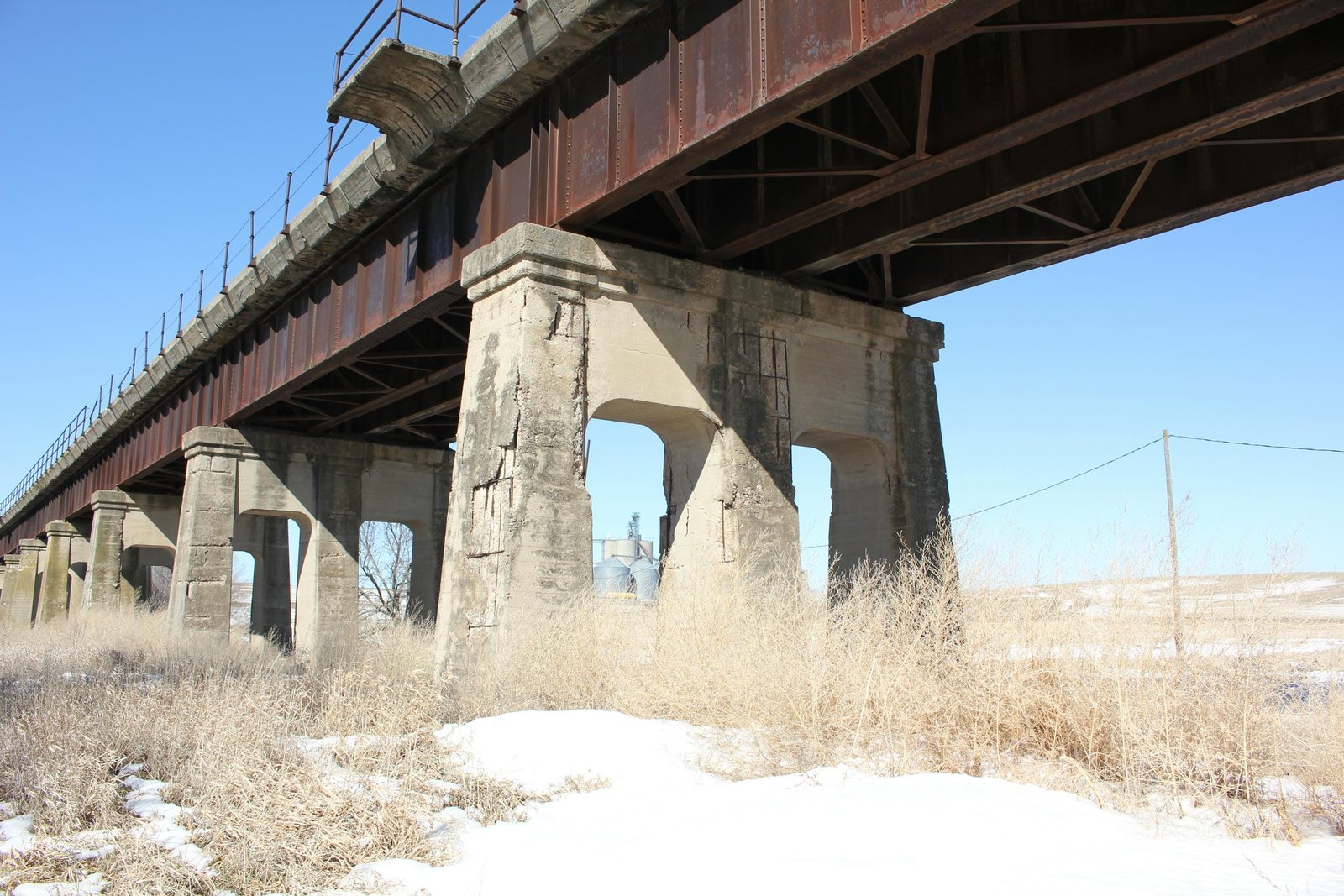
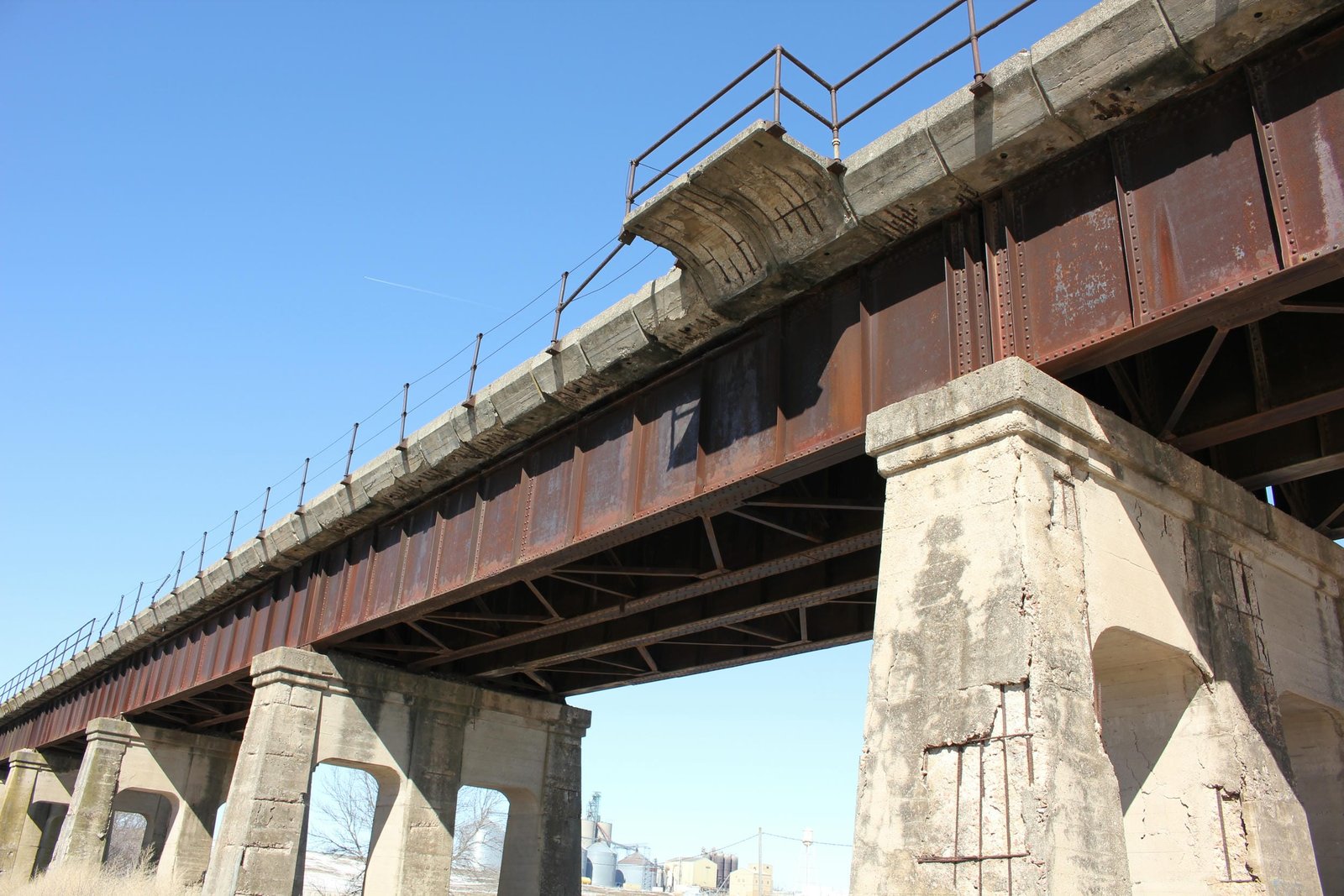
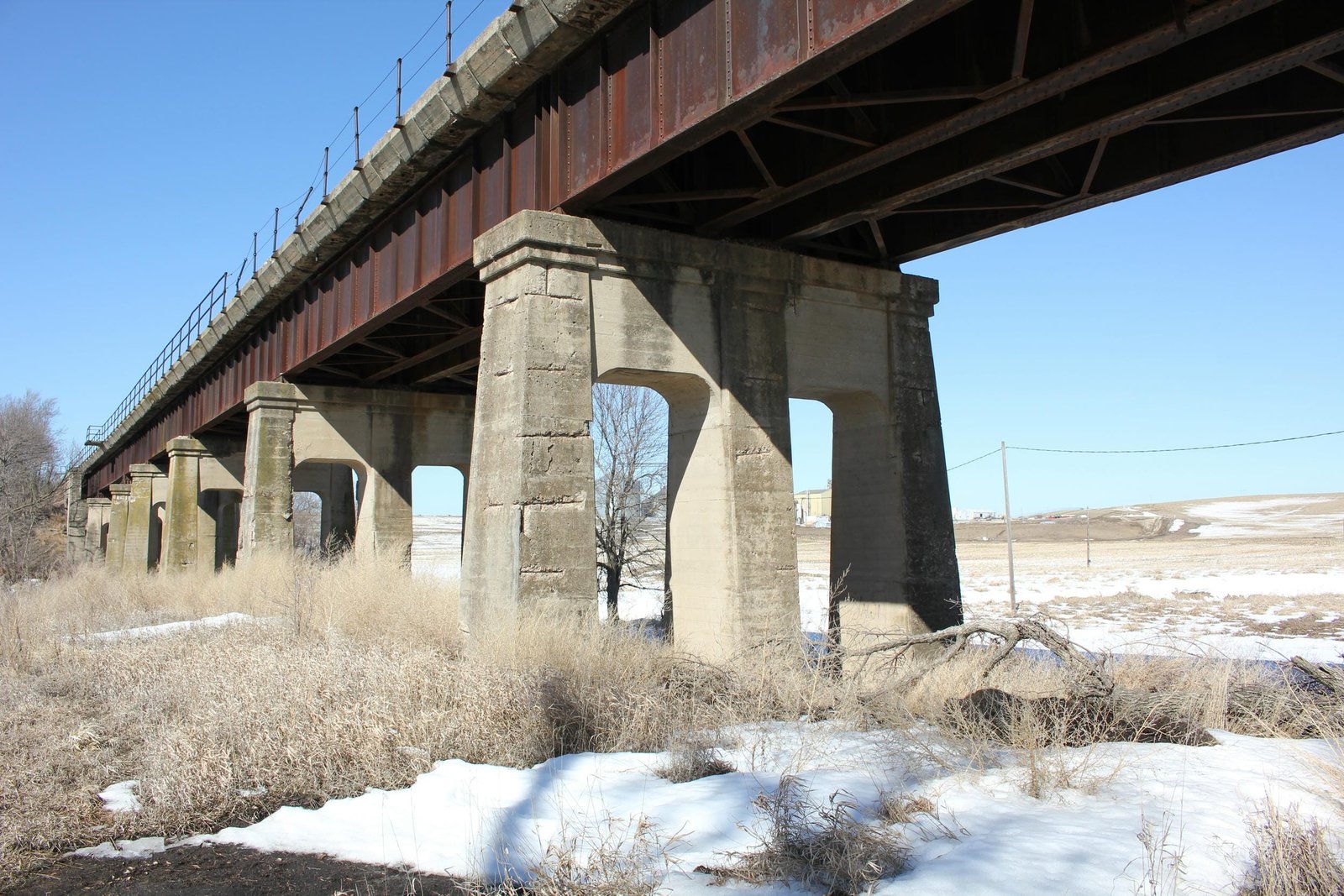
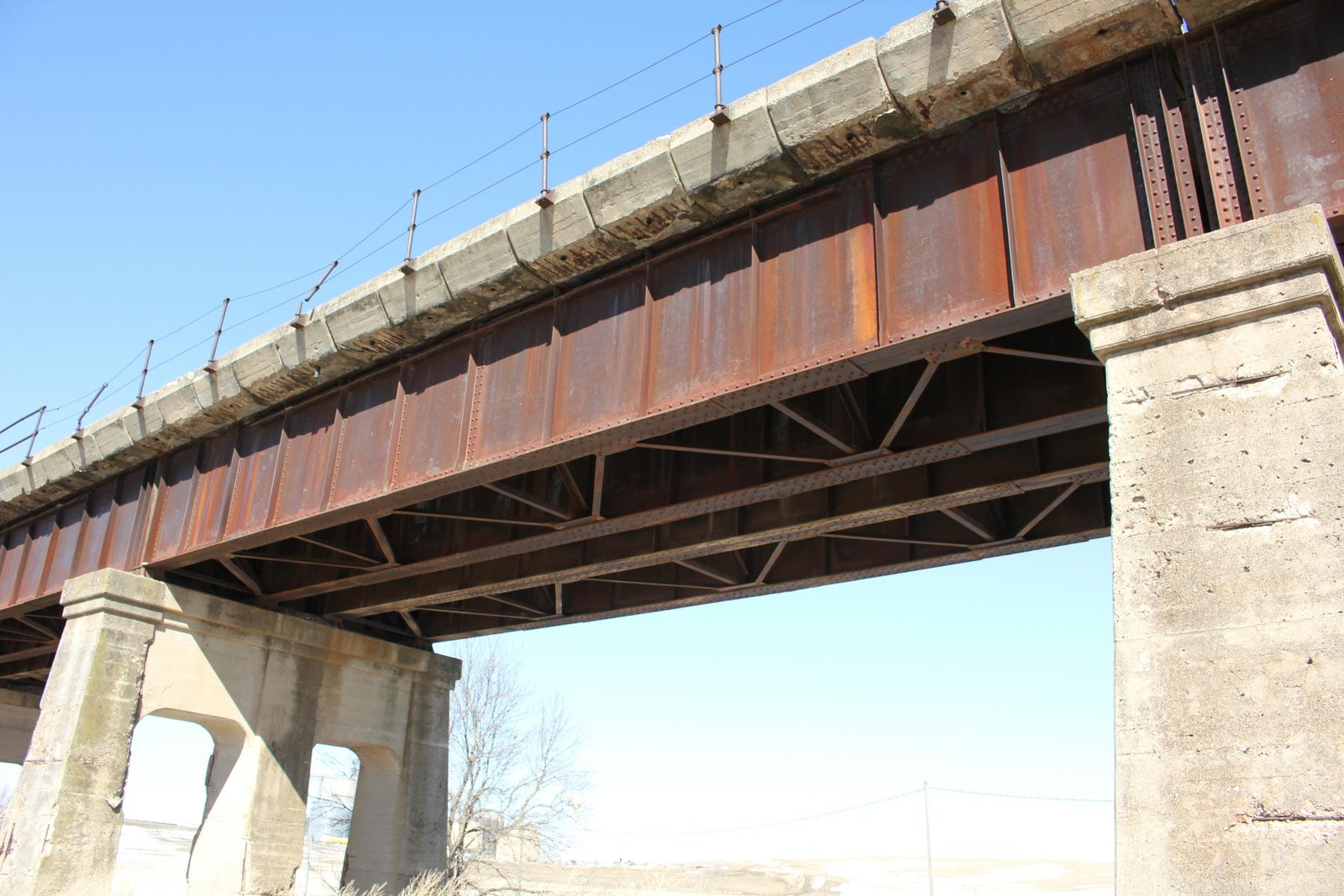
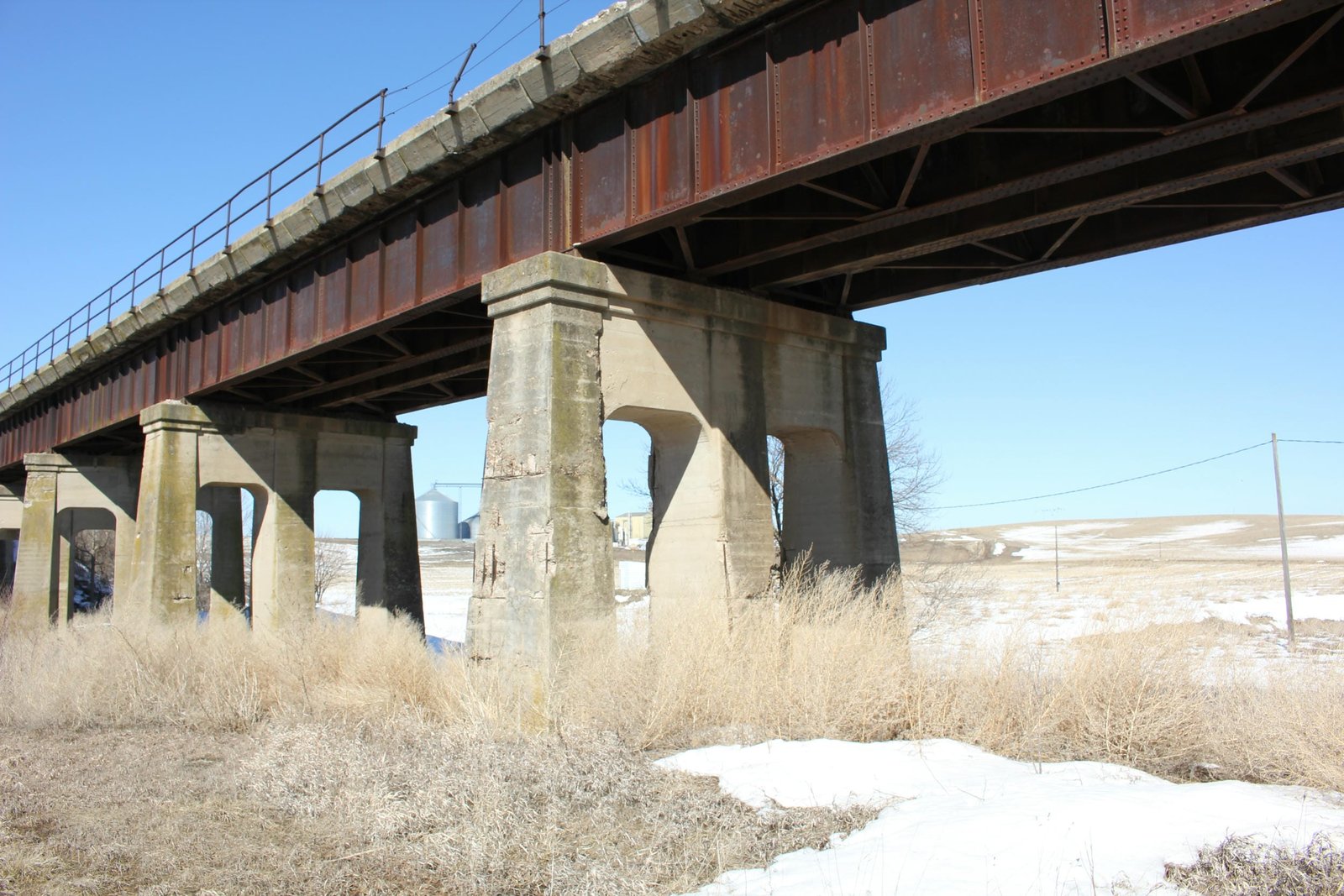
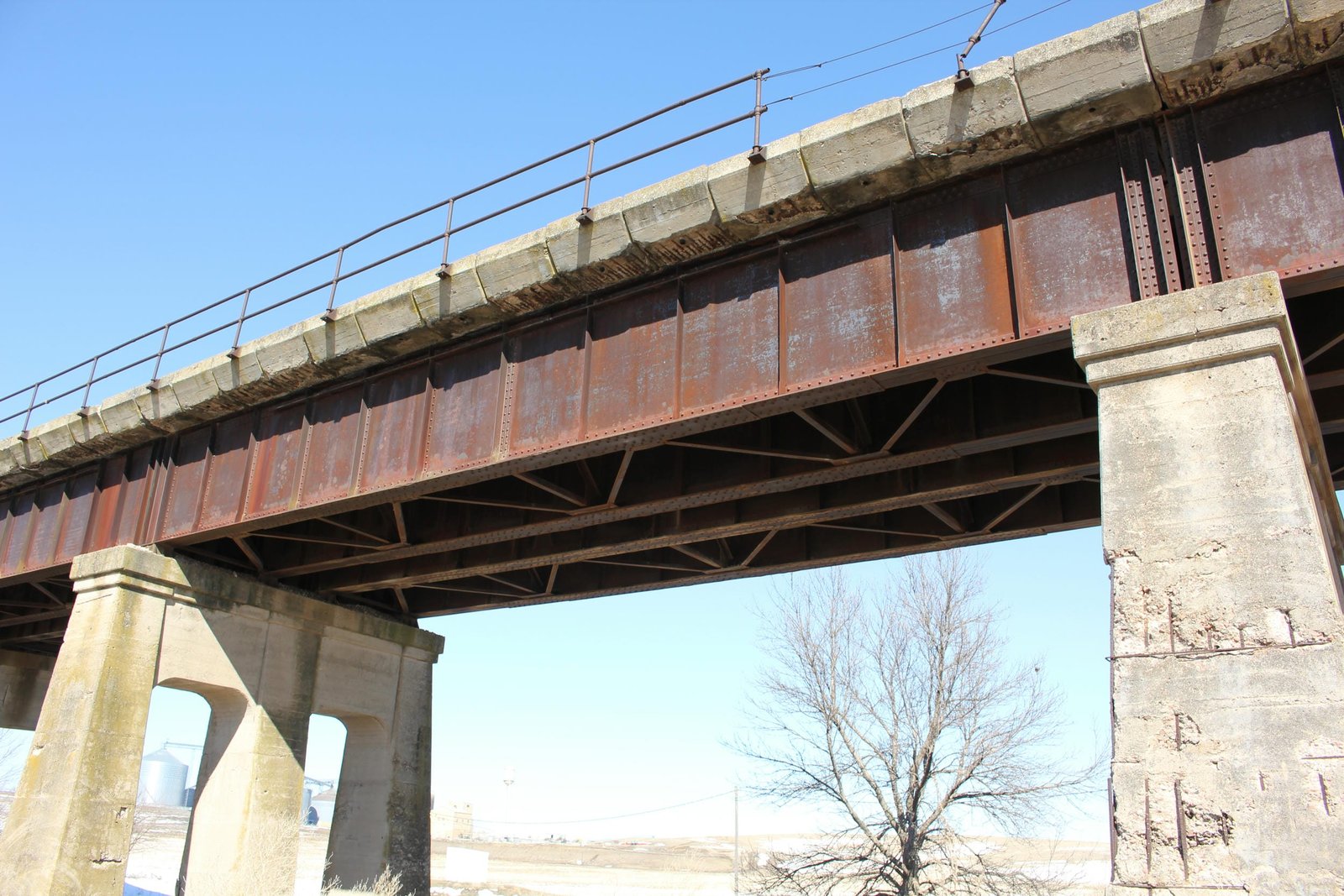
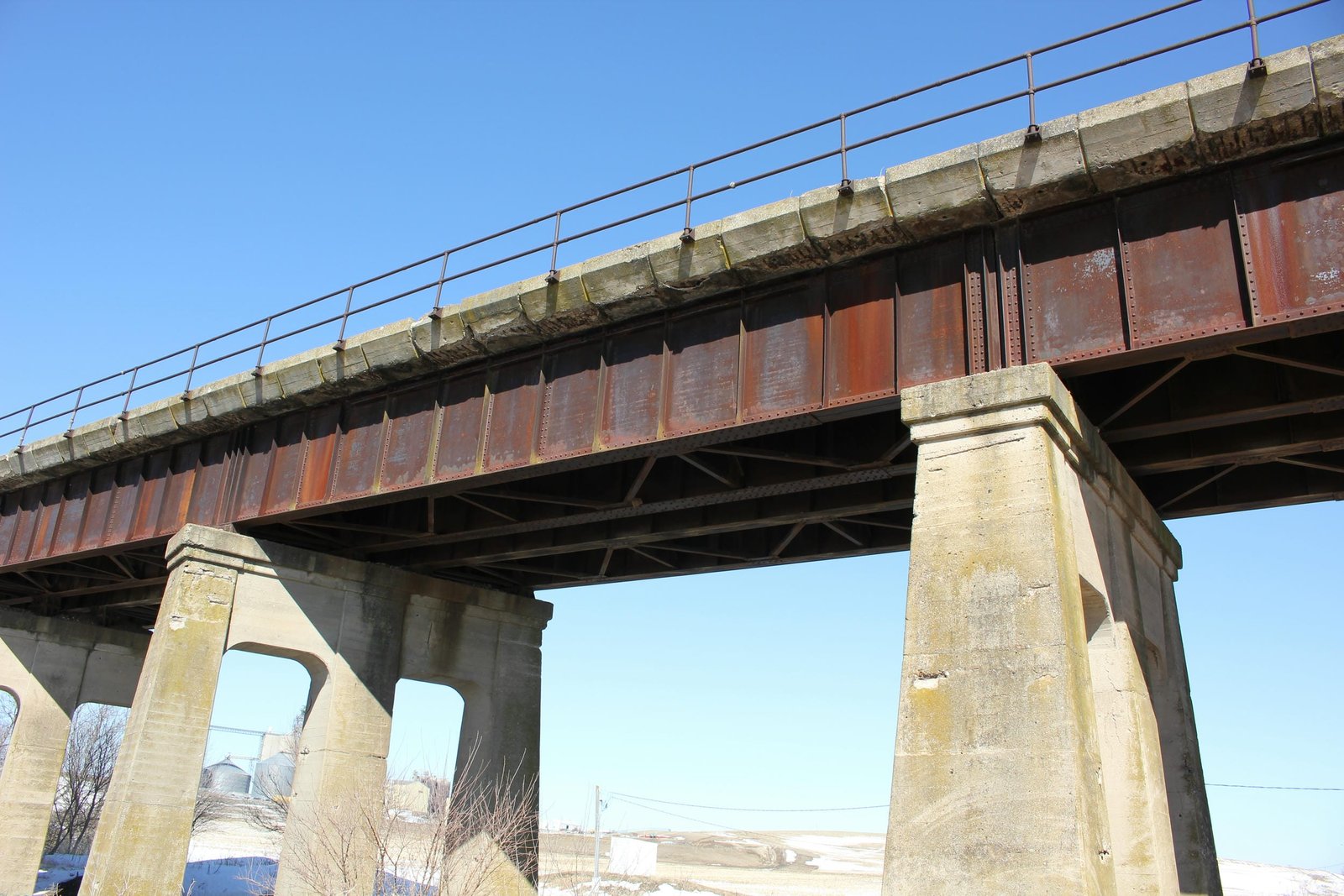
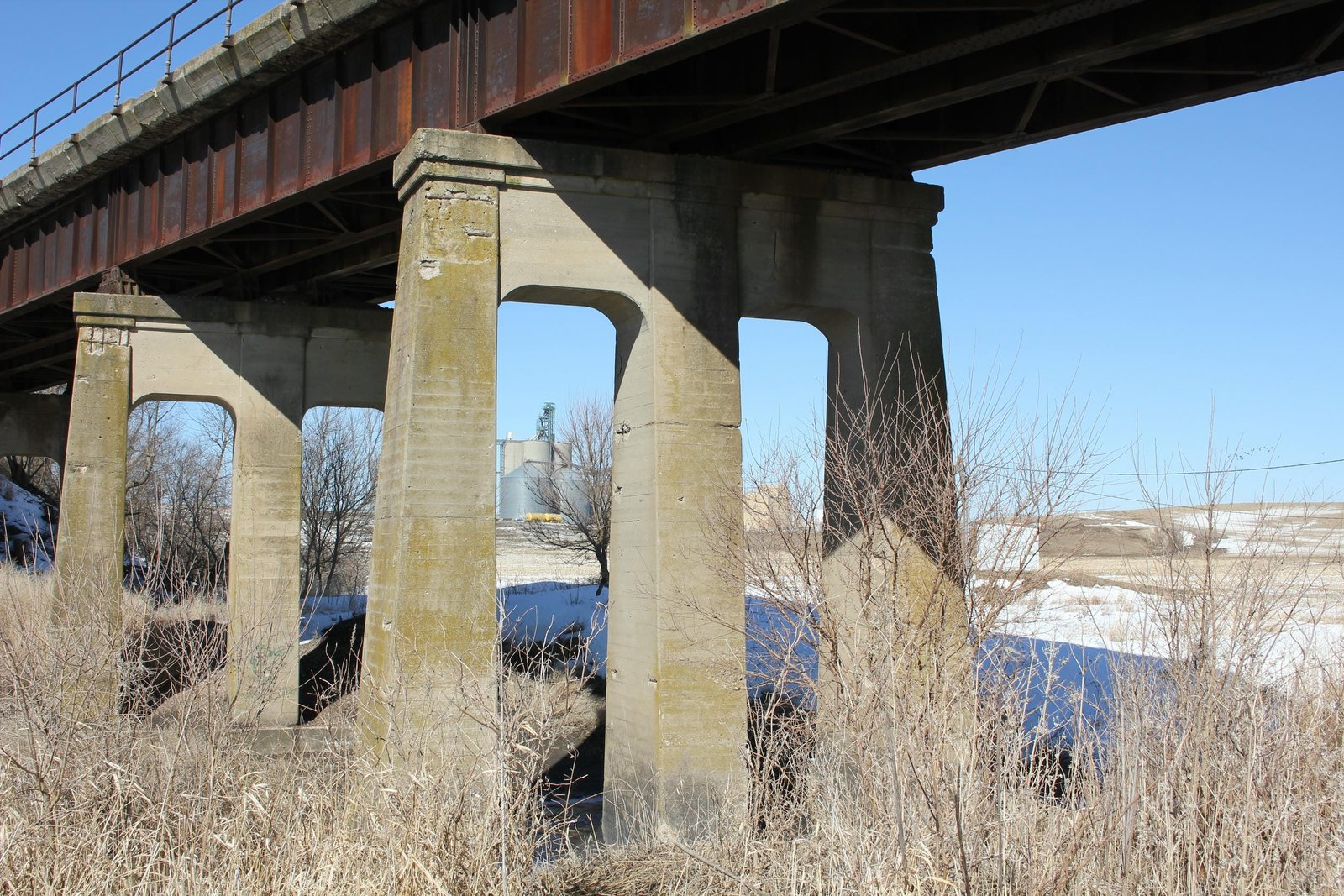
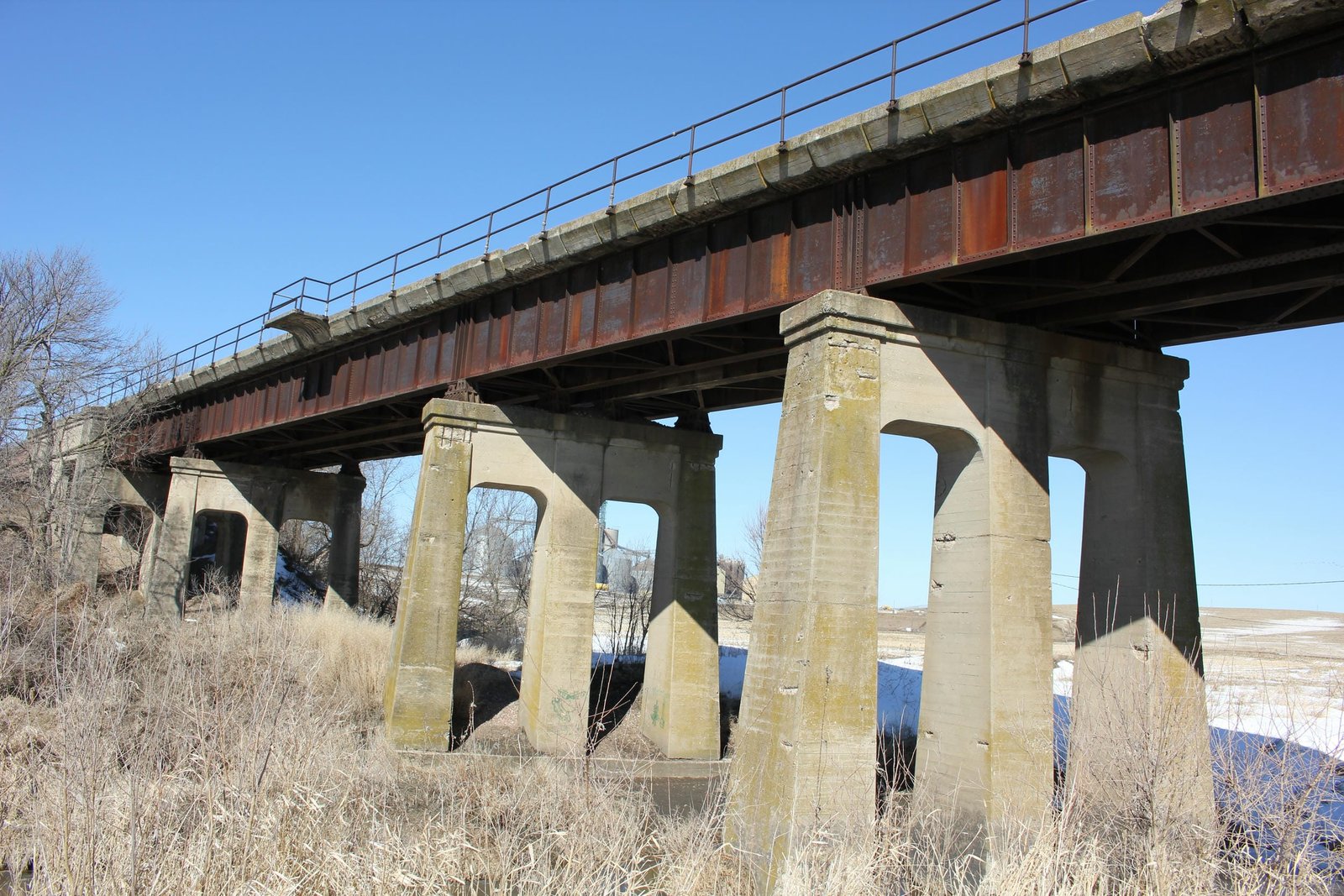
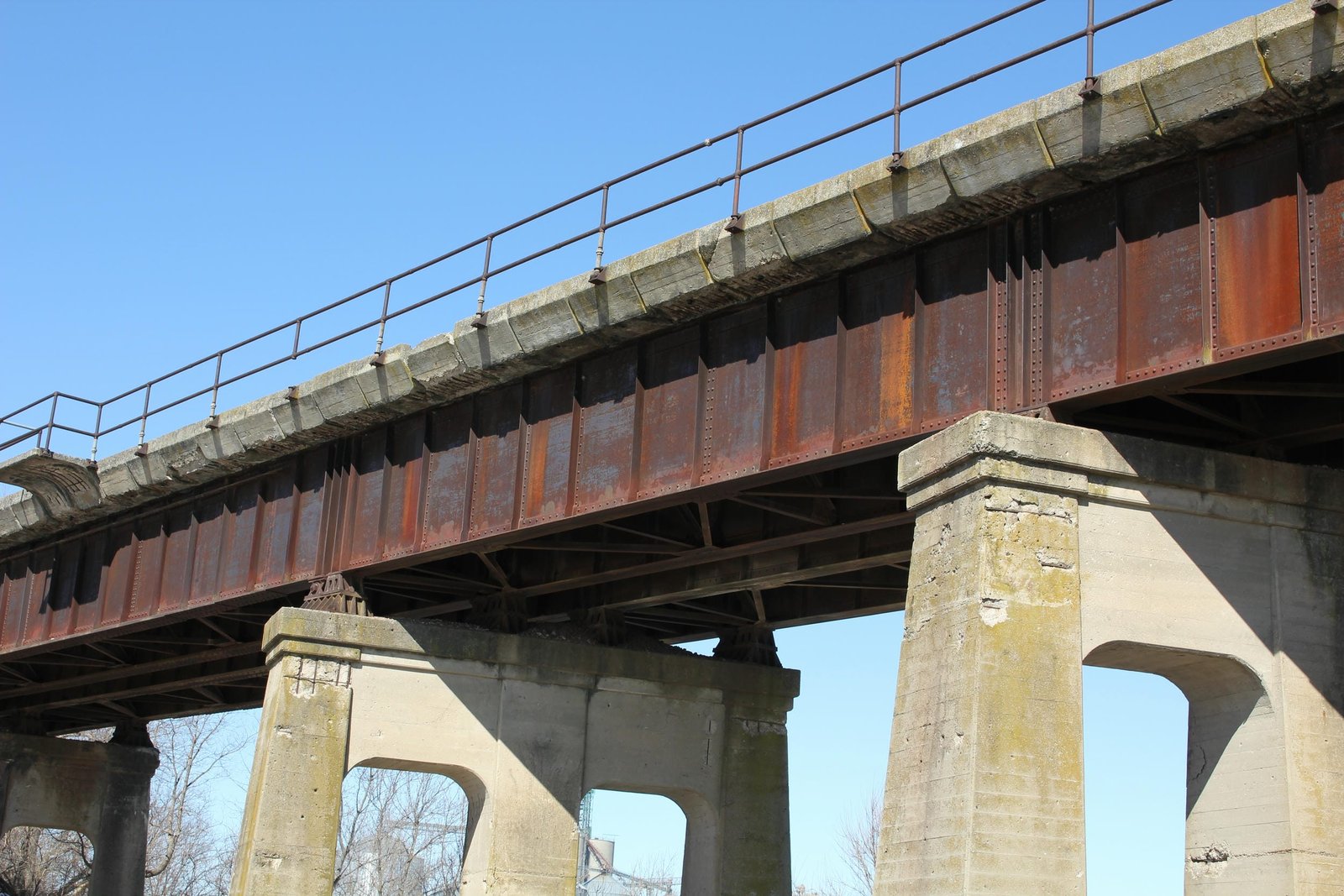
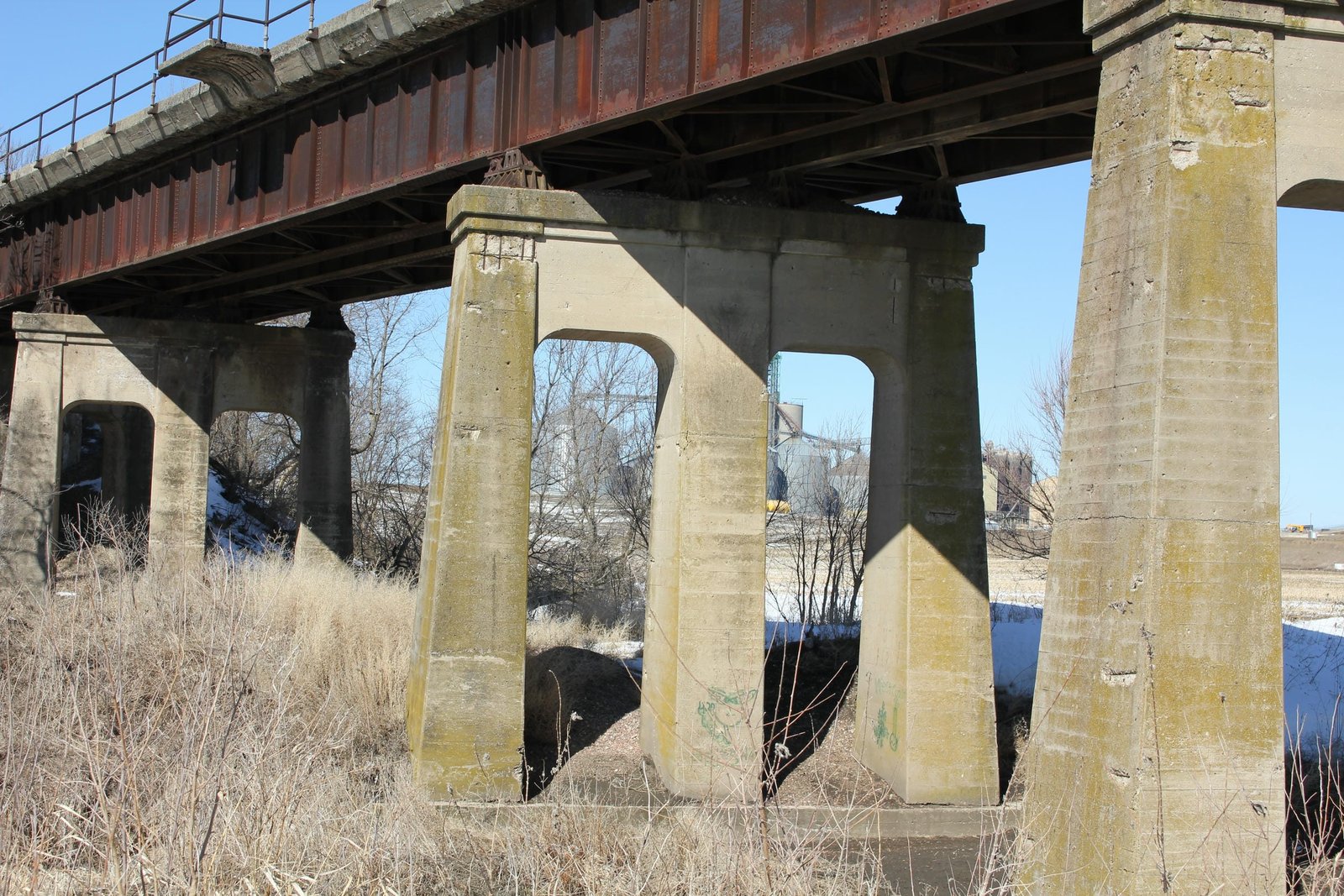
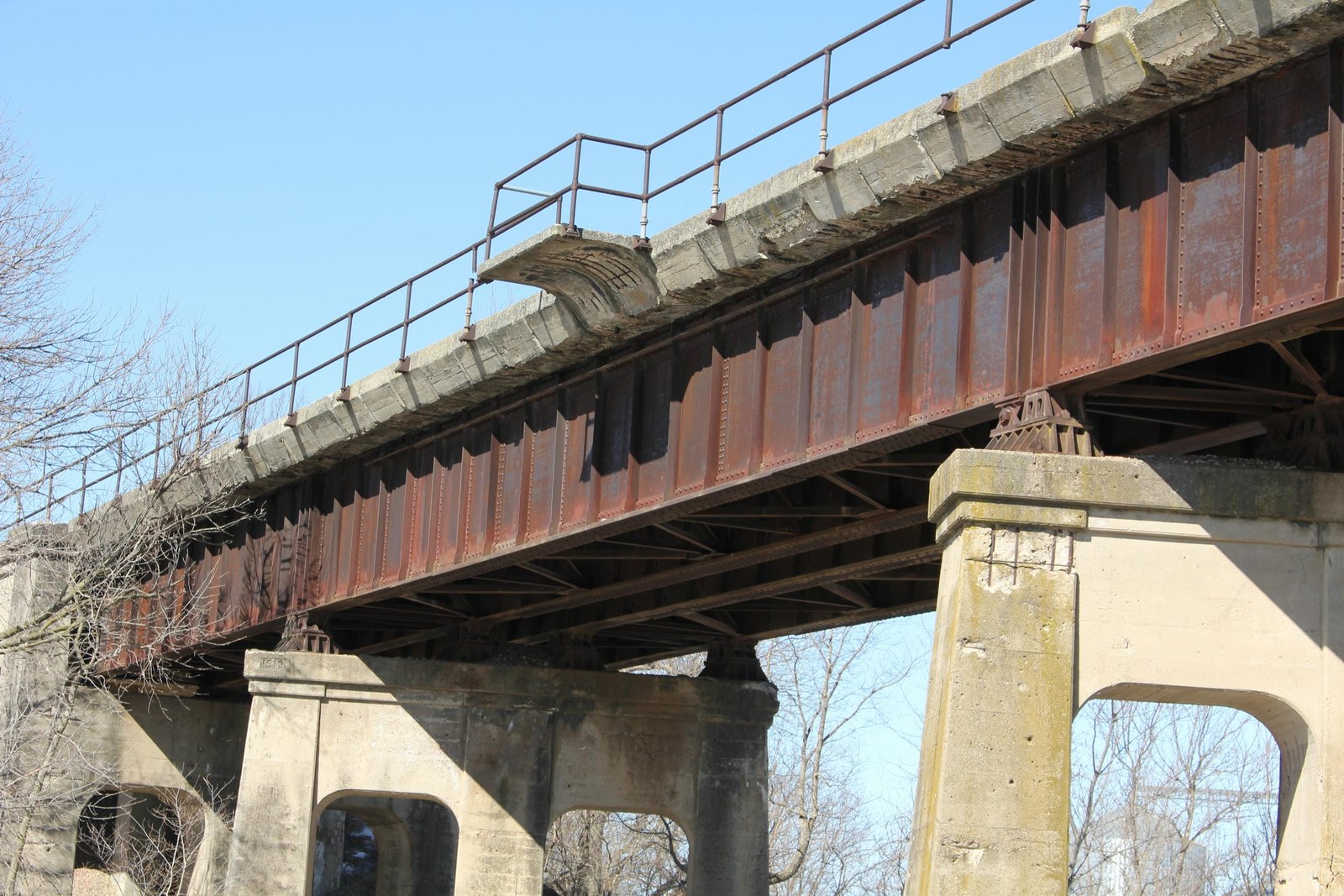
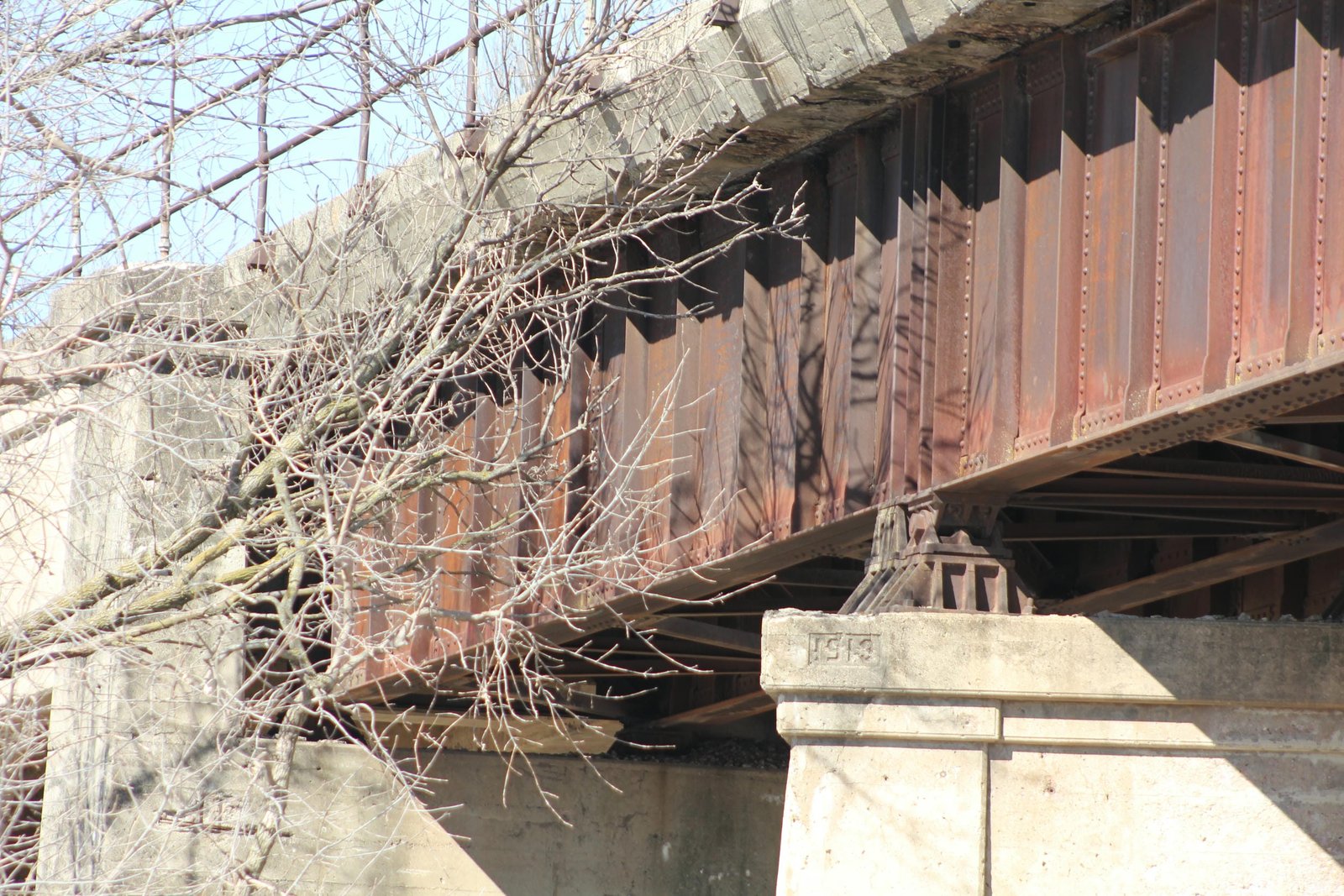
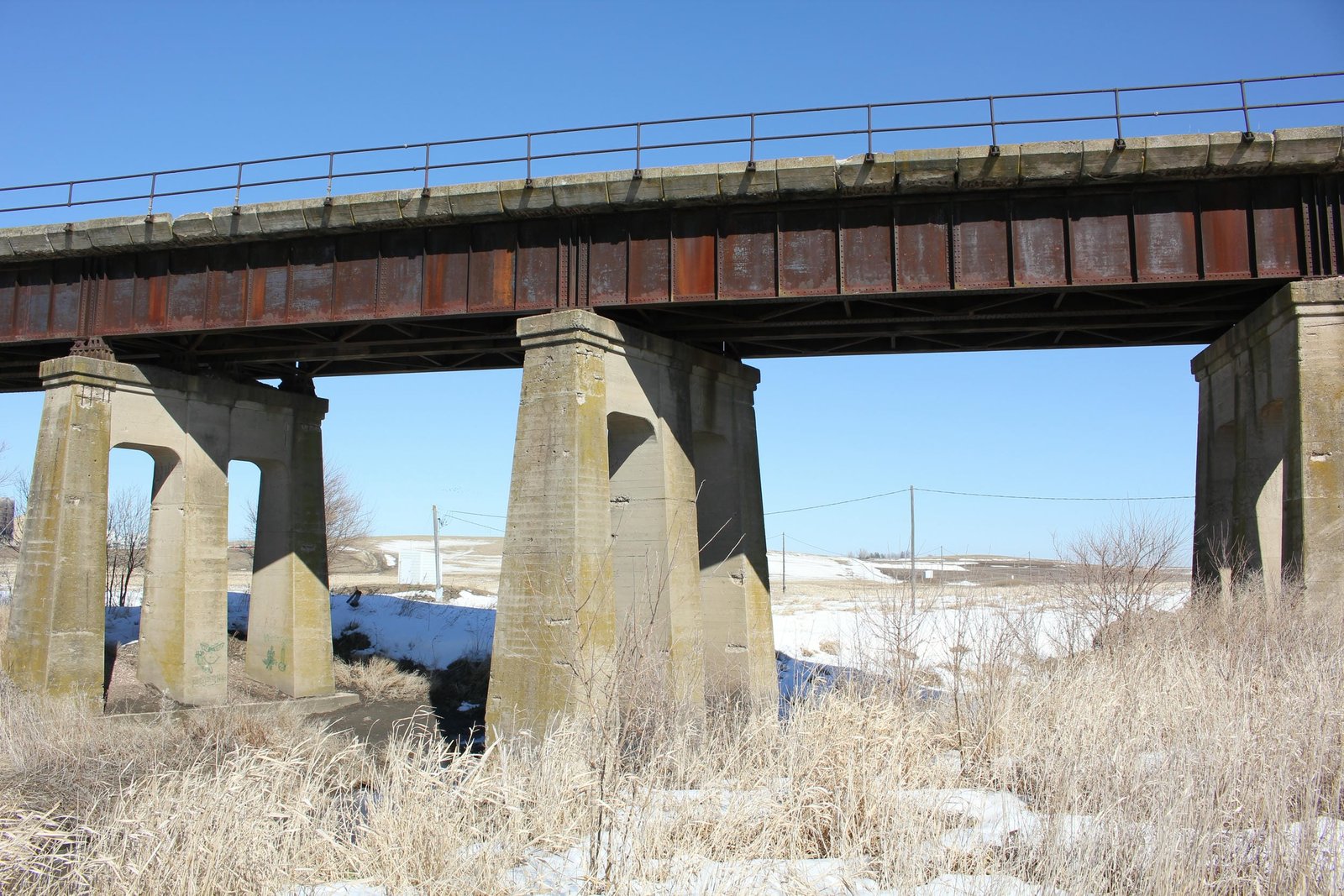
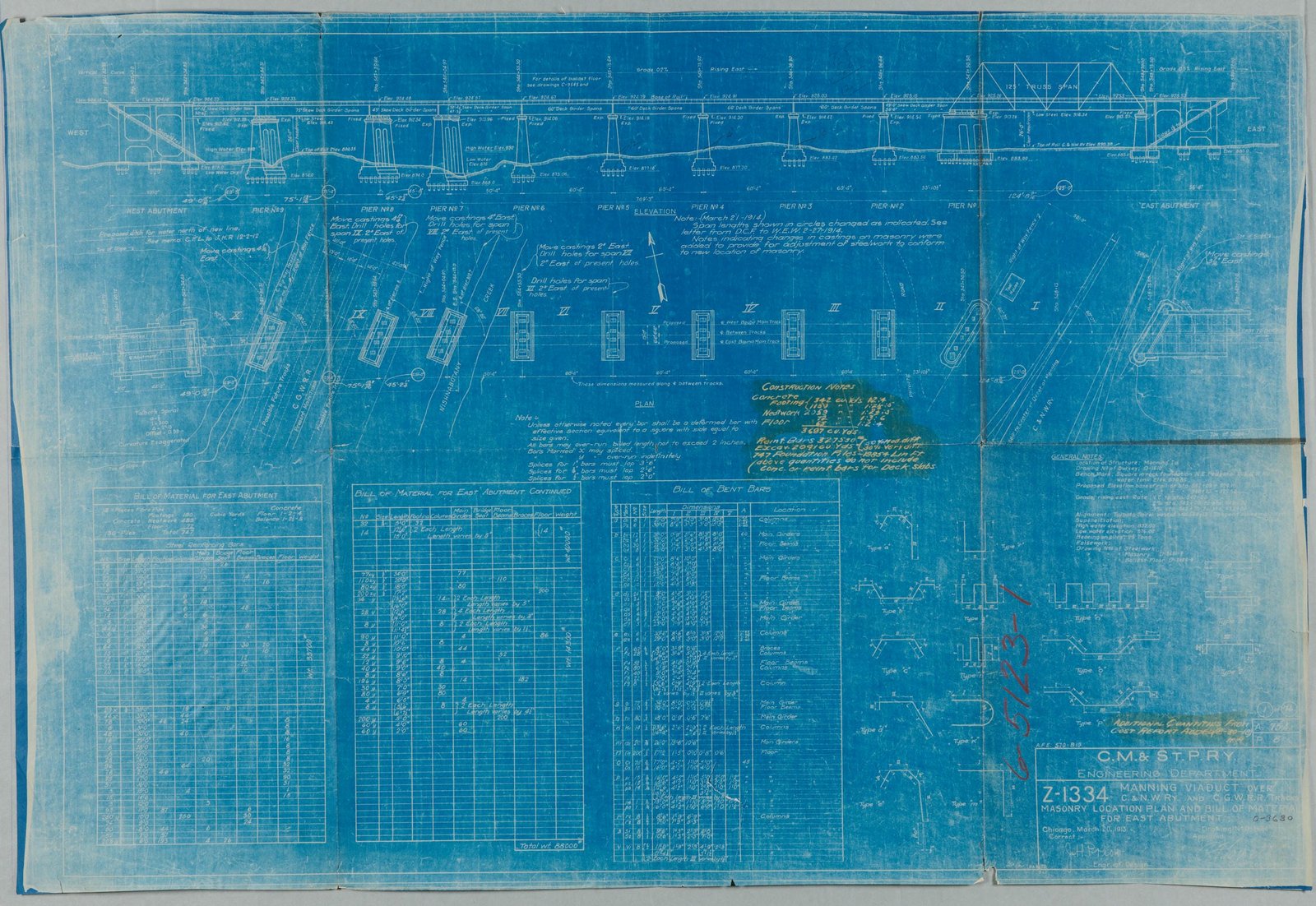
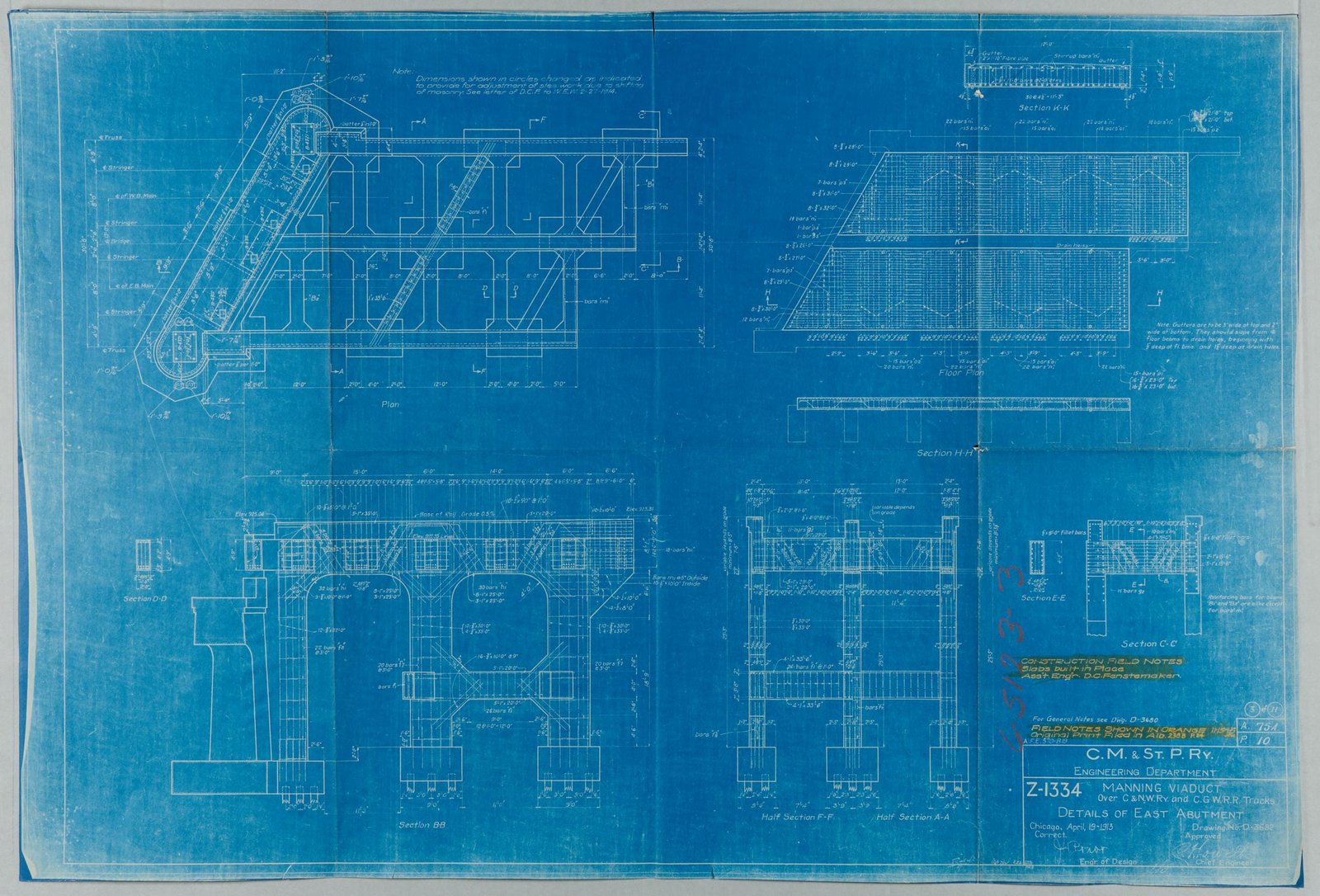
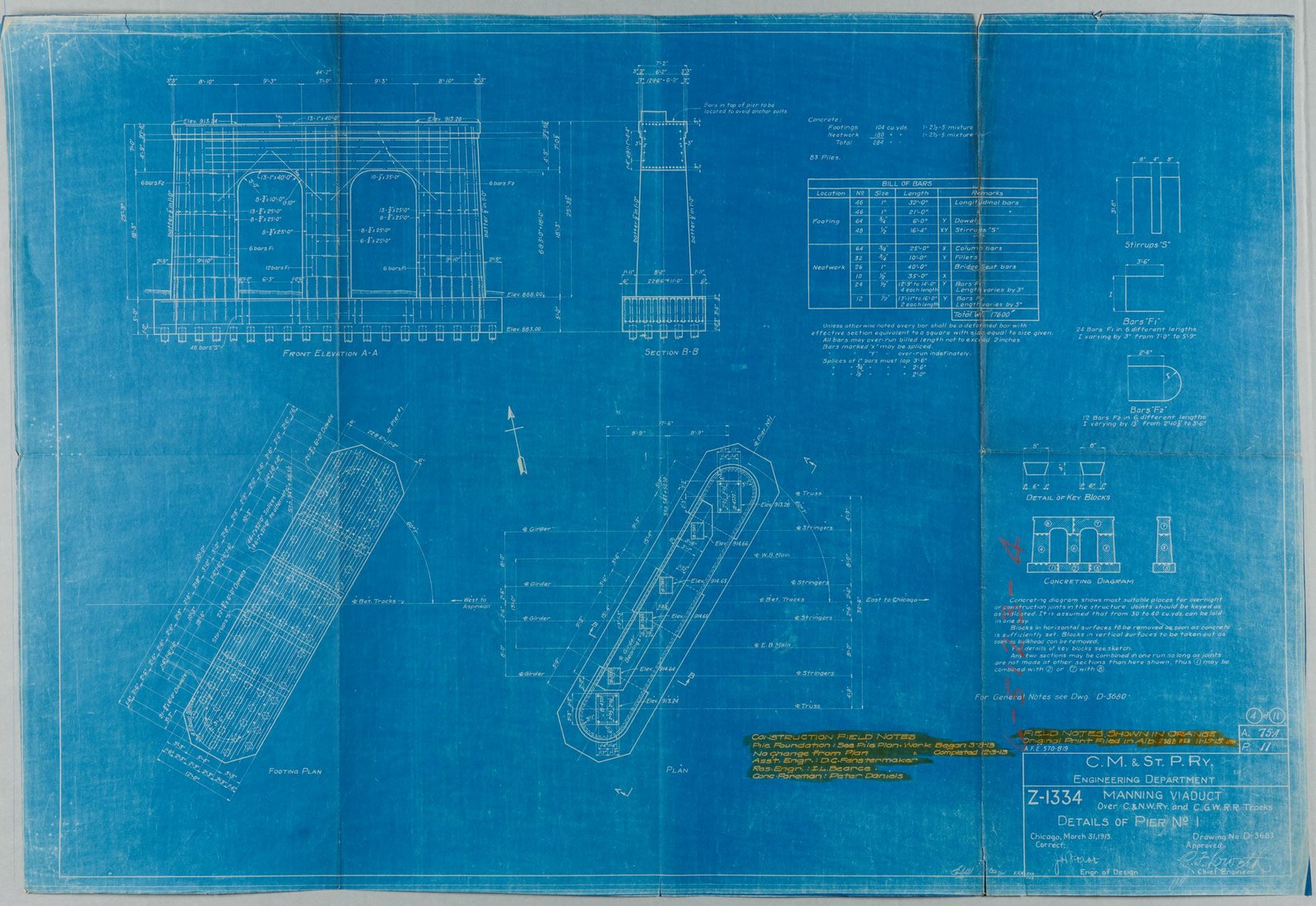
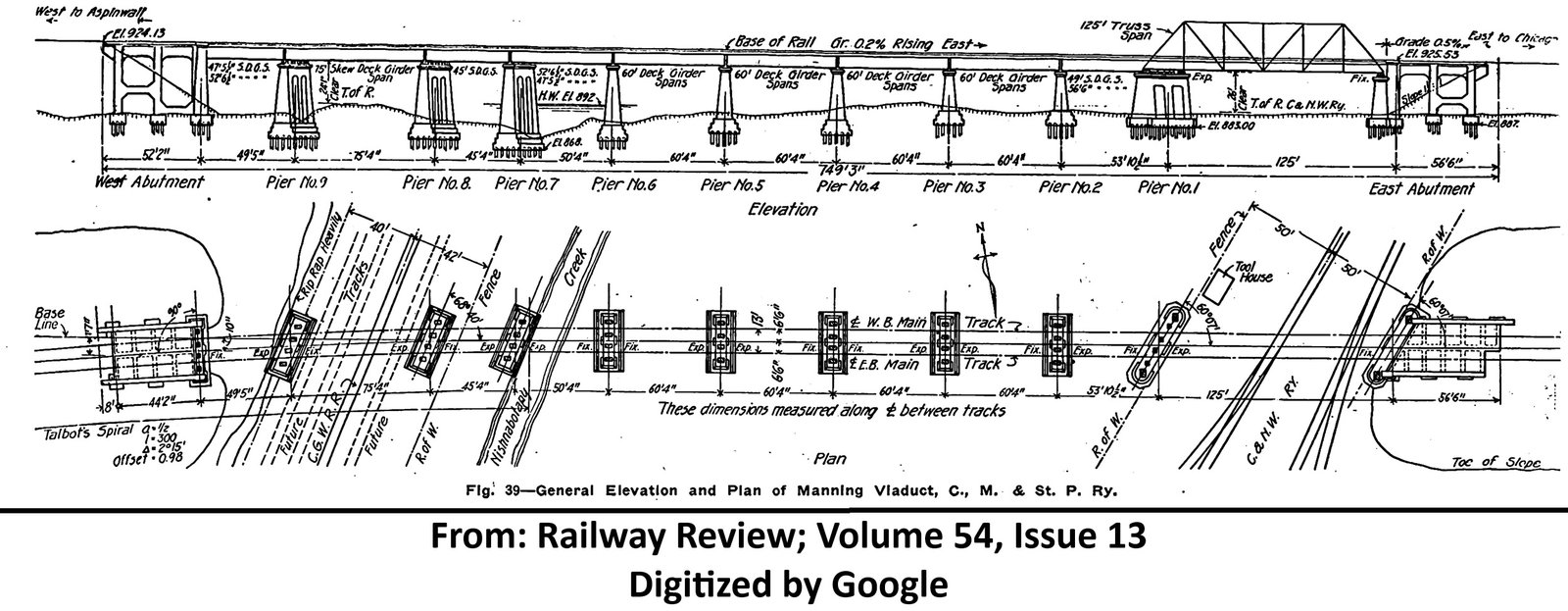
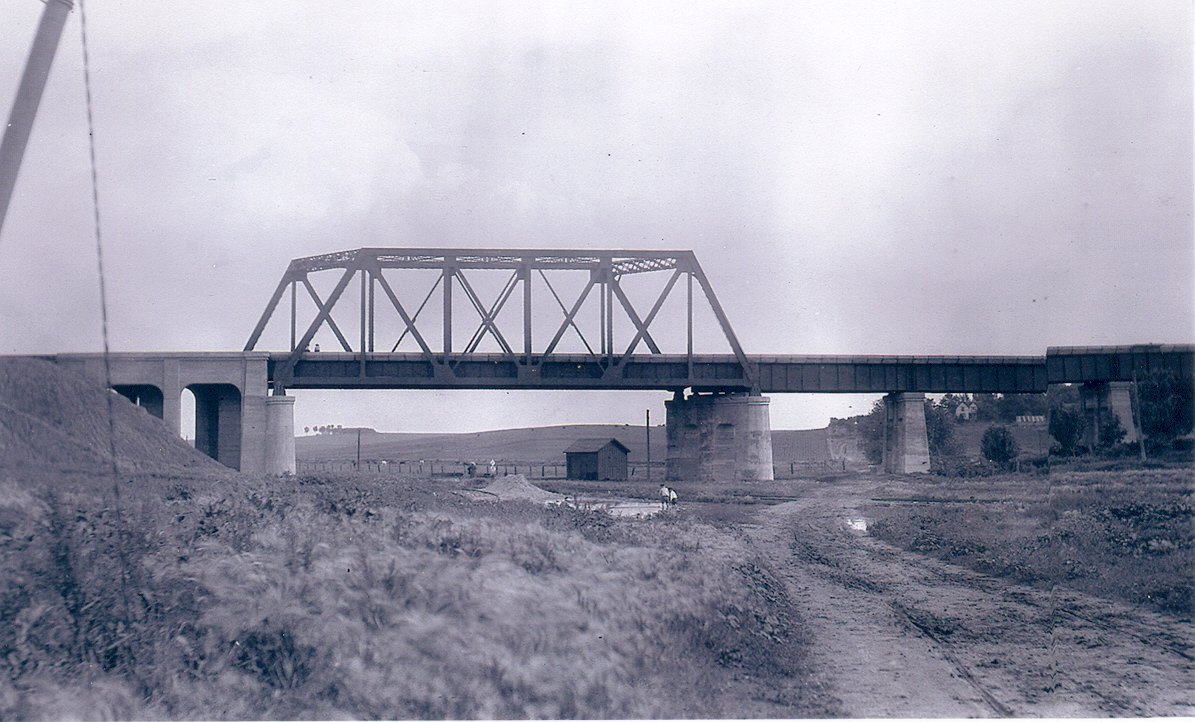
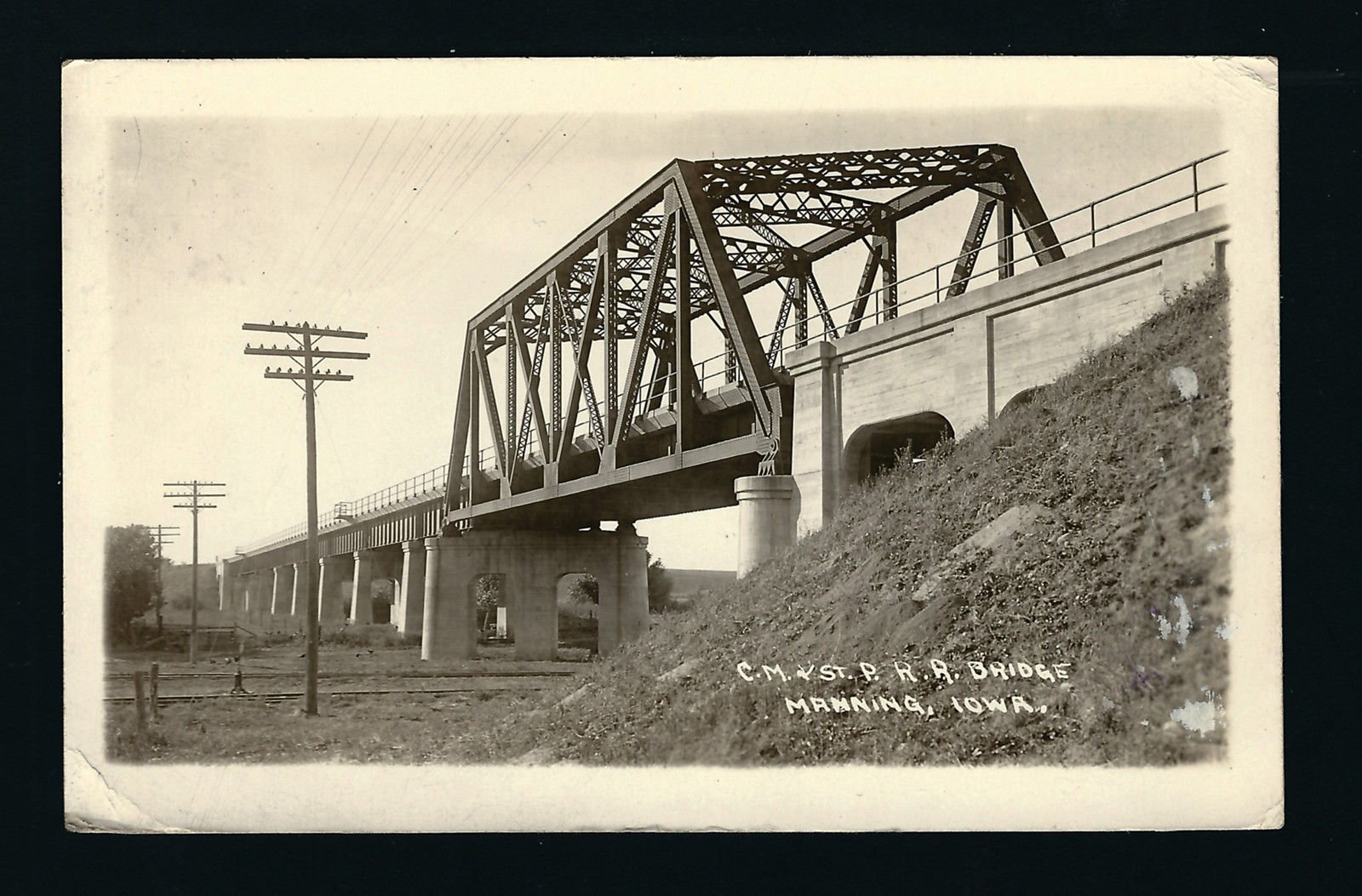
Currently, the bridge consists of a double track 125-foot, 6-panel, riveted Pratt through truss span (span #1), which is constructed at a 30-degree skew. The truss span is approached by nine deck plate girder spans on the west end, and both ends of the bridge are approached by a 52-foot concrete arch skeleton abutment, with the east abutment using a 30-degree skew. Due to the unusual geometry of the bridge, the deck plate girder spans for the north and south tracks use different lengths. The north track uses a 58-foot span with a 30-degree skew on the east end (span #2), four 60-foot spans (spans #3 through #6), one 50-foot span with a 24-degree skew on the west end (span #7), one 45-foot and one 75-foot span which are both skewed 24 degrees on each end (spans #8 and #9) and one 52-foot span with a 24-degree skew on the east end (span #10). The south track uses a 50-foot span with a 30-degree skew on the east end (span #2), four 60-foot spans (spans #3 through #6), one 53-foot span with a 24-degree skew on the west end (span #7), one 45-foot and one 75-foot span which are both skewed 24 degrees on each end (spans #8 and #9) and one 47-foot span with a 24-degree skew on the east end (span #10). The entire bridge is set onto concrete piers, and the bridge is slightly curved at the west end. In addition, all ten steel spans were covered with precast concrete deck spans until 2022, which were original to the 1913 construction. Span #1 crossed the Chicago & North Western Railway line, while span #7 crosses the West Nishanbotna River and span #9 crossed the Chicago Great Western Railway line. An unknown contractor fabricated the truss span, and it is unclear if the same unknown contractor fabricated the girder spans. The concrete portions of the bridge were constructed by labor employed by the Milwaukee Road Bridge & Building Department, which was customary for this company. The bridge was designed in-house by J.H. Prior, Assistant Engineer and Charles Frederick Loweth, Chief Engineer.
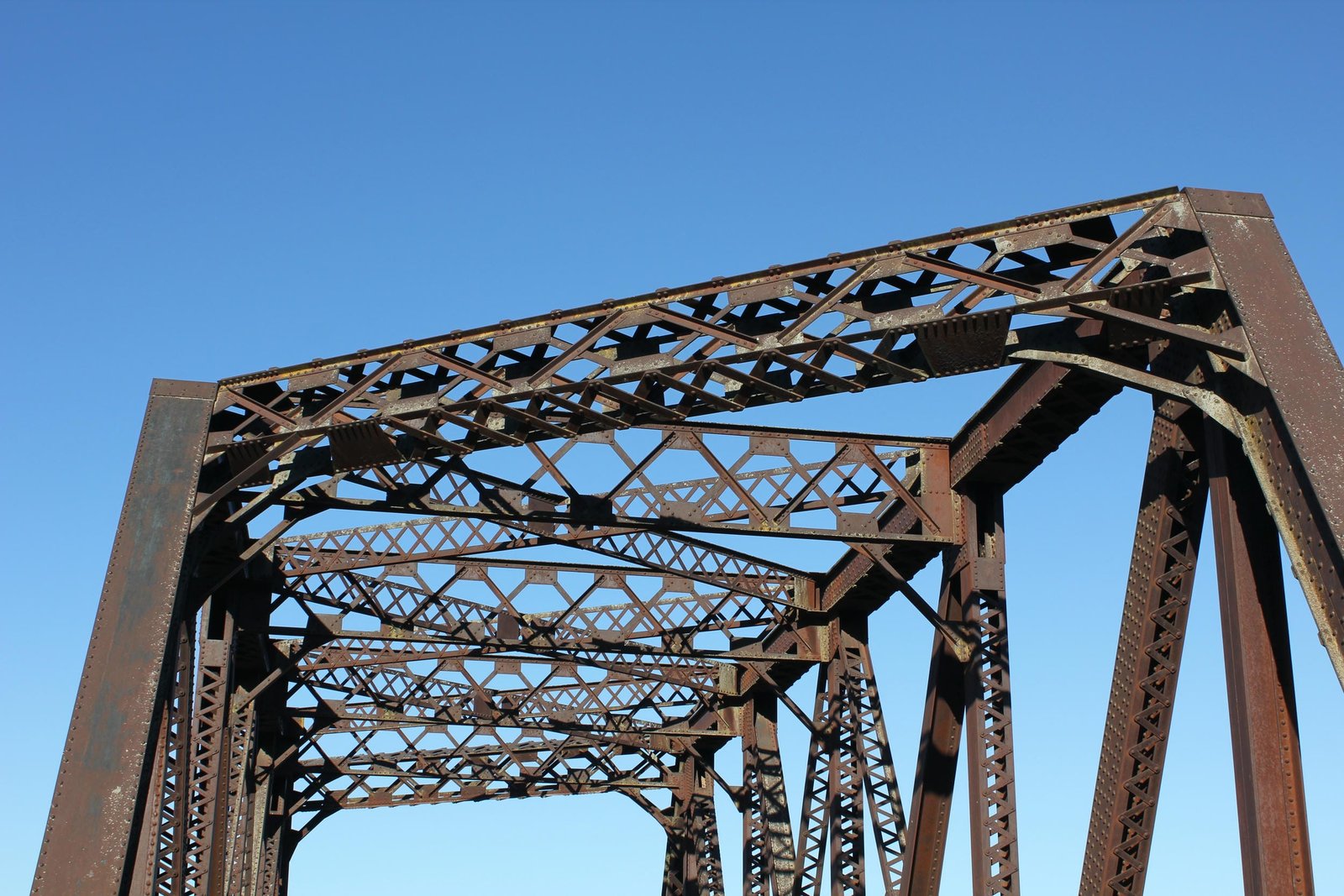
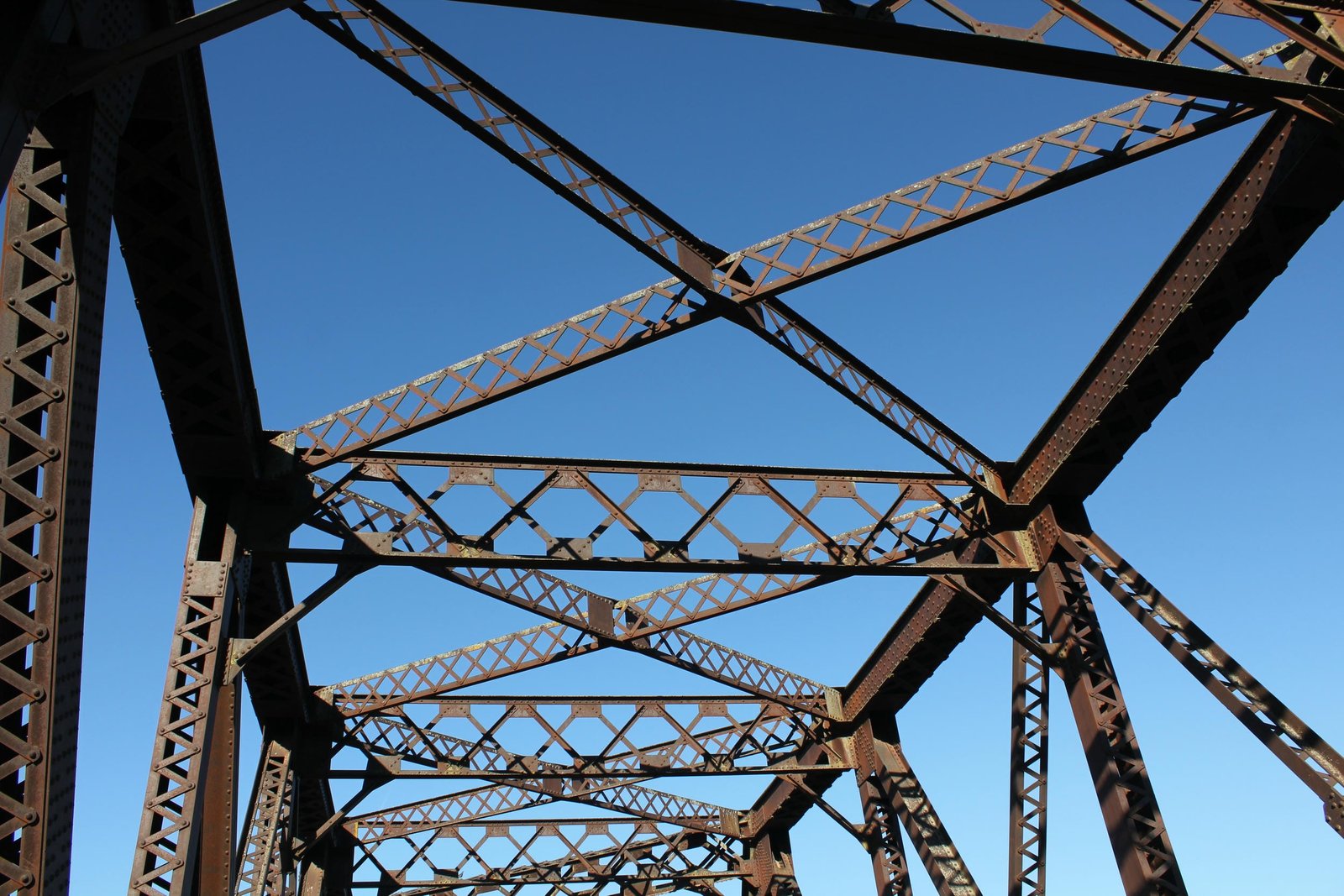
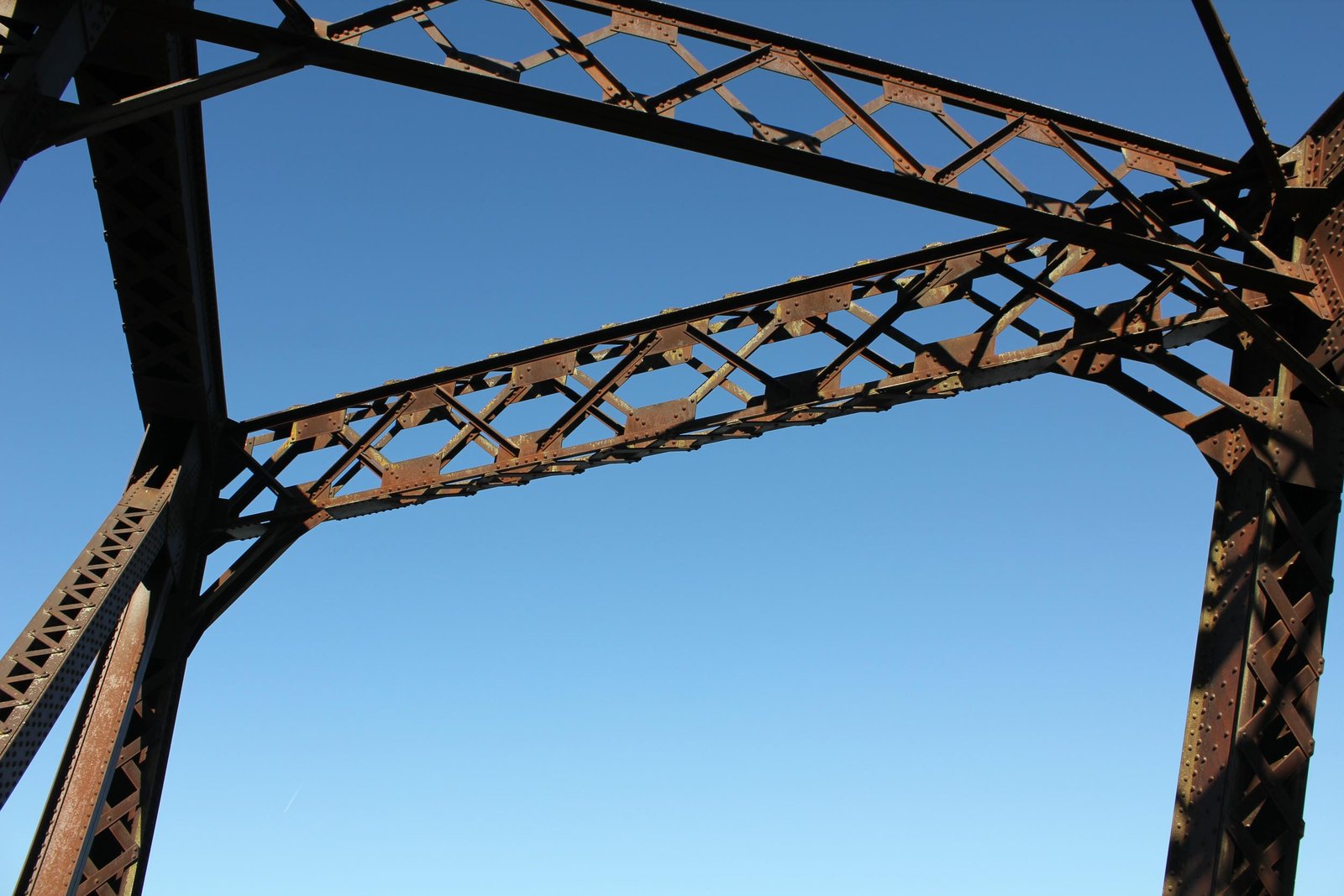
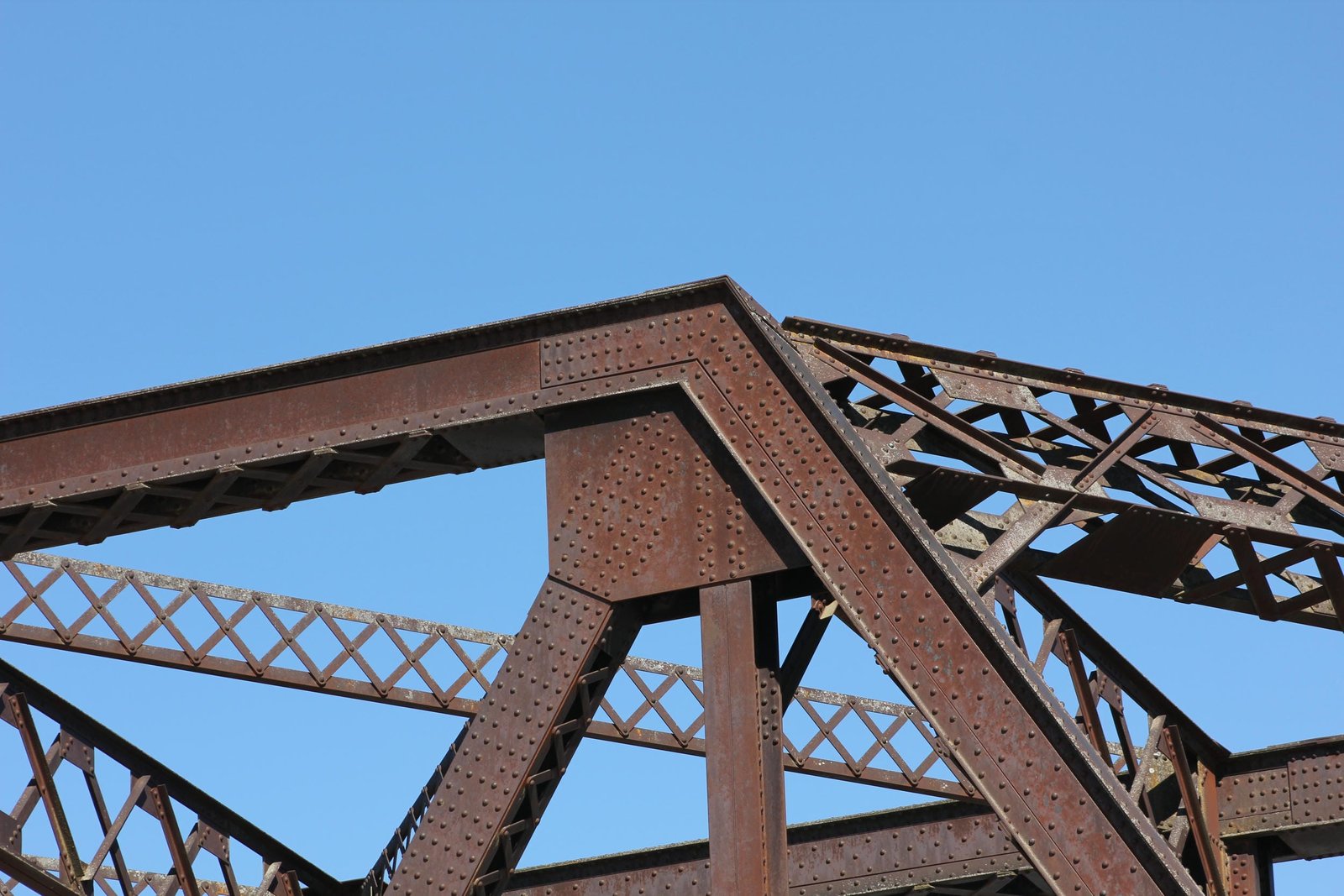
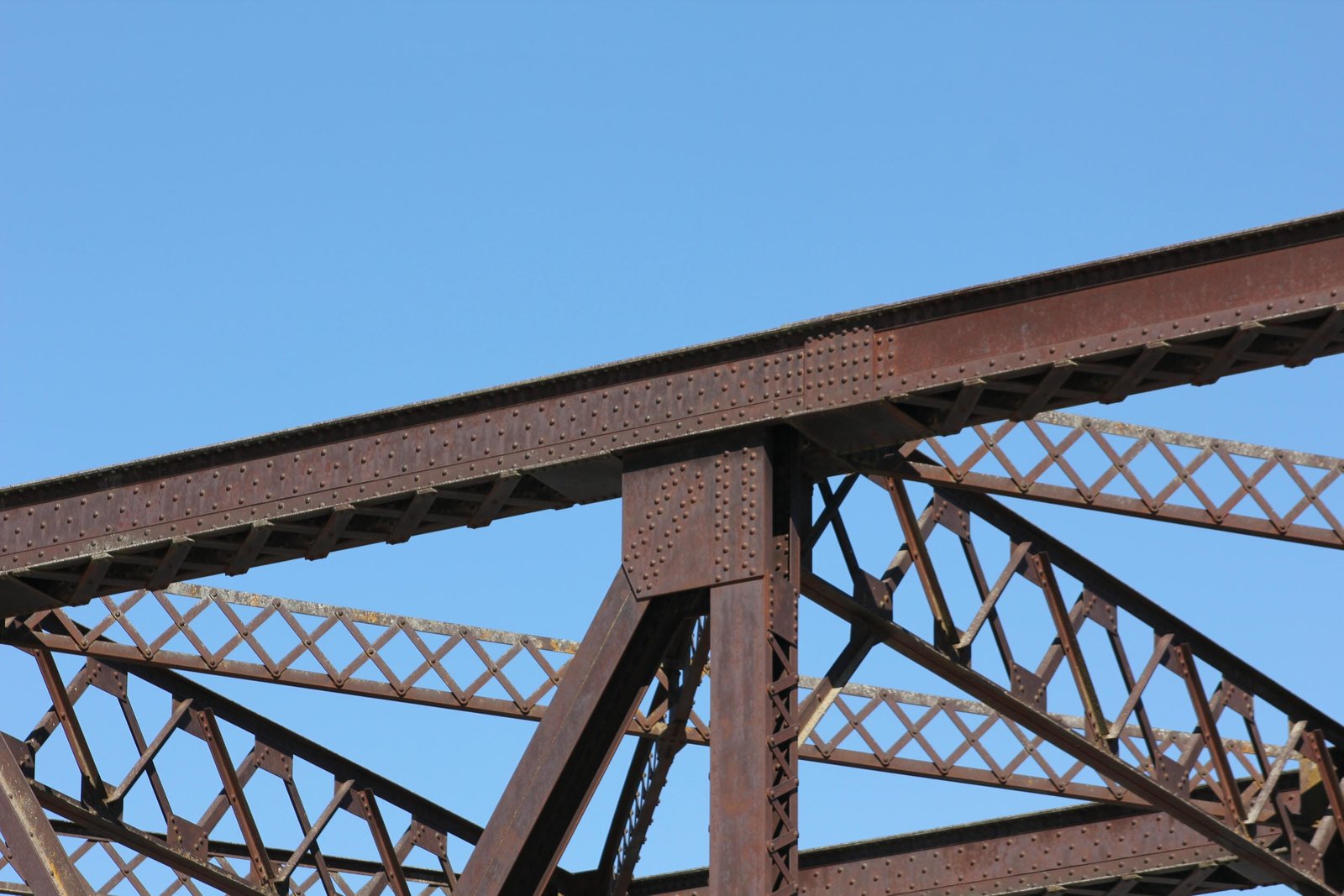
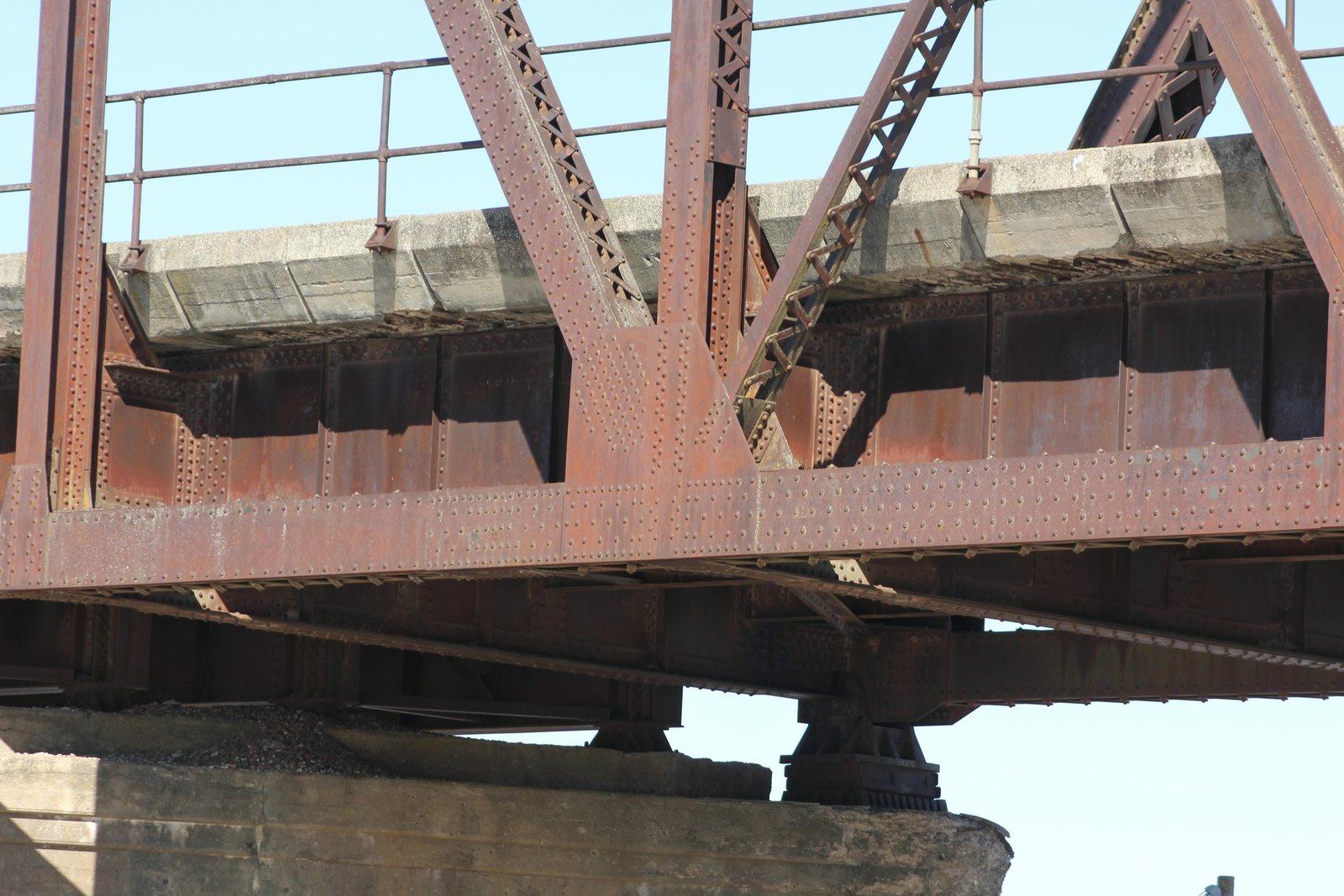
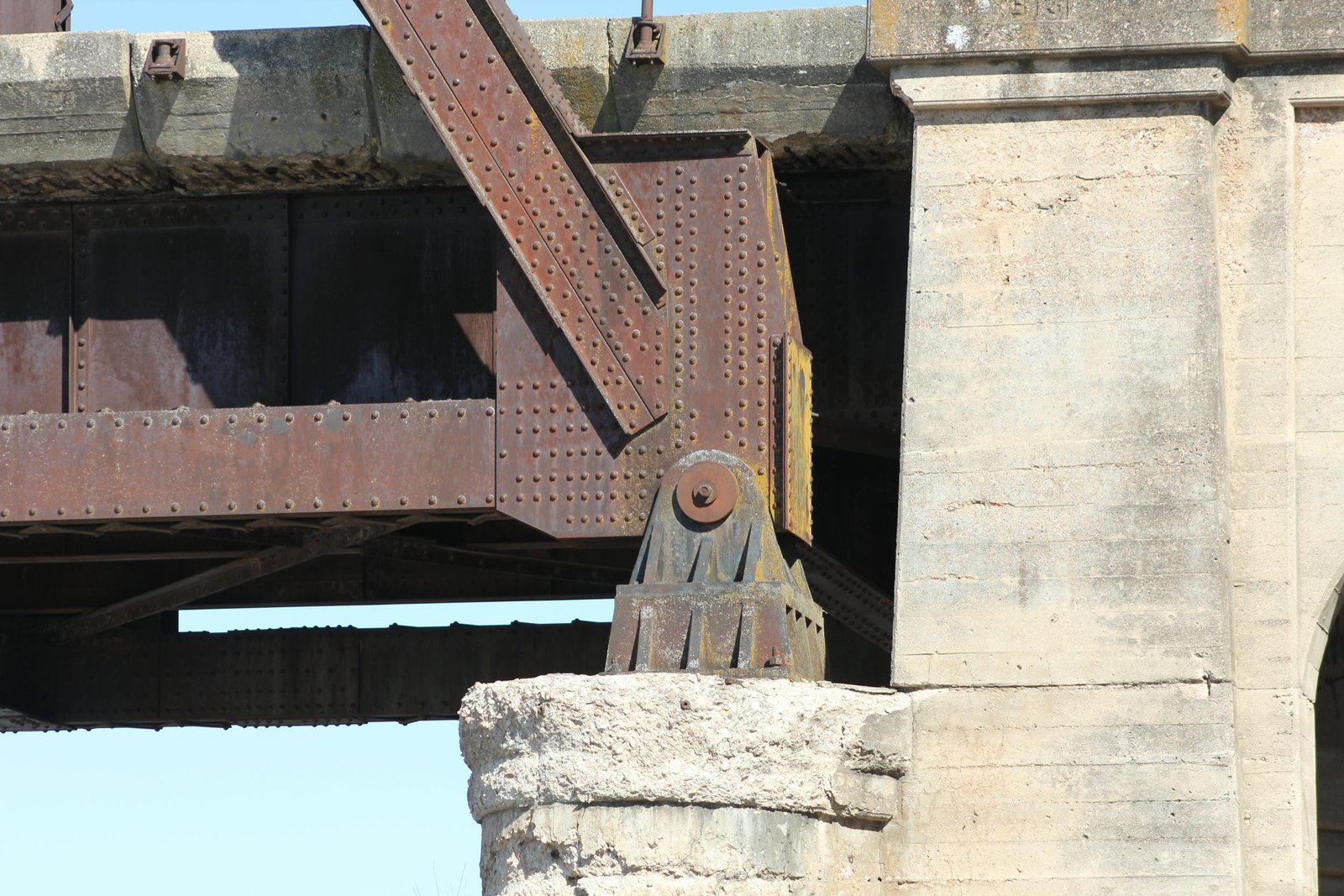
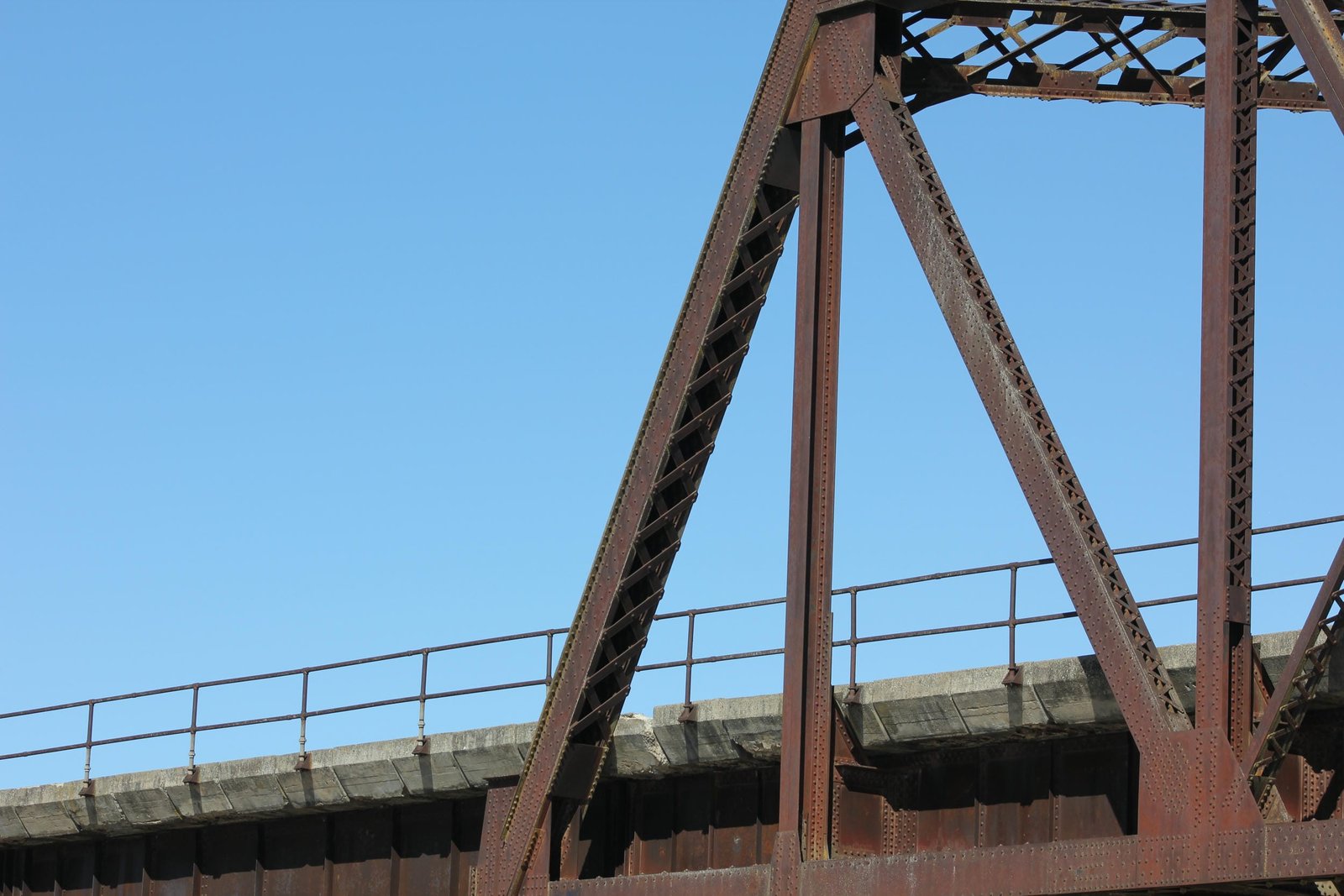
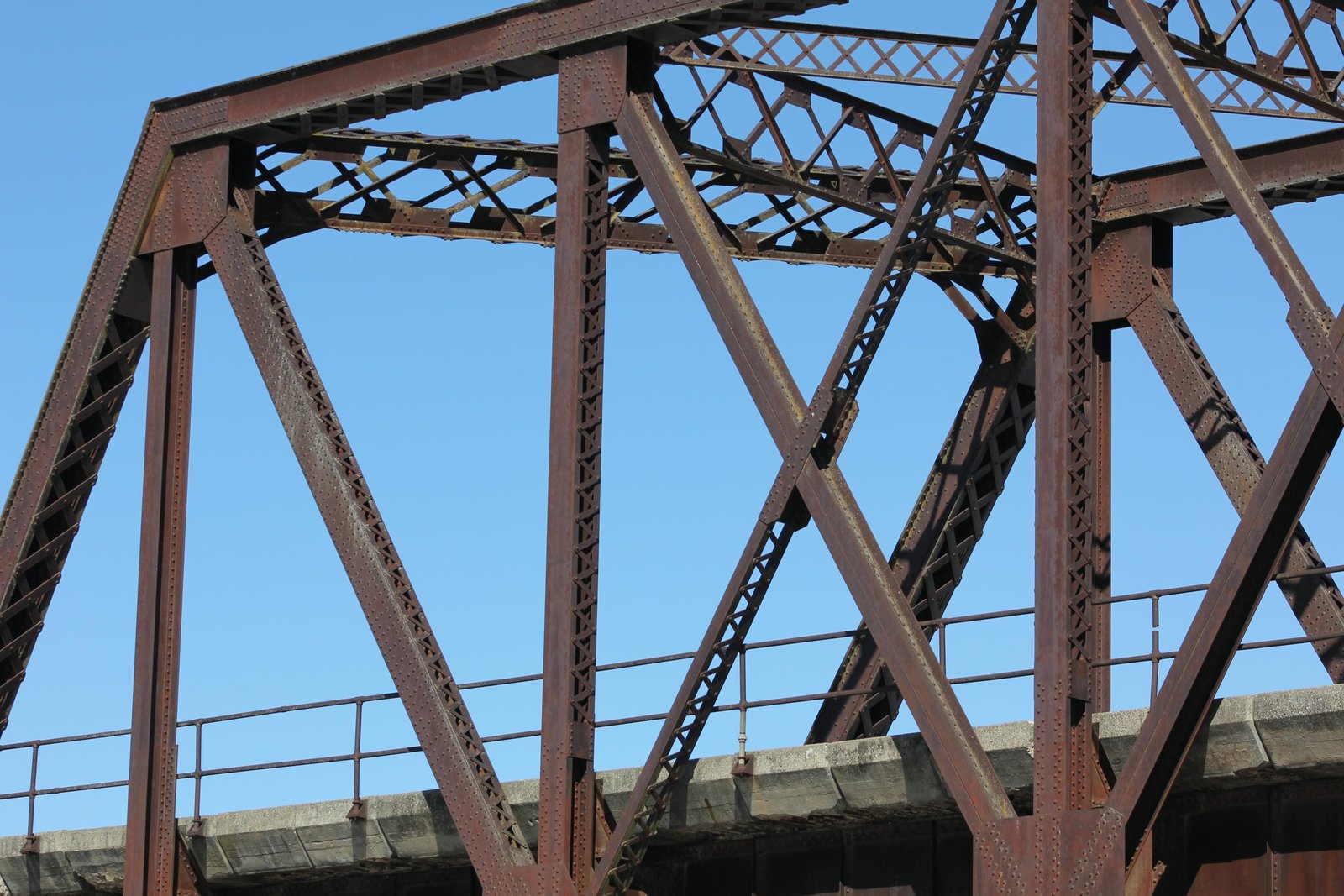
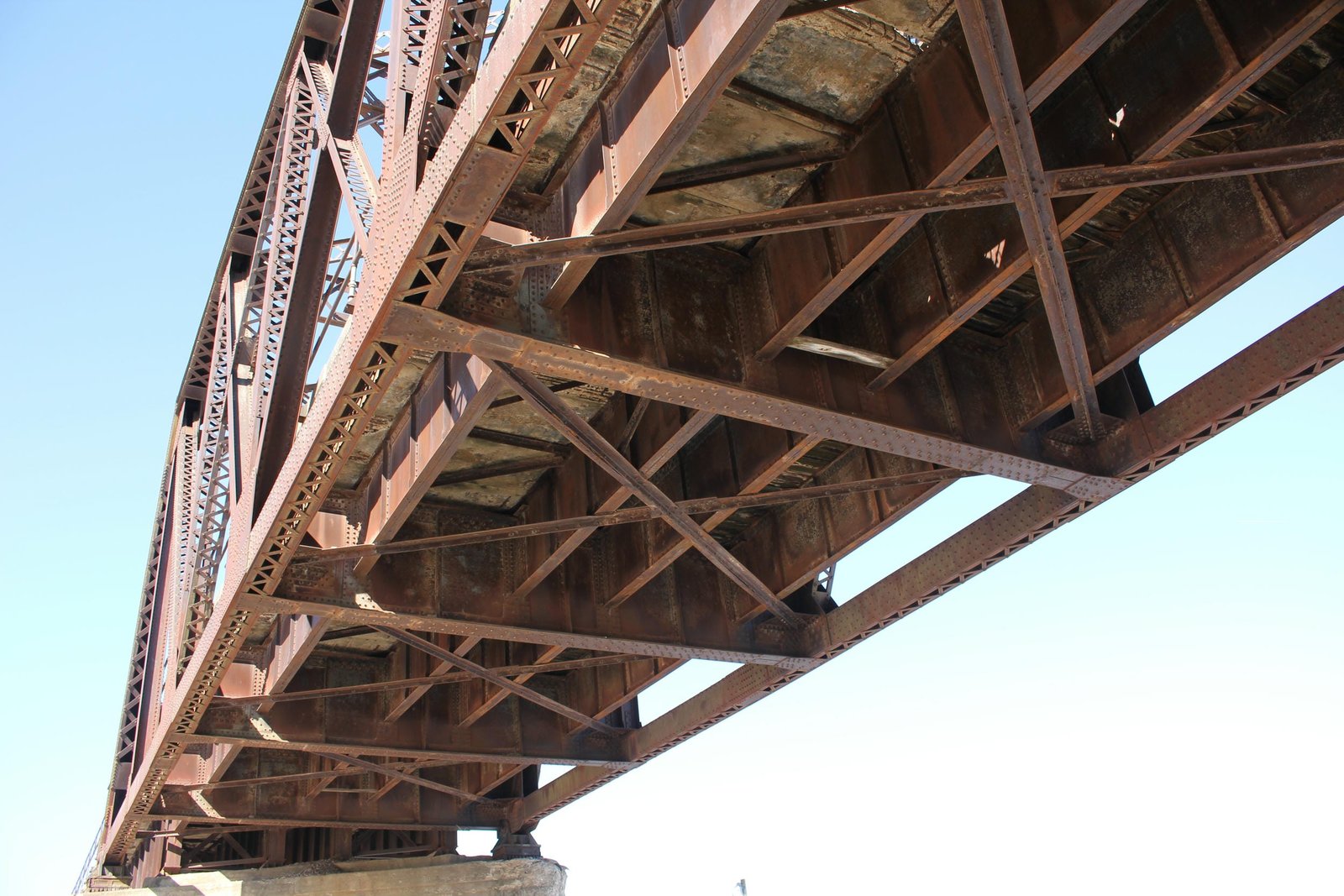
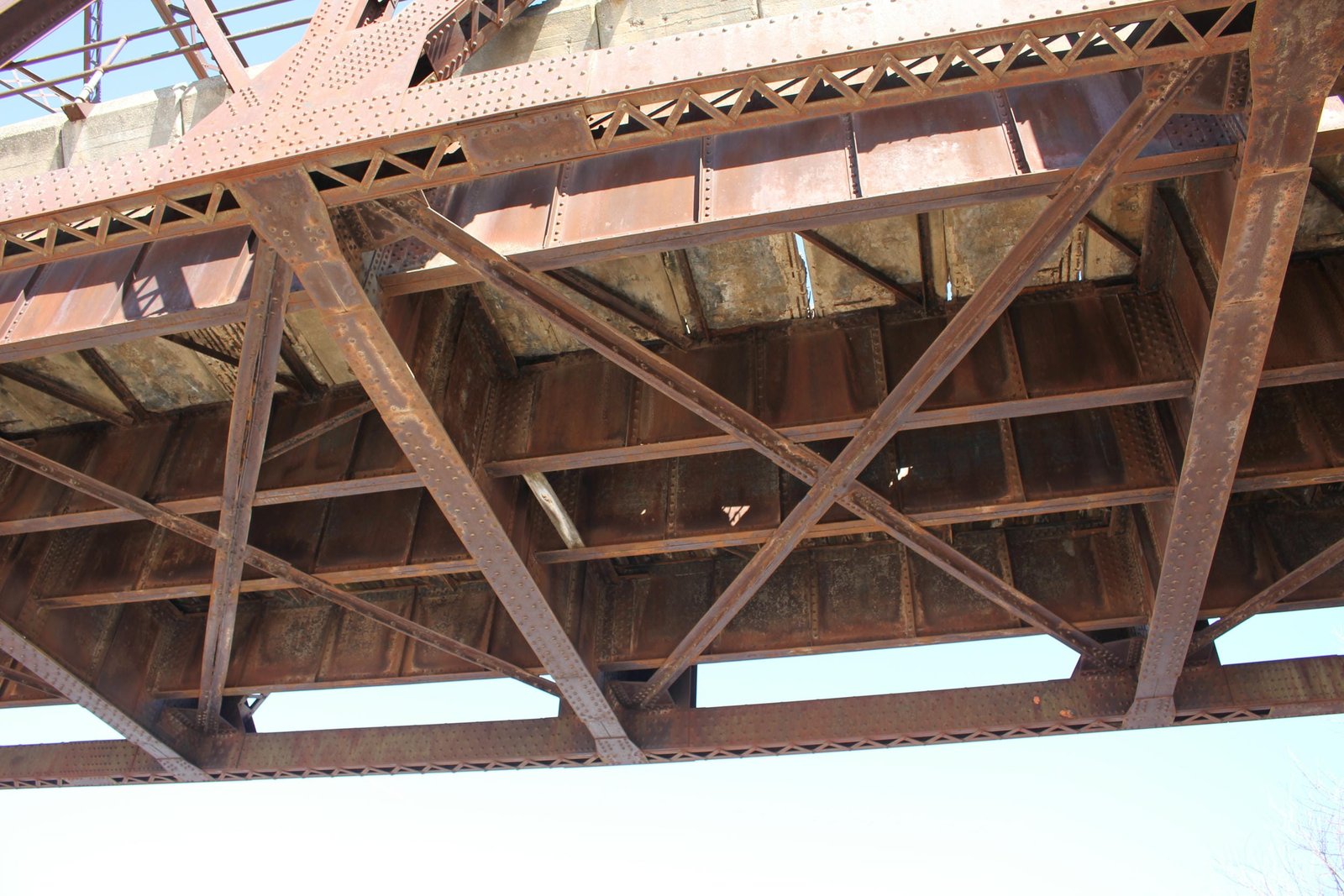
The truss span uses a unique design for the Milwaukee Road, with heavy built-up members, riveted connections and a standard floor. Both the top chord and the endposts are constructed with heavy built-up beams, consisting of two channels connected by solid plates on the exterior and X-lacing on the interior. The bottom chord is composed of a box-shaped beam, with V-lacing on both sides. The hip vertical members are both composed of solid beams, while the inner vertical members are composed of box-shaped beams with V-lacing on both sides. At the center panels, the compression members are composed of solid beams while the counters are composed of lighter V-laced beams. The compression members at the outer panels use a box-shaped design which is similar to the bottom chord. The floor is composed of plate girder floorbeams at the panel points and two plate girder stringers for each track. The bottom lateral bracing is constructed of L-shaped bars, while the upper lateral bracing is composed of heavy X-laced beams. The portal bracing uses a heavy X-laced design, which is formed from two rows of X-laced beams, which are connected by X-lacing on both the top and bottom and connected to the endposts and vertical members by two rows of heel bracing formed of L-shaped bars. The sway bracing uses a deeper X-laced beam. The deck plate girder spans are all heavily constructed, consisting of two heavy plate girders per span.
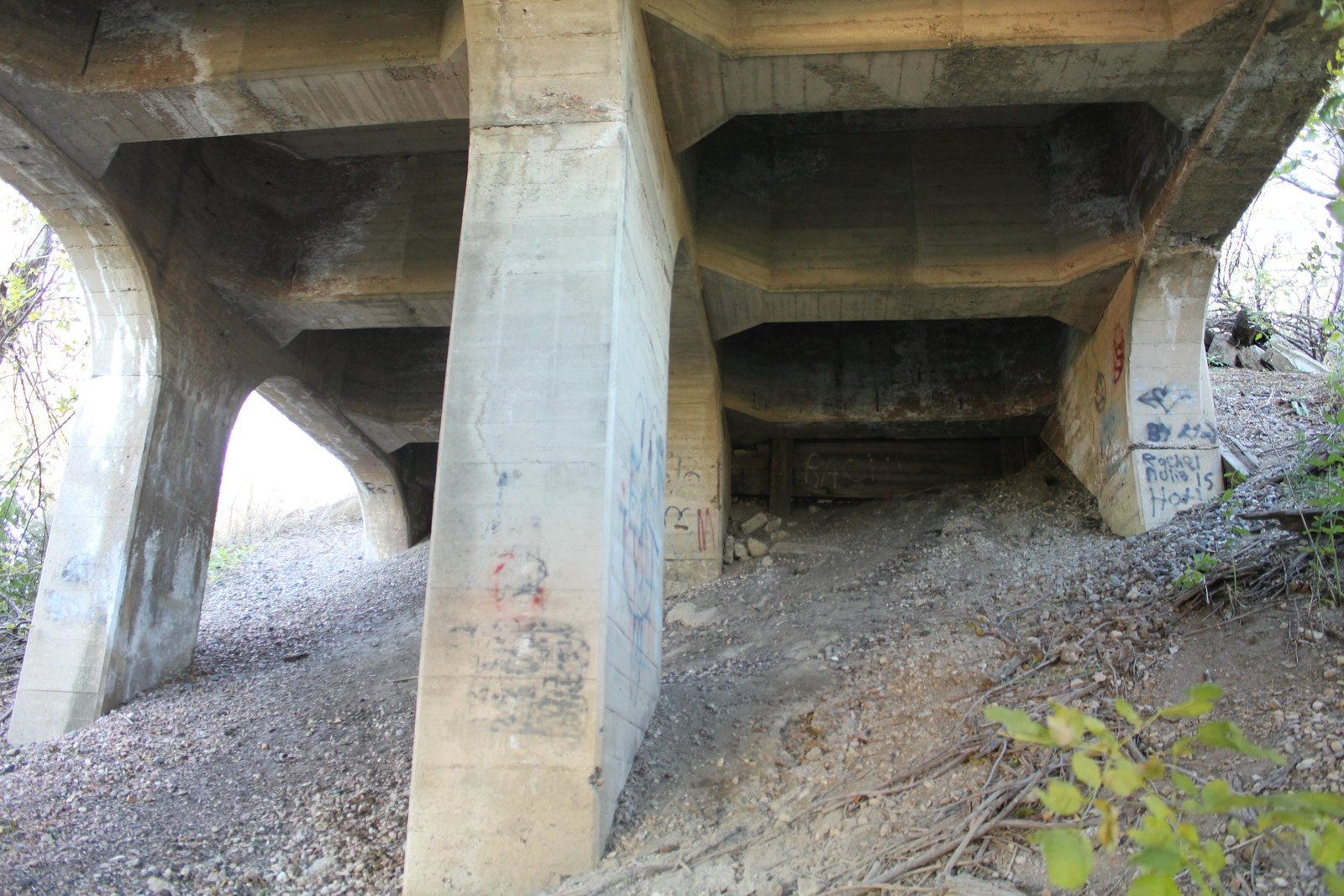
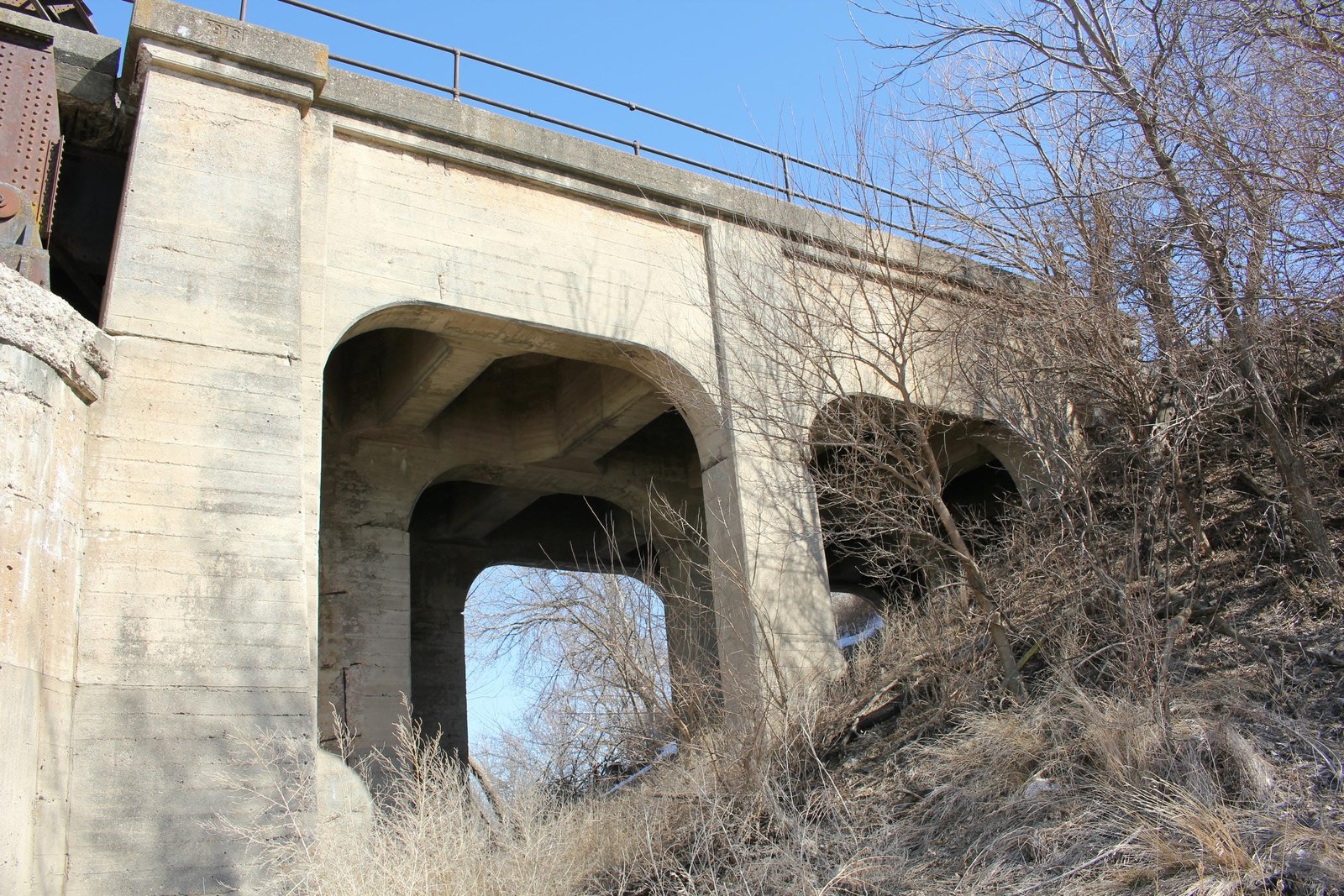
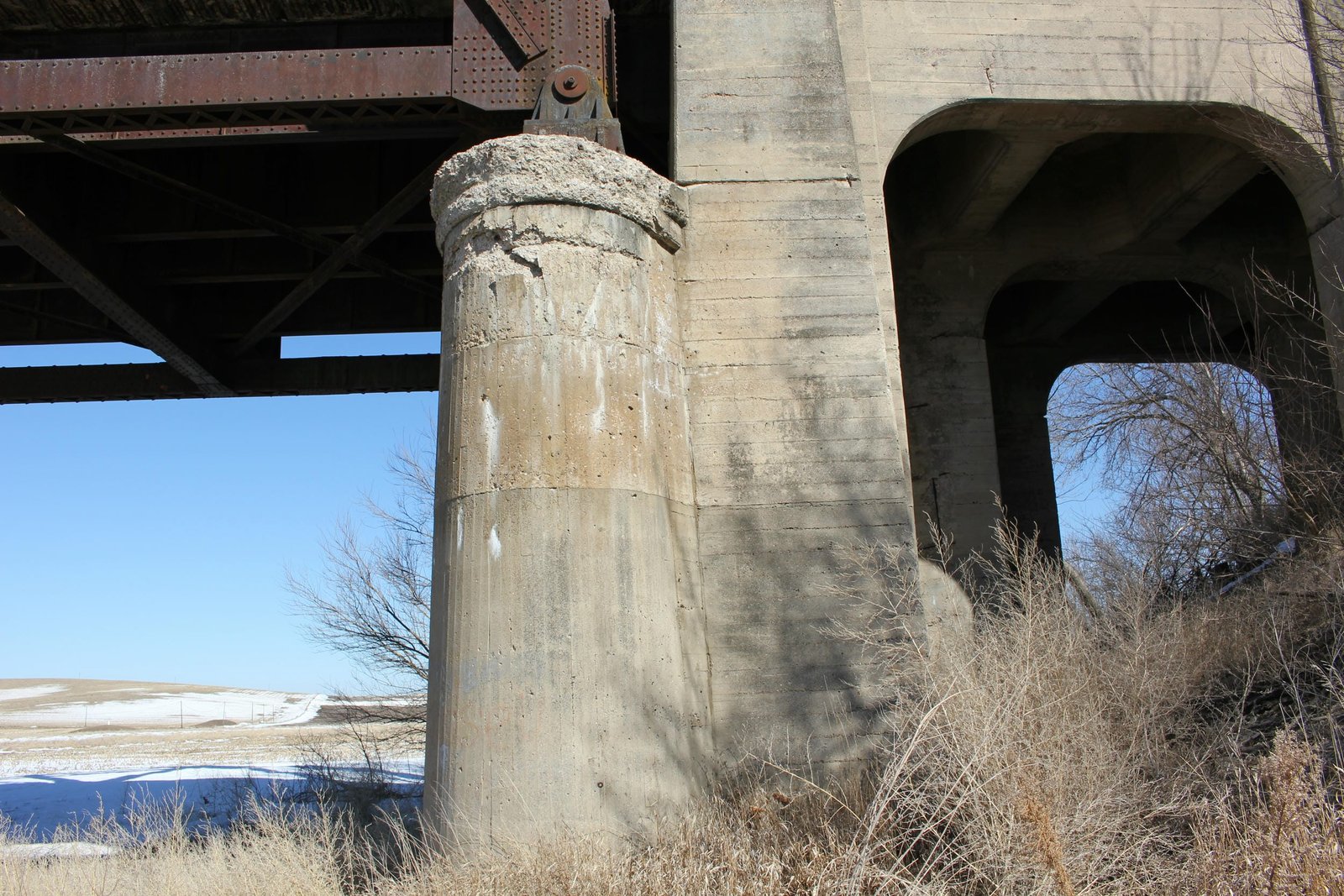
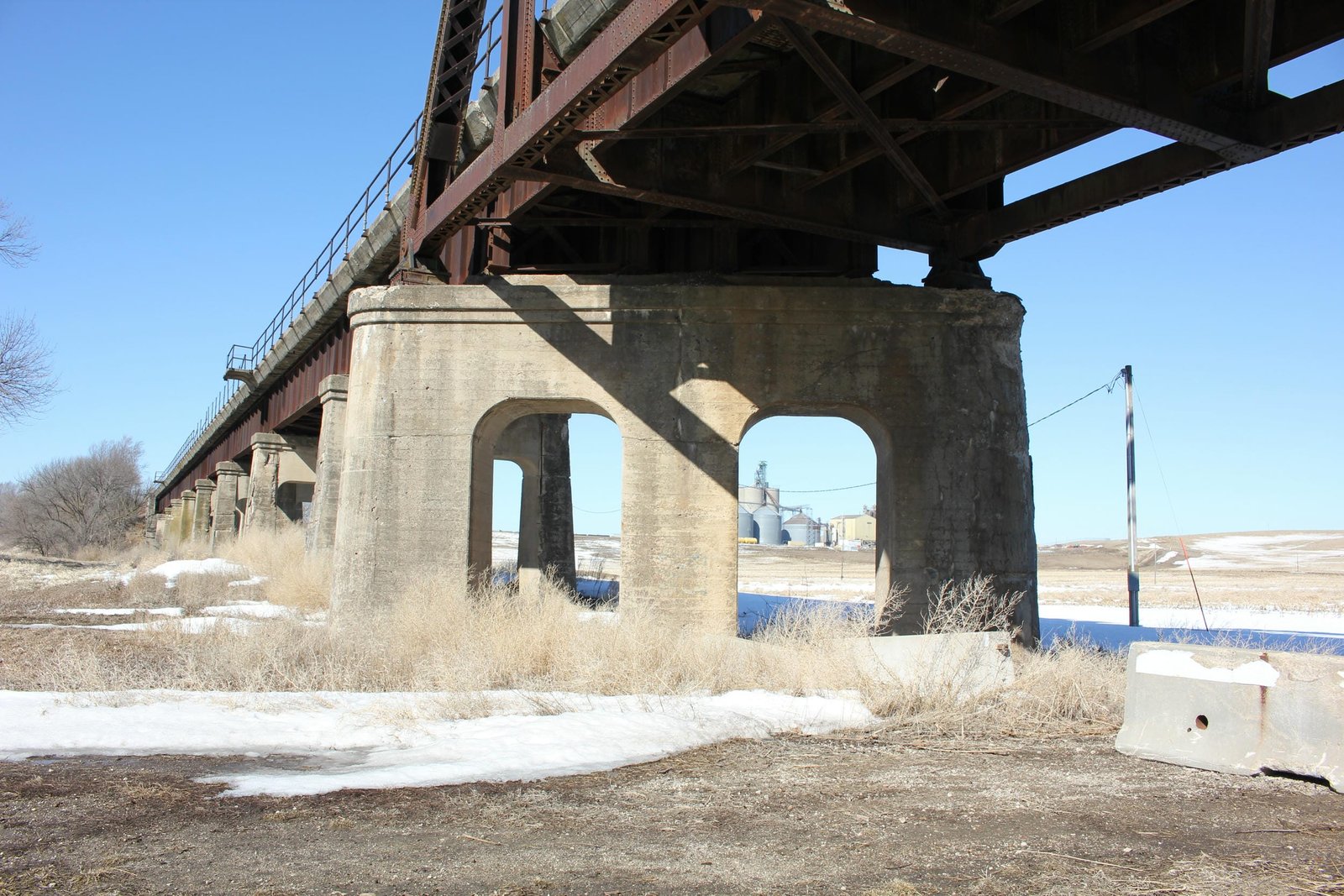
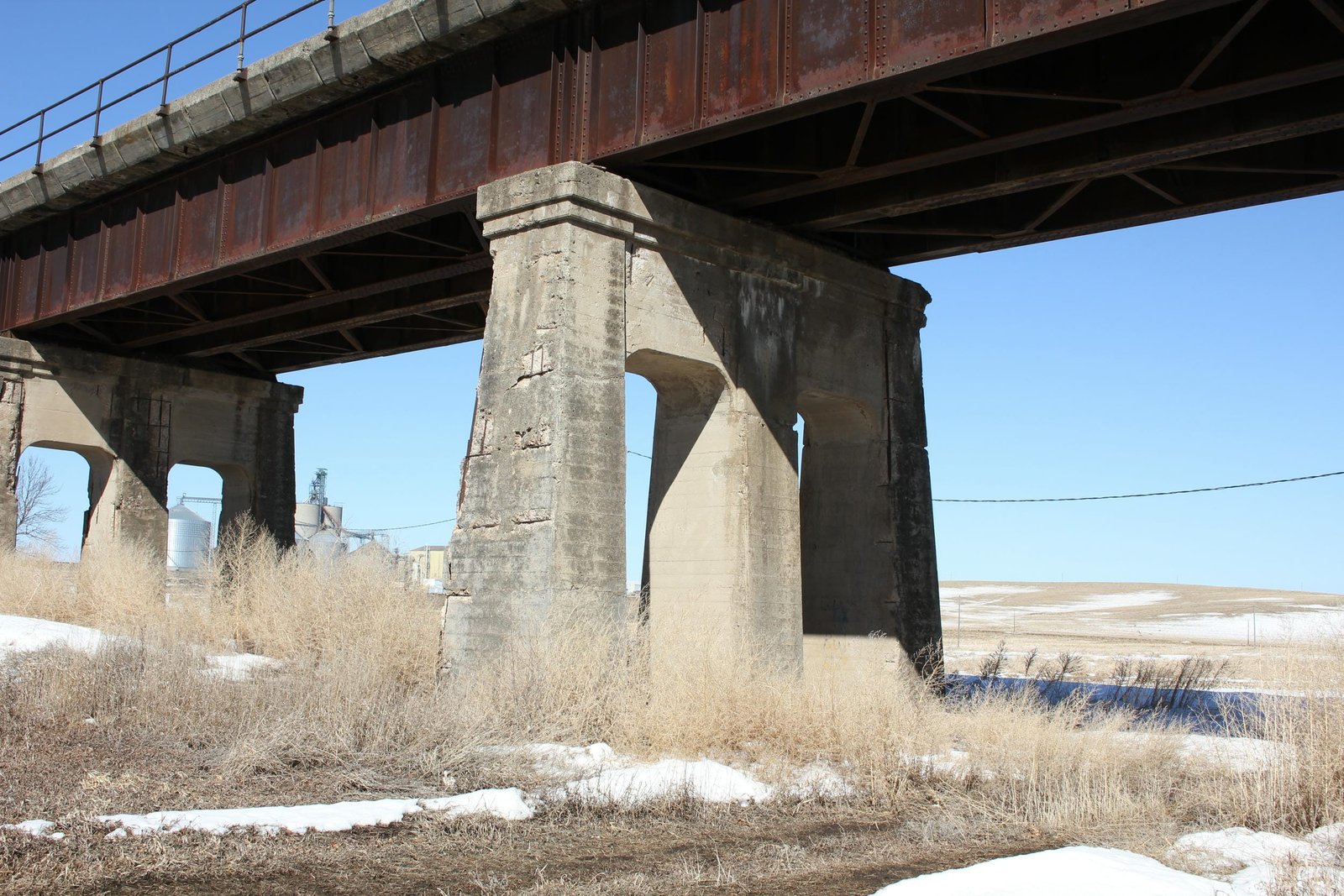
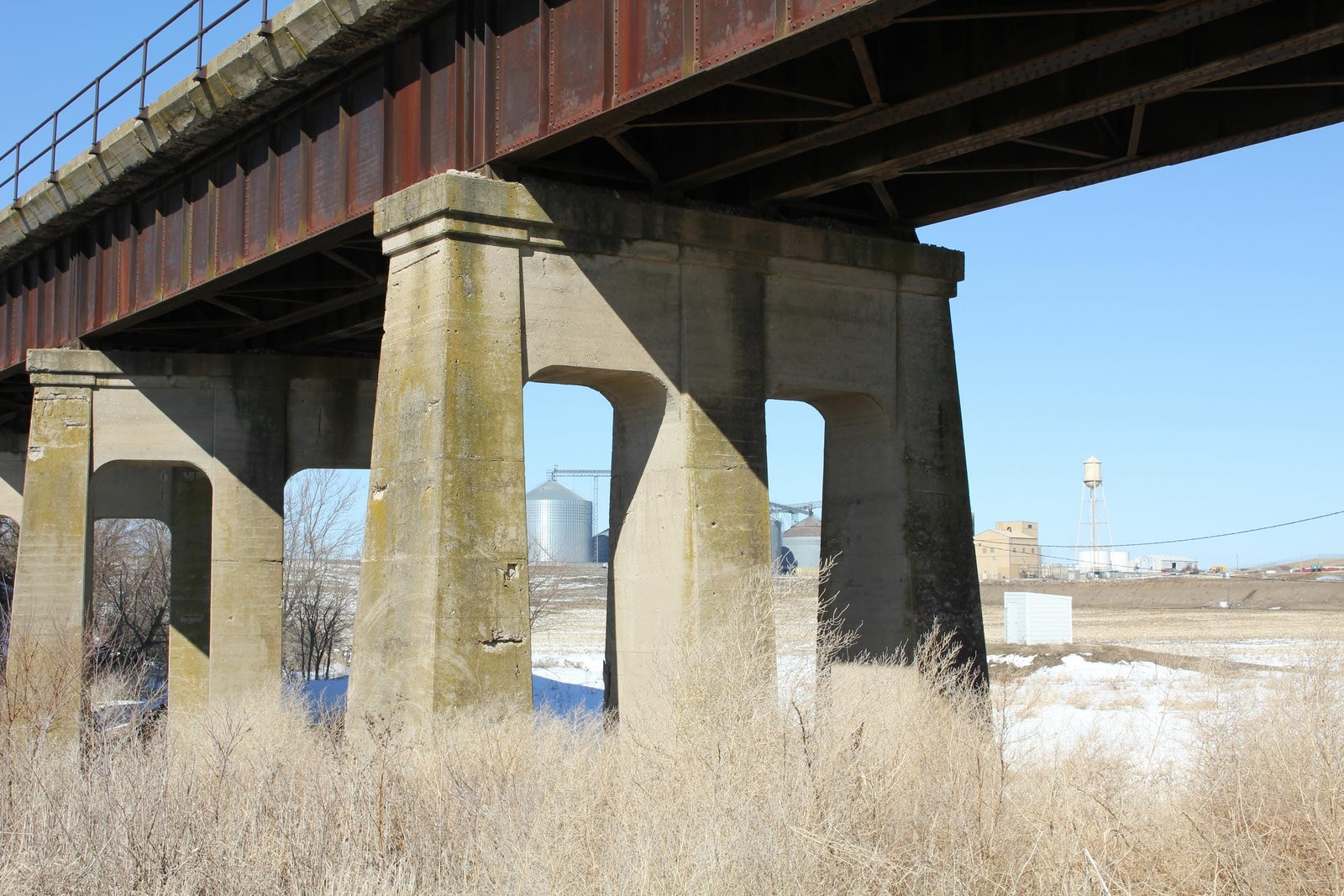
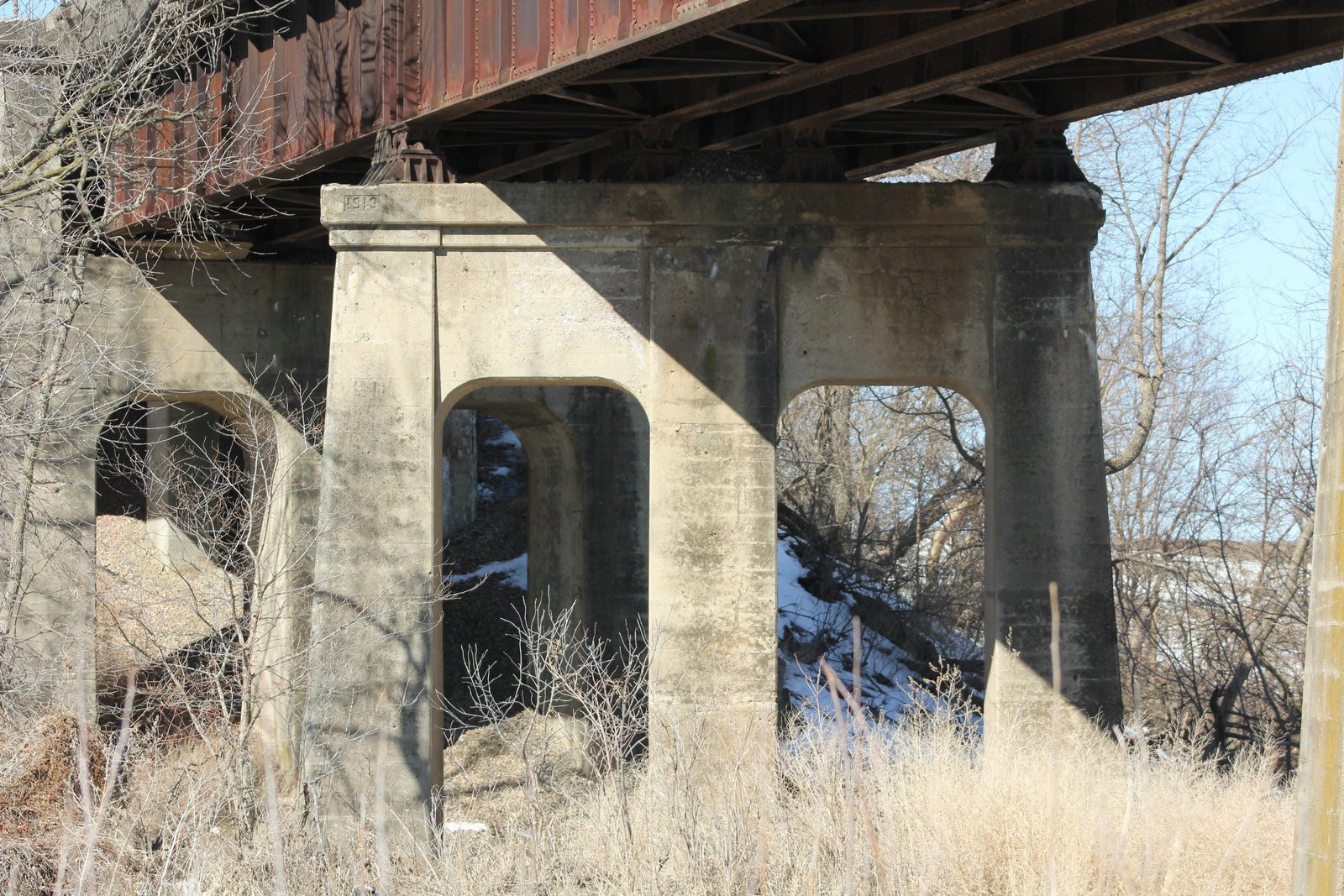
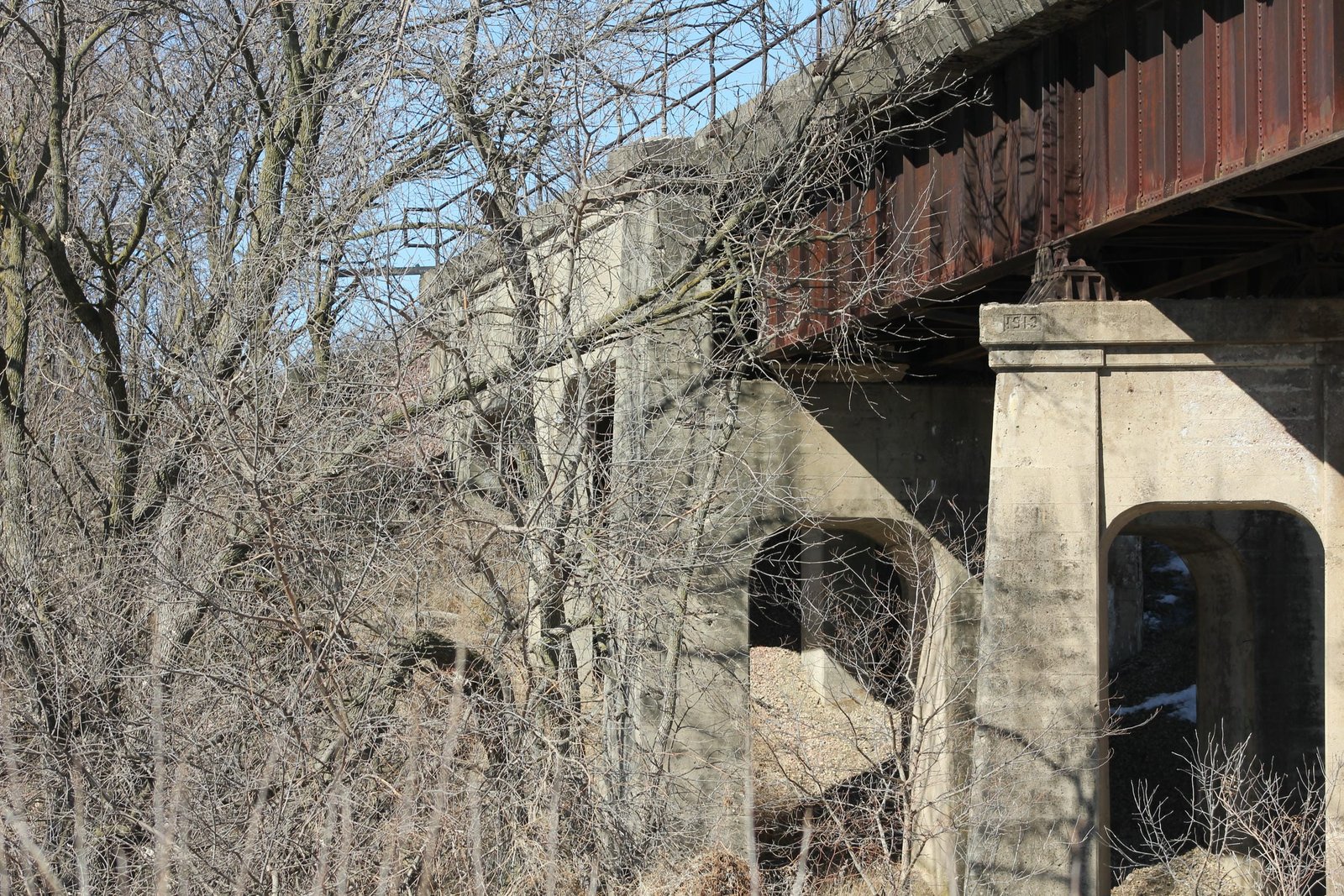
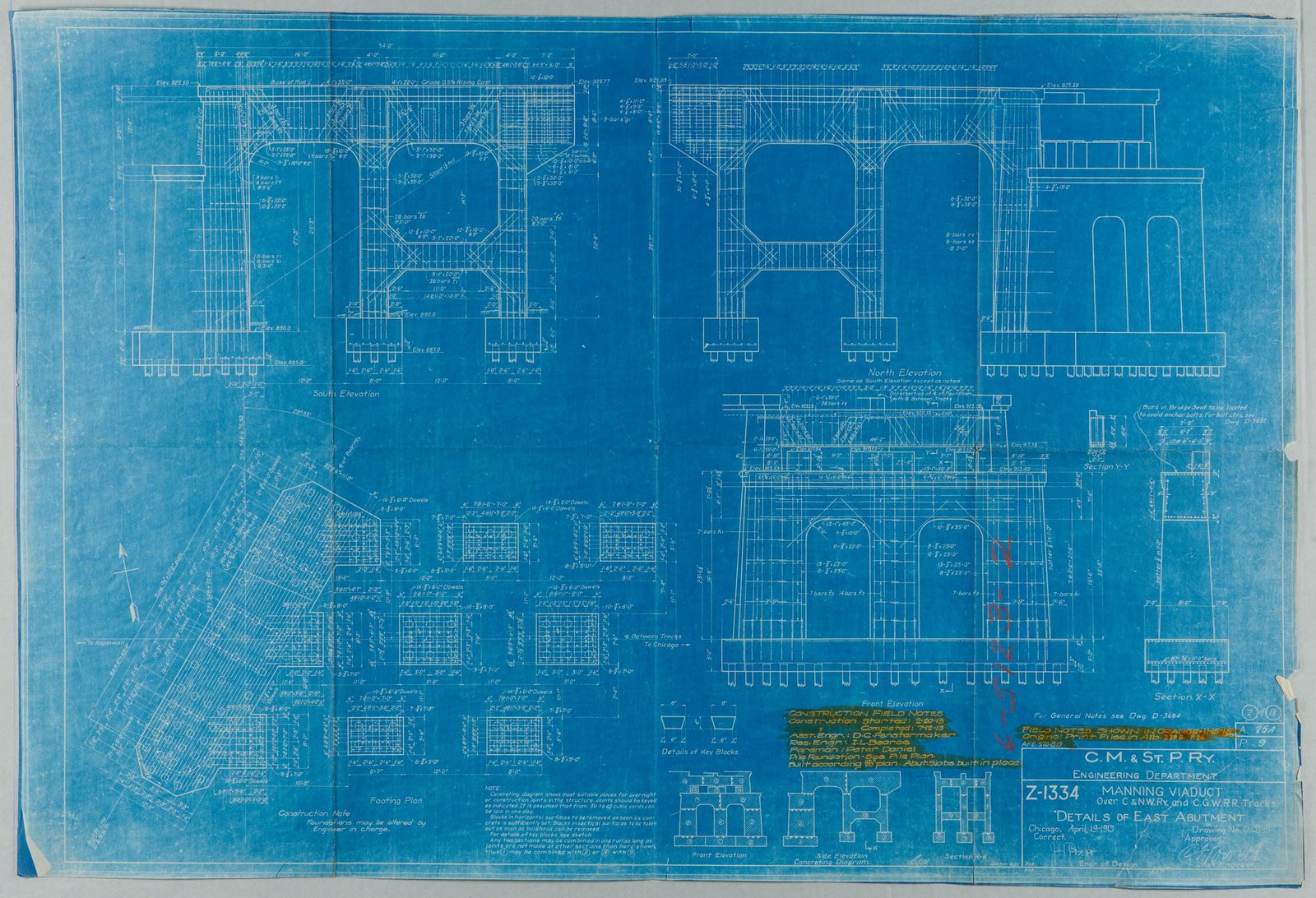
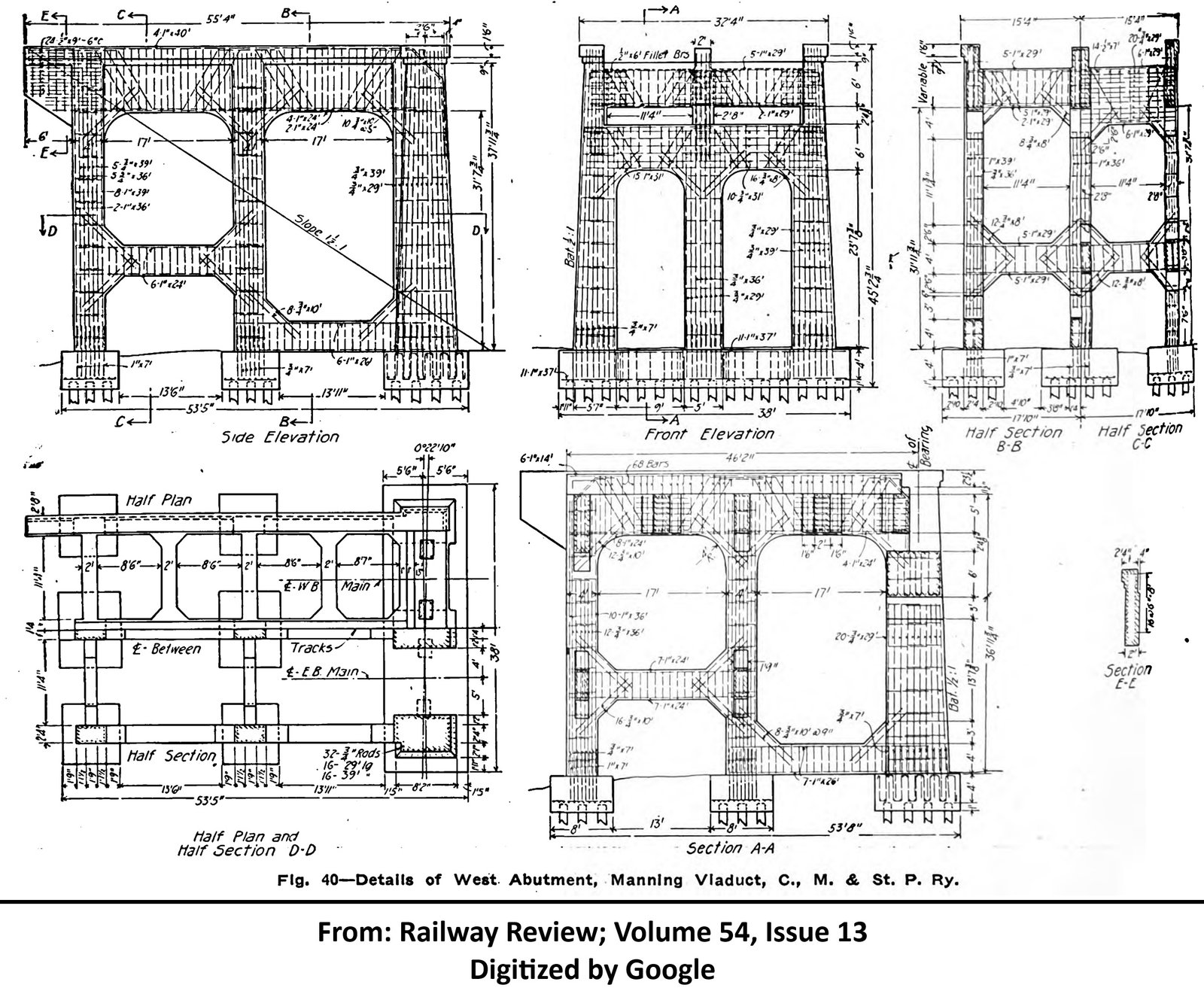
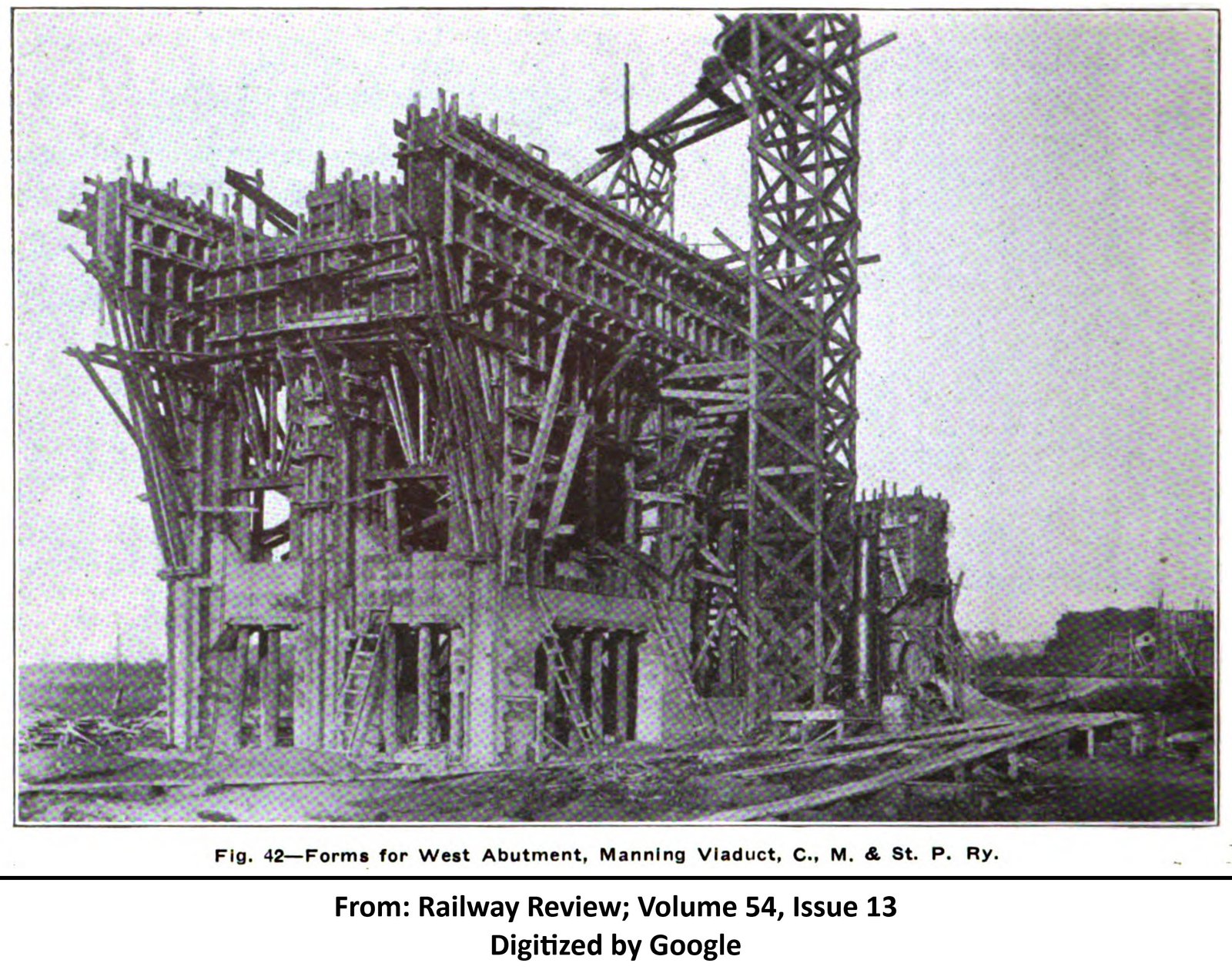
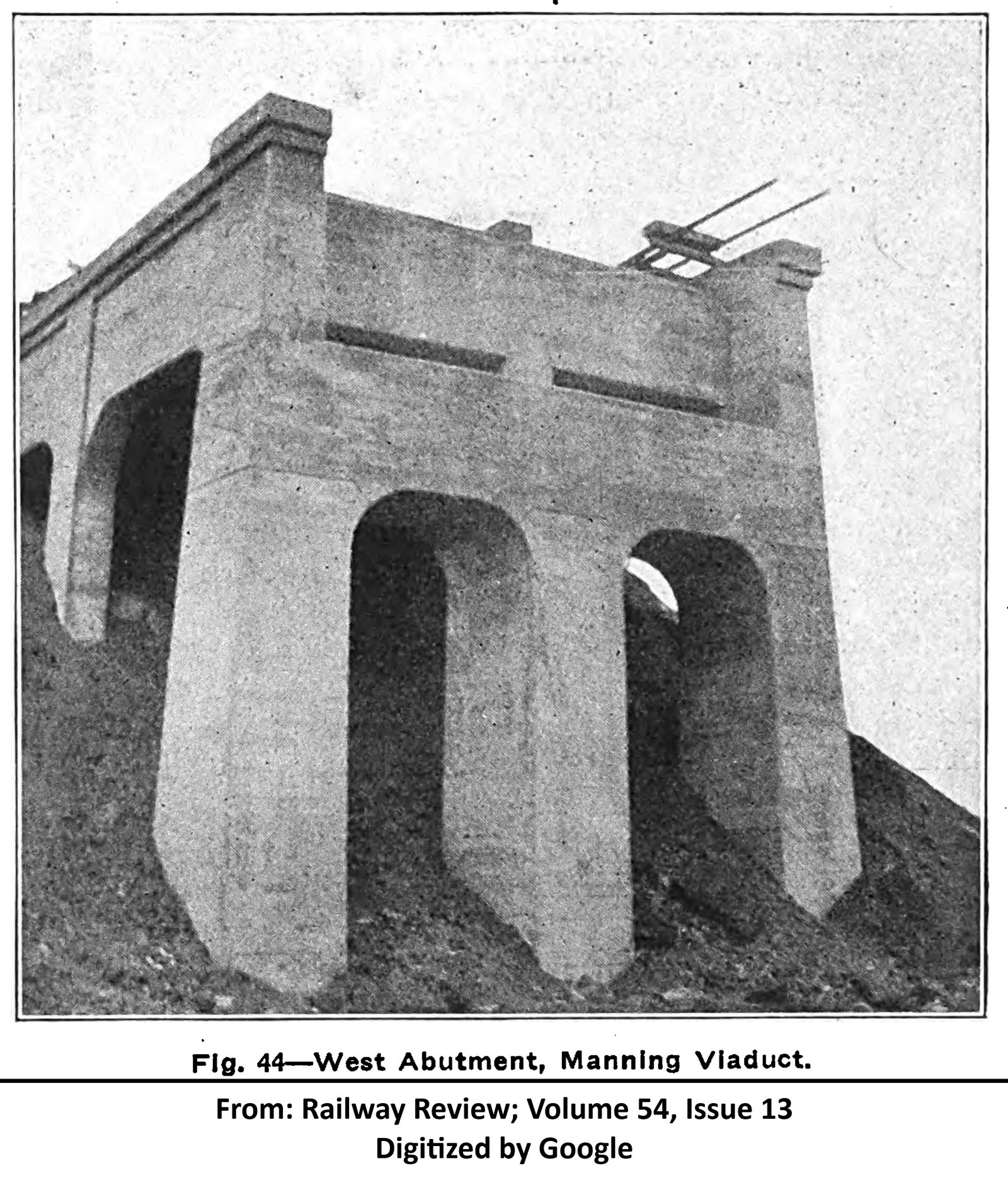
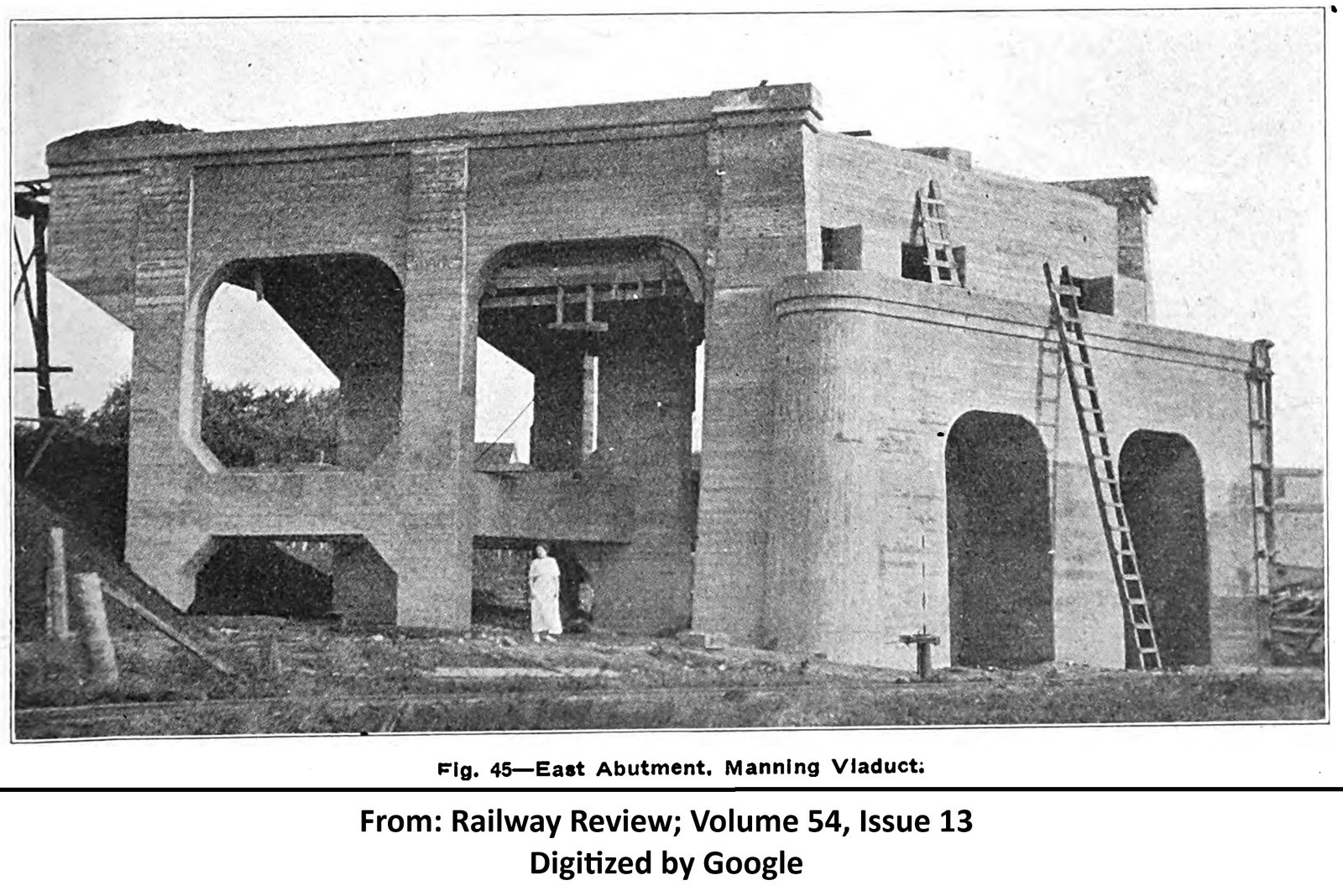
The approach spans/abutments consist of a standard concrete skeleton abutment design, which appears as a hybrid of concrete arch, concrete slab and concrete beam designs. Each approach uses three lines of arched longitudinal concrete beams to connect the piers and abutments to form two spans. These three beams are connected by square transverse beams at the mid-point of each span, forming four cells per track. The piers adjacent to the steel spans consist of three massive concrete columns, which are connected by transverse concrete arches at the top. The middle pier of each skeleton abutment uses three concrete columns, which are connected by an arched transverse beam at the top. In addition, the east abutment uses a buried longitudinal beam to connect the inner pier to the middle pier, and the west abutment uses buried longitudinal beams at both spans. The east span is slightly offset to account for the skew of the bridge. The abutment uses a timber backwall, which is buried in earth. Each approach/abutment appears to have been constructed as one large unit. The piers consist of three concrete columns, connected by transverse concrete arches at the top. In addition, the footings of the piers are connected by concrete beams.
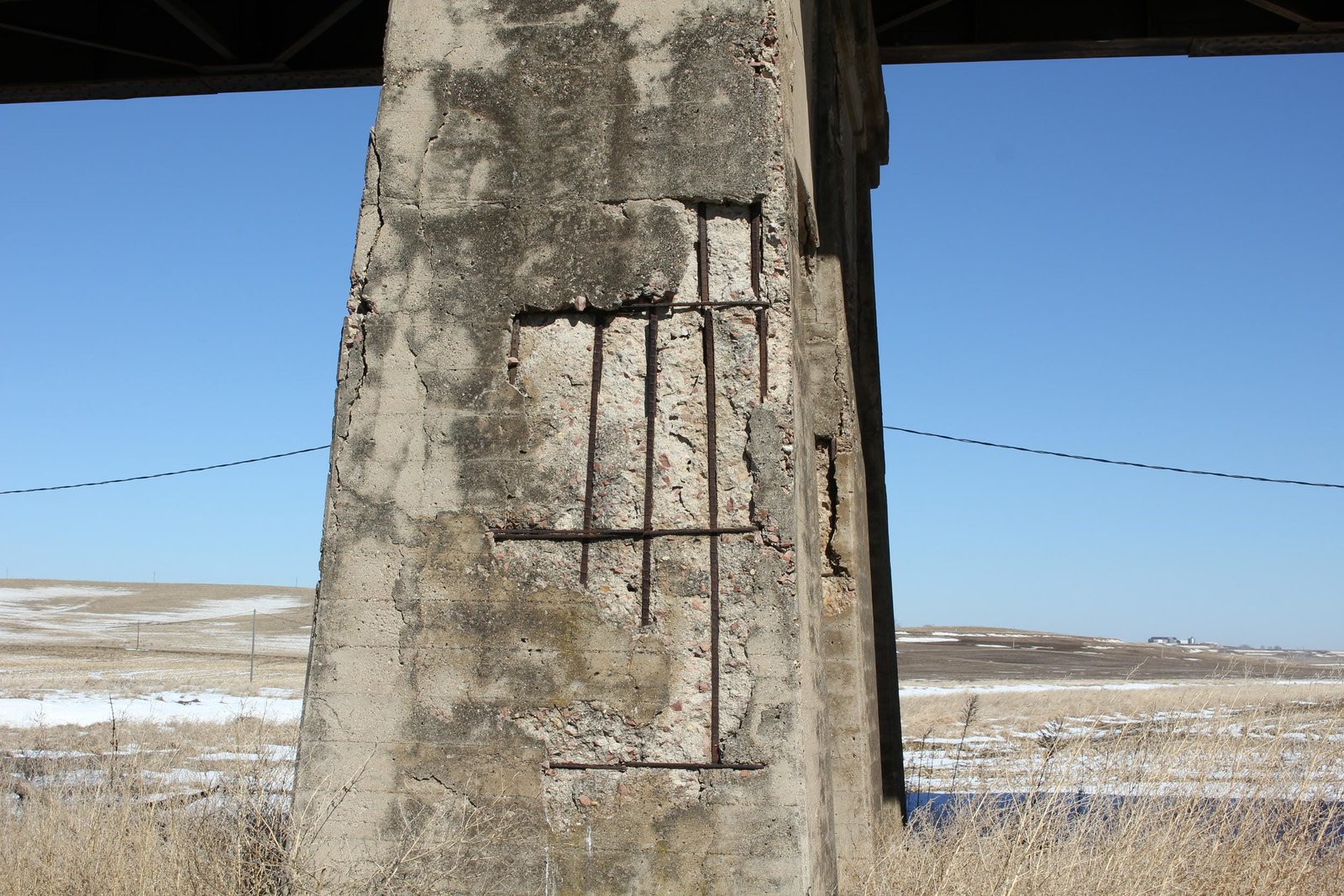
Pratt trusses were arguably the most common design for railroad truss bridge spans in the 19th Century, as they were durable, economical and simple. By the turn of the 20th Century, the design had largely been superseded by riveted Warren spans, which offered the same benefits while providing greater strength. The Milwaukee Road primarily used riveted Pratt spans during the early 20th Century, which also offered the same benefits of a riveted Warren span. Deck plate girder spans were popular for railroad use, as they were durable and easy to construct. Skeleton abutments were often used by the Milwaukee Road, particularly in areas where tall approach embankments would be prone to scour or failure. A handful of different variations of this design were used by the Milwaukee Road, but the most common used a concrete arch fascia to give the appearance of concrete arches. Despite the appearance, these approaches do not function like a concrete arch and instead are more similar to a beam or slab bridge. The Milwaukee Road also preferred the concrete arch pier design seen on this bridge, as it provided the same stability while greatly reducing the amount of material required. Since the initial construction, the only significant alteration to the bridge came in 2022, when the concrete ballast channels were replaced by a timber ballast deck. Today, the bridge remains in use as a branch line for BNSF Railway. Overall, the bridge appears to be in fair to good condition, with minor spalling and cracking noted throughout the concrete. The author has ranked the bridge as being regionally significant, due to the size and unique design.
Citations
| Build date | Milwaukee Road Drawing Collection, located at the Milwaukee Road Archives at the Milwaukee Public Library |
| Railroad History Citation | ICC Valuation Information, Compiled by Richard S. Steele |