
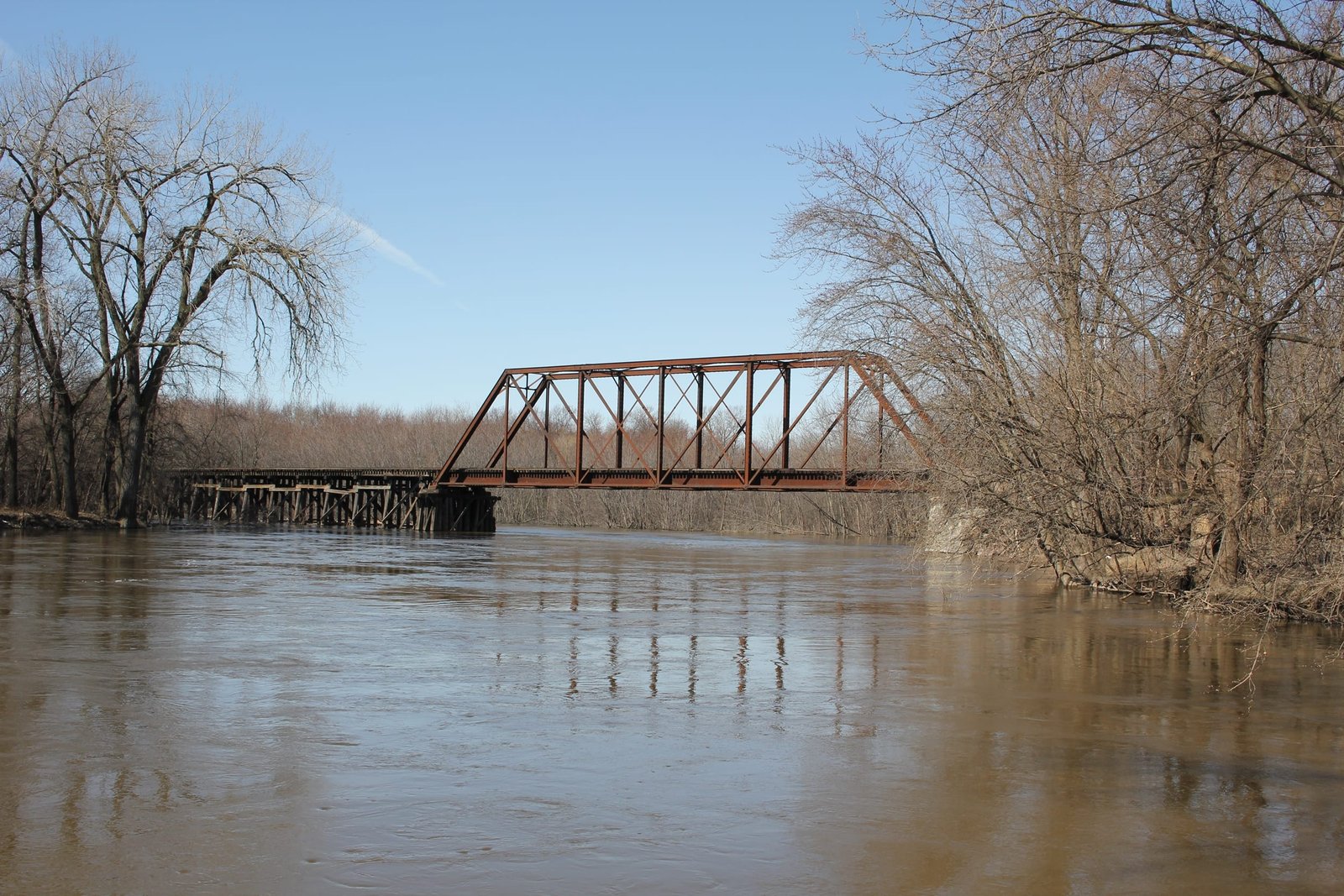


Click the photo to view the full-size version
| Name | MPL Minnesota River Bridge Minneapolis & St. Louis Railway Bridge #53 |
| Built By | Minneapolis & St. Louis Railway |
| Currently Owned By | Minnesota Valley Regional Railroad Authority (Operated by Minnesota Prairie Line, Inc.) |
| Superstructure Contractor | Phoenix Bridge Company of Phoenixville, Pennsylvania |
| Substructure Contractor | Widell Company of Mankato, Minnesota |
| Length | 1342 Feet Total, 157 Foot Main Span |
| Width | 1 Track |
| Height Above Ground | 20 Feet (Estimated) |
| Superstructure Type | Pratt Through Truss and Timber Pile Trestle |
| Substructure Type | Stone Masonry and Timber Pile |
| Date Built | 1898, Approach Rebuilt 2023 |
| Traffic Count | Less than 1 Train/Day (Estimated) |
| Current Status | Open to Traffic |
| Minneapolis & St. Louis Railway Bridge Number | 53 |
| Significance | Regional Significance |
| Documentation Date | 4/1/2018 |
In 1882, the Minneapolis & St. Louis Railway Company of Minnesota and Iowa (M&StL) constructed a 93 mile railroad between Hopkins, Minnesota and Morton, Minnesota. At the same time, the Wisconsin, Minnesota & Pacific Railway (WM&P) would construct 123 additional miles of new railroad between Morton and Watertown, South Dakota. The M&StL would reorganize as the Minneapolis & St. Louis Railroad in 1895. The WM&P sold the Morton to Watertown line to the M&StL in 1899. The line was used as a secondary route, connecting to the M&StL mainline at Hopkins. In 1908, an additional 228 miles would be constructed from Watertown to LeBeau, South Dakota by the Dakota, Minnesota & Pacific Railway Company. Initial work began on a bridge across the Missouri River at LeBeau, but the work was quickly abandoned. This company would be sold to the M&StL in 1912. The M&StL would be reorganized as the Minneapolis & St. Louis Railway in the 1920s.
Due to a severe drought, LeBeau became a ghost town, and the line from Akaska to LeBeau was abandoned in 1924, followed by the segment from Conde to Akaska in 1940. In 1960, the M&StL was purchased by the Chicago & North Western Railway (C&NW). The line was often in disrepair, especially after it was purchased by the C&NW. Further abandonments to the line came in 1969, when the segment between Revillo, South Dakota and Watertown, South Dakota was abandoned. In 1970, the line between Madison, Minnesota and Revillo would be abandoned, and the remaining line to Conde would be abandoned in 1977. The Hanley Falls to Madison segment was sold to the Burlington Northern Railroad in 1970, and the portion between Hopkins and Norwood would be abandoned in 1980. The Hopkins to Norwood segment was purchased by Carver and Hennepin Counties, and reused as the Lake Minnetonka Regional Trail. By 1982, the remaining segment between Norwood and Hanley Falls was proposed for abandonment, and the Minnesota Valley Regional Railroad Authority purchased the railroad in 1983.
In 1996, the Burlington Northern merged with Atchison, Topeka & Santa Fe to form BNSF Railway, the current operators of the Hanley Falls to Madison segment. In 2002, the Minnesota Prairie Line, Inc (MPL) began operations over the Norwood to Hanley Falls segment. MPL is a subsidiary of the Twin Cities & Western Railroad, and the line continues to see upgrades to spur business development.
Located in Morton, this through truss bridge carries a former Minneapolis & St. Louis Railway branch line (now Minnesota Prairie Line) across the Minnesota River. The first bridge at this location likely consisted of a wooden truss bridge, constructed when the line was first built. In the late 1890s, the M&StL made several improvements to this line, replacing major bridges with steel and stone and replacing several smaller timber bridges with stone culverts. The present bridge was constructed in 1898. Throughout the 20th Century, the lengthy timber pile trestle approach on the west end had been shortened, and in 2024 the approach was rebuilt and strengthened, giving the bridge its present configuration. Currently, the bridge consists of a 157-foot, 6-panel, pin-connected Pratt through truss span, approached by an exceptionally long 87-span timber pile trestle approach on the west end. The bridge is set onto a stone east abutment, while the remainder of the structure is set onto timber pile substructures. Stone for the east abutment consists of granite, likely quarried locally in Morton. Phoenix Bridge Company fabricated the truss span, while the Widell Company constructed the abutment. The timber components were originally constructed by railroad company forces, and were rebuilt by E80 Plus Constructors.
The truss span follows a traditional 19th Century design, with light members, pinned connections and a standard floor system. Both the endposts and top chord use built-up beams, which are composed of channels connected by X-lacing on the bottom and solid plates on the top. The bottom chord uses eyebars, with one set of two at the outer panels and one set of three at the center panels. The vertical truss members consist of solid beams at the hip verticals and X-laced built up beams for the center members. All diagonal members are composed of eyebars, which are formed from rectangular steel bars. Thinner steel bars with turnbuckles form the counter diagonal members. The floor system uses standard I-beam stringers and plate girder floorbeams, which are placed at the panel points. The floorbeams are riveted to the vertical members, with the lower connections running through the bottom of the vertical members. Both the upper and lower lateral bracing are composed of solid bars, which form an "X" shape across each panel. The portal bracing uses a light A-frame design, constructed out of L-shaped bars. The sway bracing uses a V-laced beam, which is connected to the vertical members by a diagonal bar. The abutment is constructed of granite cobble, which is mortared. There are short non-standard wing walls on either side. The approach uses a standard design, which has been reinforced with new stringers.
Through the second half of the 19th Century, pin-connected Pratt truss spans were the most commonly used truss design for railroad bridges. The Pratt design was simple, durable and economical. By the turn of the 20th Century, riveted Warren designs had largely superseded pin-connected spans. Phoenix Bridge Company built a number of bridges for the M&StL between the late 1890s and early 1900s. Two additional trusses of this design were constructed at Spencer, Iowa and New Ulm, Minnesota; both of which have been removed. As part of the project that constructed this bridge, an unusual riveted Warren span was installed at the Redwood River nearby. It is unclear why the M&StL used both riveted and pin connected spans as part of the same project. Since the initial construction, the bridge has seen few alterations, except for general repairs and a significant rehabilitation of the approach spans. Today, the bridge remains occasionally used. Overall, the bridge appears to be in fair condition, with no significant deterioration seen on the truss. The author has ranked this bridge as being regionally significant, due to the unusual truss design.
Citations
| Build date and builder (superstructure) | Phoenix Bridge Company order book; part of Phoenix Steel Company records located at the Hagley Museum |
| Builder (substructure) | The Improvement Bulletin; December 10, 1898 |
| Railroad History Citation | ICC Valuation Information, Compiled by Richard S. Steele |