
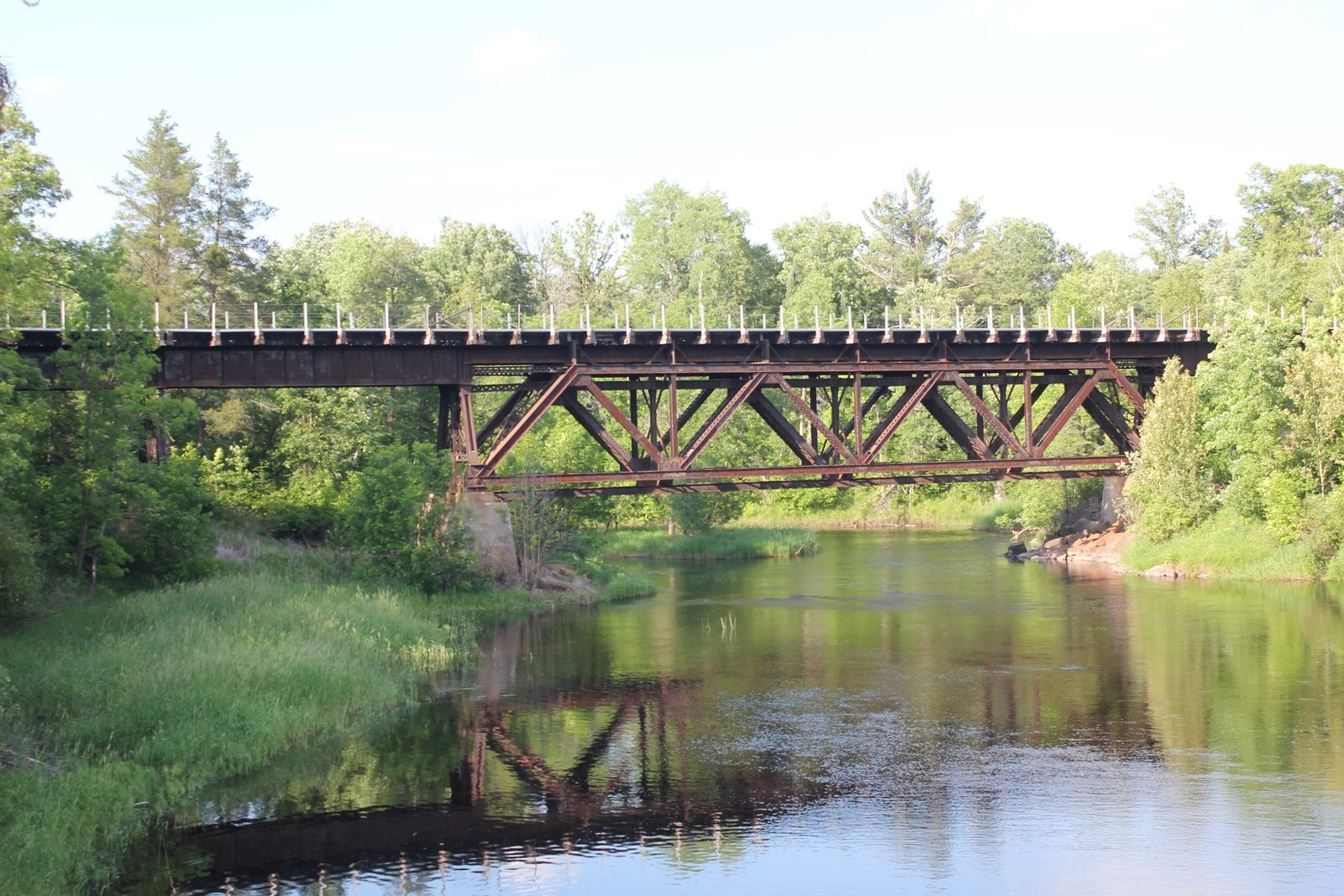


Click the photo to view the full-size version
| Name | BNSF Prairie River Bridge Great Northern Railway Bridge #108.9 |
| Built By | Great Northern Railway |
| Currently Owned By | BNSF Railway |
| Superstructure Contractor | Carnegie Steel Company of Pittsburgh, Pennsylvania (Truss and Girders) Unknown (Additional Truss and Girder Lines) Unknown (Stringer Spans) |
| Substructure Contractor | Unknown |
| Length | 305 Feet Total, 130 Foot Main Span |
| Width | 1 Track |
| Height Above Ground | 38 Feet |
| Superstructure Design | Warren Deck Truss, Deck Plate Girder and Steel Stringer |
| Substructure Design | Stone Masonry, Concrete and Steel Bent |
| Date Built | 1899; Reconstructed 1929 |
| Traffic Count | 5 Trains/Day (Estimated) |
| Current Status | In Use |
| Great Northern Railway Bridge Number | 108.9 (Old #67) |
| BNSF Railway Bridge Number | 108.9 |
| Significance | Regional Significance |
| Documentation Date | 6/23/2015 |
In 1890, the Duluth and Winnipeg Railroad began construction on a new 85 mile railroad extending from Cloquet, Minnesota to Deer River, Minnesota. Construction was completed from Cloquet to Paupores in 1890, to Gunn in 1891, and to Deer River by 1892. In 1896, the D&W was sold to the Great Northern Railway (GN), which had built and acquired an extensive amount of railroad lines throughout Minnesota. The Eastern Railway Company of Minnesota would construct 99 additional miles from Deer River to Fosston, Minnesota in 1898; as well as an extension from Cloquet to Boylston, Wisconsin in 1899. The Eastern Railway Company would be purchased by the GN in 1907.
The GN operated this route as a mainline, as it connected to Seattle on the west, and the Twin Ports of Duluth, Minnesota and Superior, Wisconsin on the east. The line was critical for hauling iron ore, timber and agricultural commodities. In 1970, GN merged with rival Northern Pacific Railway and Chicago, Burlington & Quincy Railroad to form Burlington Northern Railroad. BN was in turn merged with Atchison, Topeka & Santa Fe Railway in 1996, to form BNSF Railway. BNSF currently operates the Cass Lake to Boylston segment of this line as the Lakes Subdivision.
Located along US Highway 2 east of Grand Rapids, this deck truss bridge carries a former Great Northern Railway mainline over the Prairie River. The first bridge at this location likely consisted of a timber deck truss span, approached by timber pile trestle spans. In the late 1890s and early 1900s, the GN invested significant capital into this line, replacing aging timber bridges with steel, stone and concrete structures. In 1899, a new steel deck truss and deck plate girder span was constructed, set onto stone substructures. As trains became heavier in the 1920s, it was decided to strengthen the bridge. In 1929, the bridge was strengthened with a third truss line and a third girder line in the approaches. In addition, the stone substructures were encased in concrete, new concrete abutments were constructed and an additional steel stringer span was added at each end. Currently, the bridge consists of a 130-foot, 8-panel, riveted Warren deck truss span, approached by two 45-foot deck plate girder spans and a 20-foot steel stringer span on the west end and one 45-foot deck plate girder span and one 20-foot steel stringer span on the east end. The bridge is set onto concrete encased stone piers, steel bents and concrete abutments. Carnegie Steel Company fabricated the truss and girder spans, while unknown contractors fabricated the additional truss and girder lines and the approach spans. An unknown contractor constructed the stone substructures, while an additional unknown contractor completed the concrete encasements and new concrete abutments.
The truss span follows a standard design for the era, with heavy members, riveted connections and a standard floor. In addition, the third truss line is significantly heavier than the outer trusses, and is set lower than the original truss span. Both the top chord and endpost use a heavily built-up design, with two channels connected by X-lacing on the bottom and solid plates on the top. The bottom chord uses a similar design, with two channels connected by V-lacing on both sides. At the third truss line, the endposts and top chord are similar to the original truss, while the bottom chord uses X-lacing on both sides. The vertical members of the original truss use solid beams, while the diagonal members are composed of both rectangular bars and X-laced beams. The third truss line also uses solid vertical members, and all diagonal members use heavy X-laced beams. The floor system is set above the trusses, and consists of plate girder floorbeams at the panel points and two plate girder stringers. The lower lateral bracing and internal lateral bracing both consist of L-shaped bars, which were added during the 1929 strengthening. The deck plate girder spans use a standard design, with three heavy plate girders and modified internal bracing. The approach spans both use six shallow beams, arranged into two sets of three. The bents are composed of three steel columns, with the center column added directly over the original bracing. The outer columns are composed of two channels, while the inner column is also composed of two channels connected by a light V-lacing. A transverse bracing is present at the top and bottom, and was modified upon installation of the third girder line. The original piers used a rectangular shape, and the concrete encasement follows the original shape. The end piers and abutments use a standard design for the era, with a rectangular shape. No wing walls are present on the abutments. Stone from the original abutments has been reused as rip-rap to stabilize the embankments.
Throughout the second half of the 19th Century, pin-connected Pratt spans were the dominant railroad truss bridge design. By the turn of the 20th Century, this design had fallen out of favor and was largely superseded by riveted Warren trusses. Warren trusses offered greater strength and rigidity, while maintaining economy and a simple design. The strengthening technique of using additional girder/truss lines was commonly used by the Great Northern. This technique provided for a cost effective and long term solution to strengthening bridges. The additional lines could either be made from secondhand material from another bridge, or created new. It is currently unknown if the additional lines on this bridge were moved from another location. This technique was used at a number of other bridges in Minnesota, mainly as part of an improvement project in the mid to late 1920s. Carnegie Steel Company was best known for manufacturing steel, but it appears this firm fabricated bridges as well during the late 1890s. Since the 1929 reconstruction, the bridge has seen no significant alterations. Today, the bridge remains in use as part of a BNSF Railway secondary line. Overall, this bridge appears to be in fair to good condition, with the 1929 strengthening still holding up well. The author has ranked this bridge as being regionally significant, due to the unique strengthening of the bridge and the early age of the truss span.
Citations
| Build date and builder (superstructure) | Great Northern Mesabi Division Bridge Index, located at the Minnesota Historical Society |
| Railroad History Citation | ICC Valuation Information, Compiled by Richard S. Steele |