


Click the photo to view the full-size version
| Name | BNSF Otter Tail River Bridge (Frazee) Northern Pacific Railway Bridge #199 |
| Built By | Northern Pacific Railway |
| Currently Owned By | BNSF Railway |
| Superstructure Contractor | Pencoyd Iron Works (A&P Roberts Company) of Pencoyd, Pennsylvania (North Track) Unknown (South Track) |
| Substructure Contractor | Unknown |
| Length | 132 Feet Total, 56 Foot Main Span |
| Width | 2 Tracks |
| Height Above Ground | 20 Feet (Estimated) |
| Superstructure Type | Deck Plate Girder |
| Substructure Type | Steel Bent and Concrete |
| Date Built | 1896, Widened 1906 |
| Date Strengthened (South Track) | 1909 |
| Traffic Count | 50 Trains/Day (Estimated) |
| Current Status | Open to Traffic |
| Northern Pacific Railway Bridge Number | 199 |
| BNSF Railway Bridge Number | 199.9 |
| Significance | Local Significance |
| Documentation Date | 7/24/2016 |
In 1871, the Northern Pacific Railroad (NP) continued building west from Staples, Minnesota; reaching Moorhead by the end of the year. The line extended to Duluth on the east. The line would be extended west to Bismarck, North Dakota by 1882. In 1877, the St. Paul & Northern Pacific Railway (StP&NP) would purchase and complete the partially built Saint Paul and Pacific Railroad line between Sauk Rapids and Brainerd, a distance of 61 miles. At Brainerd, the line connected to the NP line. Between 1883 and 1884, the StP&NP would complete an additional 66 miles from Northtown Junction in Minneapolis to Sauk Rapids. A 33 mile connection between Little Falls and Staples would be completed by the StP&NP in 1889. In 1896, the NP and StP&NP were sold and reorganized as the Northern Pacific Railway (NP). Further revisions near Little Falls were made in 1899, when a new bridge was constructed across the Mississippi River at the line slightly rerouted.
NP operated the Minneapolis to Moorhead segment of this line as their mainline between the Twin Cities and the Pacific Coast. As a result, significant reconstruction was done to the original route. The route was double tracked between 1902 and 1910, including a large reconstruction of the route between Hawley and Dilworth. In 1970, NP would merge with rival Great Northern Railway and the Chicago, Burlington & Quincy to form Burlington Northern Railroad (BN). In 1996, BN merged with the Atchison, Topeka & Santa Fe Railway to form BNSF Railway. BNSF currently operates the Northtown to Moorhead portion of this line as the Staples Subdivision, and it is one of the busiest railroad lines in Minnesota. A short segment of the original mainline through Little Falls also remains in use to serve Fort Ripley.
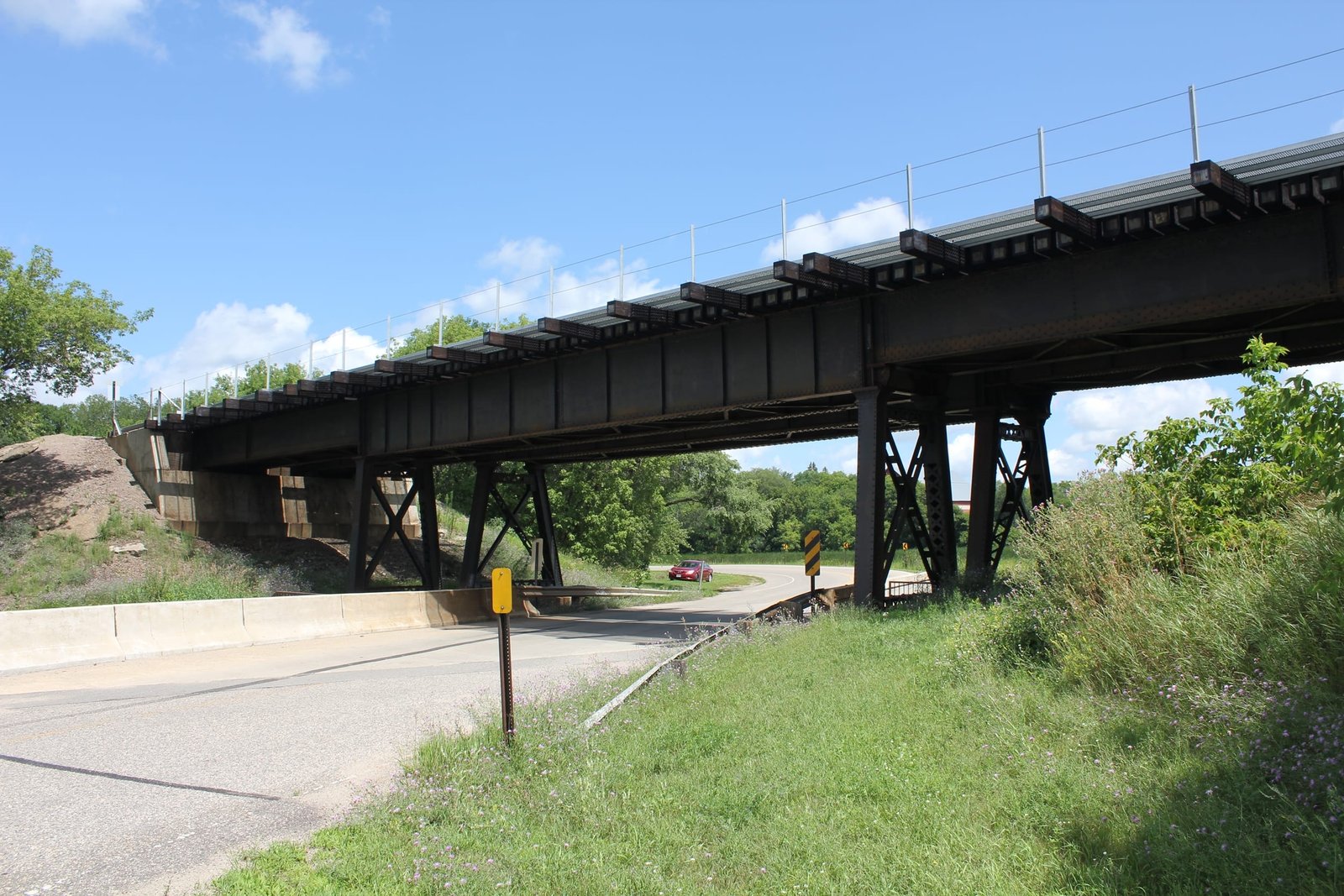
Located on the southeast side of Frazee, this deck plate girder viaduct carries the former Northern Pacific Railway over the Otter Tail River and River Drive. The first bridge at this location was likely a timber pile trestle. In 1896, the bridge would be reconstructed with a deck plate girder span, set onto concrete abutments and steel bents. During a double tracking project in 1906, the bridge would be widened by adding an identical structure to the south side of the bridge. Due to the increasing weight of locomotives, the original 1896 structure would be strengthened in 1911, giving the bridge its current configuration. The bridge consists of a 56-foot and two 36-foot deck pplate girder spans, set onto steel bents, concrete pedestals and concrete abutments. The girders use a standard design for the era, and steel towers were likely used to minimize the amount of masonry required for the bridge. Pencoyd Iron Works fabricated the north track superstructure, while an unknown contractor fabricated the south track spans. Railroad company forces constructed the north track substructure, and it is unclear if the south track substructure was constructed by railroad company forces or by an unknown contractor. While uncommon in this area of Minnesota, these small deck girder viaducts were commonly built across the United States, due to the ease of construction, economy and durability. Overall, this bridge appears to be in fair to good condition, with minor deterioration noted. The author has ranked this bridge as being locally significant, due to the common design.
Citations
| Build Date | Bridge Book at the Northern Pacific Railway Historical Association Archives |
| Builder (north track superstructure) | Northern Pacific Railway Engineering Department Records at the Minnesota Historical Society |
| Railroad History Citation | ICC Valuation Information, Compiled by Richard S. Steele |