


Click the photo to view the full-size version
| Name | CPKC Plymouth Avenue Bridge |
| Built By | Minneapolis, St. Paul & Sault Ste. Marie Railroad |
| Currently Owned By | Canadian Pacific Kansas City Limited |
| Superstructure Contractor | American Bridge Company of New York |
| Substructure Contractor | Trainor Brothers of Minneapolis, Minnesota |
| Length | 75 Feet Total, 45 Foot Main Span |
| Width | 1 Track |
| Height Above Ground | 12 Feet 8 Inches |
| Superstructure Type | Through Plate Girder and Steel Stringer |
| Substructure Type | Stone Masonry and Steel Bent |
| Date Built | 1900 |
| Traffic Count | Less than 1 Train/Day (Estimated) |
| Current Status | Open to Traffic |
| Significance | Local Significance |
| Documentation Date | 12/27/2017 |
ln In 1887, the Minneapolis and St. Croix Railway (M&StC) constructed 36 miles of new railroad between Shoreham, Minnesota and the St. Croix River near Osceola, Wisconsin. The line connected to ongoing Minneapolis, St. Paul & Sault Ste. Marie Railway (Soo Line) construction in Wisconsin. In 1888, 5 additional miles of new railroad would be constructed from Cardigan Junction to Soo Line Junction in St. Paul (near present day Arlington Avenue and Jackson Street). The M&StC would be purchased by the Soo Line in 1888. In 1890, a one mile extension would be constructed from the Northern Pacific Railway and Great Northern Railway tracks, across the Mississippi River to Camden Junction. In 1899, a new spur was built along the west bank of the Mississippi River to reach downtown Minneapolis. An additional extension would be made to Seventh Street in St. Paul in 1909. A new cutoff was constructed in 1911 between the Mississippi River Bridge and Central Avenue. By 1937, the Soo Line had entered bankruptcy, and it would be reorganized as the Minneapolis, St. Paul & Sault Ste. Marie Railroad in 1944.
By 1961, the Soo Line would be merged with other CP subsidiaries Duluth,
South Shore & Atlantic Railroad and Wisconsin Central Railroad to
form Soo Line Railroad, a company controlled by CP. In 1981, the southern mile from Soo Line Junction to Seventh Street would be abandoned. In 1984, the Soo
Line would be reorganized as the Soo Line Corporation, and the railroad
would be fully merged into CP in 1990. In 2023, CP would merge with Kansas City Southern Railway to form CPKC, which currently operates this route. The Minneapolis to Withrow segment of the line is known as the Withrow Subdivision.
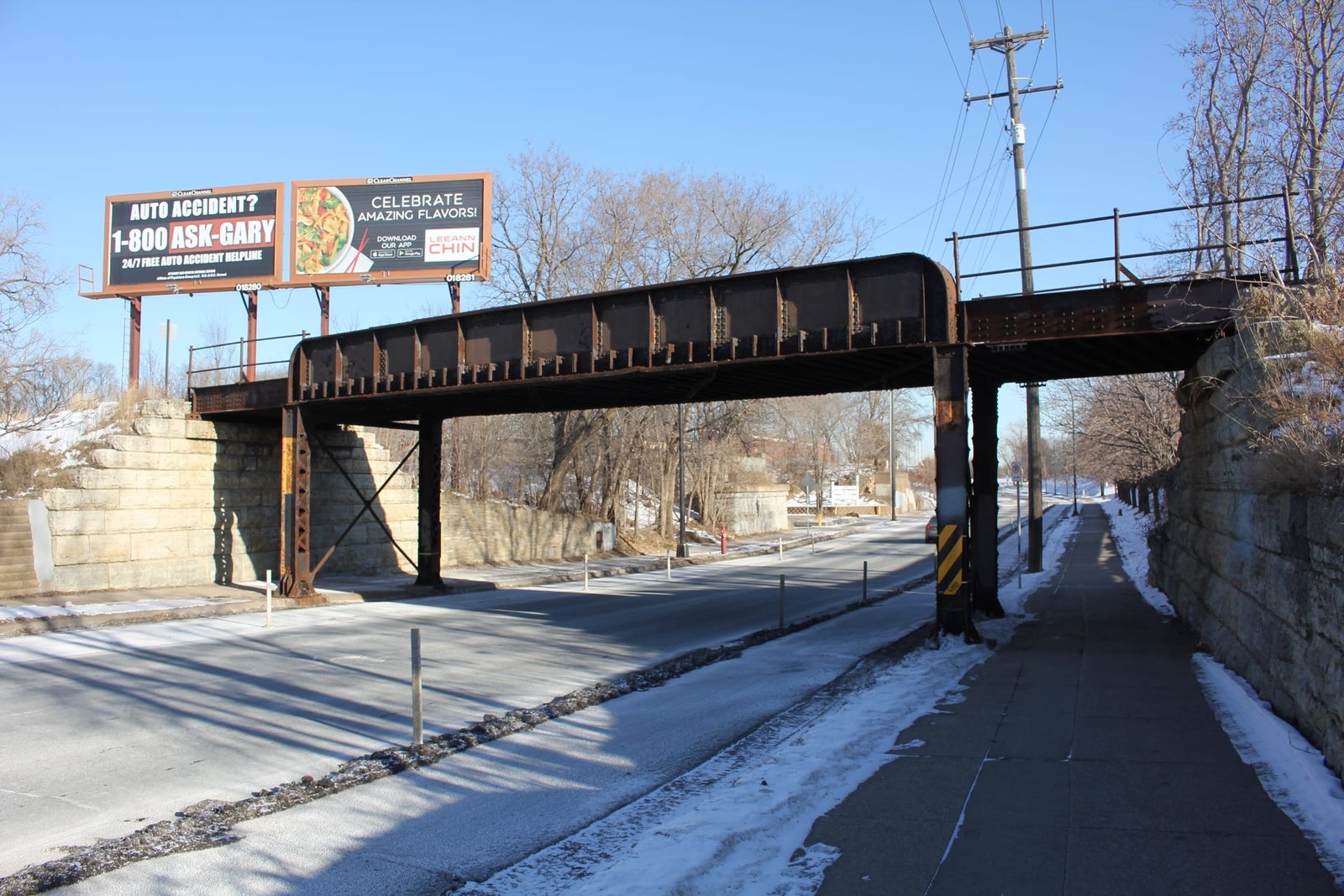
Located just north of downtown Minneapolis, this through plate girder bridge carries a former Soo Line spur over Plymouth Avenue. Originally, the Northern Pacific Railway and Chicago, St. Paul, Minneapolis & Omaha Railway (Omaha Road) operated sprawling terminal facilities near this location. The first bridge here was constructed in 1883, and consisted of a 126-foot pin-connected Pratt through truss span, built for the Northern Pacific Railway. Later in the 19th Century, the Omaha Road added three additional bridges further east. In 1900, the Soo Line constructed a short spur from north Minneapolis to open terminals in the same area. As part of the work, a single track through girder bridge would be constructed across Plymouth Avenue. The NP replaced its truss bridge in 1911 with a girder bridge, and reused the truss span at Grand Forks, North Dakota. The Omaha Road also rebuilt their bridges in the early 20th Century. The eastern two Omaha Road bridges were removed in the mid-1970s, and the western Omaha Road and NP bridges were removed in the mid-1980s, leaving the former Soo Line bridge as the sole remaining structure at this location.
Currently, the bridge consists of a 45-foot through plate girder span, approached by a 15-foot steel stringer span on either end. The bridge is set onto stone abutments and steel bents. The main span follows a standard design for the era, with two modest sized girders, rounded girder ends and a ballast deck floor composed of numerous parallel I-beams. The approach spans each use two shallow beams, which are located parallel to and above the floor. The floor system also consists of several parallel beams and a ballast deck. Each bent is composed of two V-laced columns, commected ny am X-bracing. The abutments use stepped wing walls, which extend parallel to the roadway. Stone for the abutments consists of a tan limestone, quarried at an unknown location. American Bridge Company fabricated the superstructure, while local contractor Trainor Brothers constructed the abutments. Through plate girder spans were popular for railroad use, as they were durable and easy to construct. Solid floor spans became popular around the turn of the 20th Century, especially after being introduced for track elevation projects in Chicago. Since the initial construction, the bridge has seen no significant alterations. Today, the bridge is rarely used, and will likely be abandoned in the future. Overall, the bridge appears to be in fair condition, with no significant deterioration noted. The author has ranked the bridge as being locally significant, due to the common design.
small through plate girder carries a CPKC spur across Plymouth Avenue. Originally built in 1900, the bridge features a single through plate girder span, approached by steel stringer spans on either end. The bridge sits on stone abutments and steel bent piers. This type of grade separation is typical of early grade separations across America. At one time, the Northern Pacific and the Chicago, St. Paul, Minneapolis & Omaha had parallel bridges across Plymouth Avenue at this location. Those bridges were removed between 1984 and 1991. Overall, the bridge appears to be in fair to poor condition, with significant deterioration throughout the bridge. As of 2023, the bridge is only serving a spur to the Star Tribune building, and appears to be out of service. The author has rated the bridge as being locally significant, due to the common design.Citations
| Build date and builder (superstructure) | Soo Line Historical and Technical Society Archives |
| Builder (substructure) | The Minneapolis Journal; April 23, 1900 |
| Railroad History Citation | ICC Valuation Information, Compiled by Richard S. Steele |