
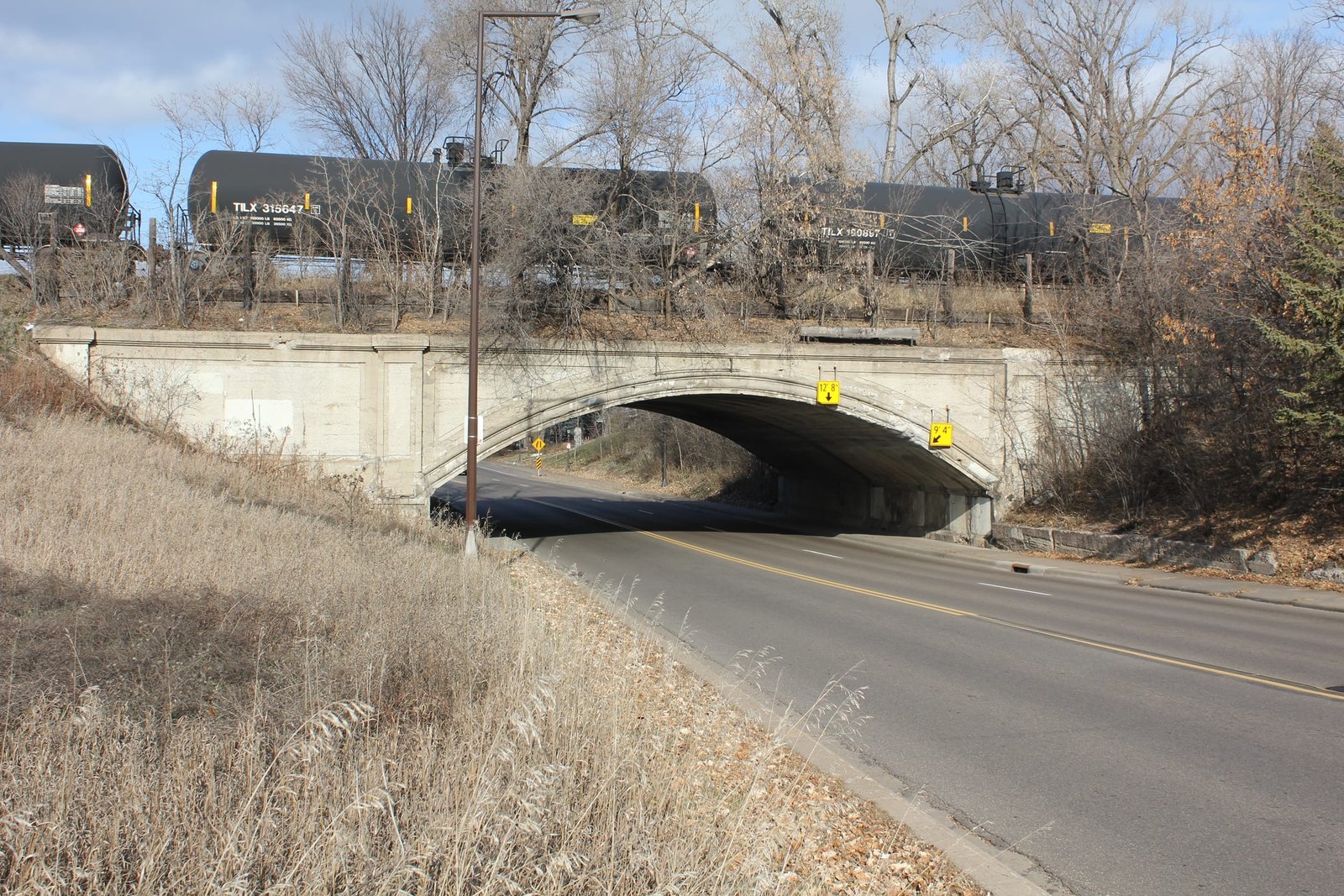


Click the photo to view the full-size version
| Name | BNSF Lexington Parkway Bridge Northern Pacific Railway Bridge #4.1 |
| Built By | Northern Pacific Railway |
| Currently Owned By | BNSF Railway |
| Builder | Northern Pacific Railway St. Paul Division Forces |
| Length | 50 Feet Total |
| Width | 4 Tracks, 2 In Use (72 Feet) |
| Height Above Ground | 13 Feet |
| Superstructure Type | Closed Spandrel Concrete Arch |
| Substructure Type | Concrete |
| Date Built | 1908 |
| Traffic Count | 50 Trains/Day (Estimated) |
| Current Status | Open to Traffic |
| Northern Pacific Railway Bridge Number | 4.1 |
| BNSF Railway Bridge Number | 4.9 |
| Significance | Moderate Significance |
| Documentation Date | 8/26/2015 |
In 1885, the Saint Paul and Northern Pacific Railway Company (StP&NP) began construction on five separate lines in Minneapolis. Line "A" would extend from Seventh Street in St. Paul to 20th Street in Minneapolis, crossing the Mississippi River twice. Line "B" would extend from St. Anthony Junction (near present day MN-280 and Kasota Avenue) to Northtown Junction. Line "C" would extend along Ramsey Street from Line "A" to Plymouth Avenue. Line "D" consisted of a 1 mile long industrial line along 2nd Street. Line "E" consisted of a connection between Line "A" and Line "C" along Mulberry Street. Work on the five lines would be completed in 1886.
The StP&NP would be purchased by the Northern Pacific Railway (NP) in 1896. NP continued to operate these lines as part of their vast Twin Cities network. Portions of line "C" would be abandoned in the 1960s. In 1970, NP would merge with rival Great Northern Railway and the Chicago, Burlington & Quincy to form Burlington Northern Railroad (BN). Line "E" would be abandoned during the 1970s. Portions of line "A" through downtown Minneapolis were removed during the 1980s, and Bridge #9 was purchased by the City of Minneapolis for trail use. In 1996, BN merged with the Atchison, Topeka & Santa Fe Railway to form BNSF Railway. BNSF currently owns line "A" and line "B" as part of the St. Paul Subdivision. The northern portions of Line "A" are also used by BNSF as a spur to serve the Cemstone plant. Lines "C" and "D" have largely been developed, and line "E" has become part of a trail.
Located on the west side of St. Paul, this attractive concrete arch bridge carries a former Northern Pacific Railway mainline over Lexington Parkway near Como Park. In the early 20th Century, the City of St. Paul undertook a series of beautification projects throughout the city to improve parks and transportation. One of the selected projects was to extend Lexington Avenue north to Como Park, using a wide parkway design. After several years of negotiations with the railroad, work on this bridge began in 1907 and was completed in 1908. Currently, the bridge consists of a 50-foot closed spandrel concrete arch bridge, set onto concrete substructures and constructed for four tracks at a width of 72 feet. The superstructure follows a modified standard design, with a semicircular arch and short headwalls. The arch shape has a relatively shallow rise, to maximize clearance underneath and minimize grading required on the railroad. The substructures use a U-shaped design, typical of bridges from this era. In addition, several decorative features are notable throughout the bridge. Based on the use of several construction joints in the arch line, it is believed that the bridge was constructed in segments, possibly by a movable form. The bridge was constructed by St. Paul Division forces, employed by the Northern Pacific Railway. Concrete arch bridges became popular at the turn of the 20th Century, as they were durable, cost effective and easy to construct. Since the initial construction, the bridge has seen no significant alterations. Today, the center two tracks remain in use as part of a heavily used BNSF Railway mainline. Overall, the bridge appears to be in fair condition, with spalling noted throughout the structure. These defects are mainly cosmetic, and the author believes the bridge could potentially be repaired and restored to its original appearance. The author has ranked this bridge as being moderately significant, due to the size of the arch and decorative nature of the structure.
Citations
| Build Date | St. Paul Division Bridge Book at the Northern Pacific Railway Historical Association Archives |
| Railroad History Citation | ICC Valuation Information, Compiled by Richard S. Steele |