
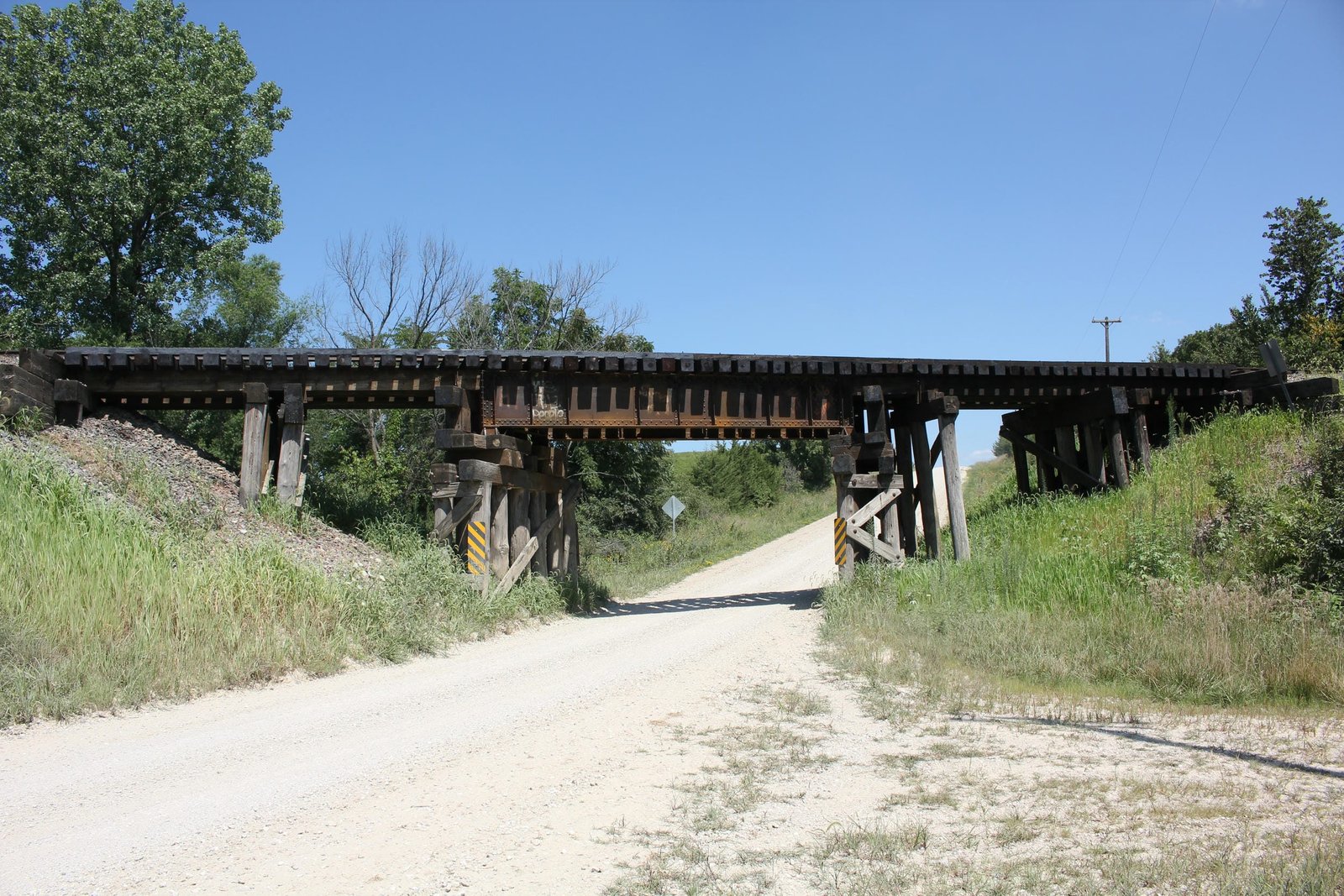


Click the photo to view the full-size version
| Name | UP County G48 Bridge Chicago, Rock Island & Pacific Railroad Bridge #482 |
| Built By | Chicago, Rock Island & Pacific Railway |
| Currently Owned By | Union Pacific Railroad |
| Superstructure Contractor | Unknown |
| Length | 88 Feet Total, 25 Foot Main Span |
| Width | 1 Track |
| Height Above Ground | 12 Feet 0 Inches |
| Superstructure Design | Deck Plate Girder and Timber Pile Trestle |
| Substructure Design | Timber Pile |
| Date Built | c. 1940, Using a Span Fabricated c. 1900 |
| Original Location | Unknown |
| Traffic Count | 10 Trains/Day (Estimated) |
| Current Status | In Use |
| Chicago, Rock Island & Pacific Railroad Bridge Number | 482 |
| Union Pacific Railroad Bridge Number | 48.21 |
| Significance | Local Significance |
| Documentation Date | 8/4/2019 |
In 1871, the Chicago & South Western Railway constructed 61 miles of new railroad between Shearwood, Missouri and Allerton, Iowa, as part of a larger project to construct a line between Leavenworth, Kansas and Washington, Iowa. In 1873, the Des Moines, Indianola & Missouri Railroad (DMI&M) constructed a 21 mile railroad line, extending from Des Moines, Iowa south to Avon, Iowa; and west to Indianola, Iowa. Both railroads would be sold to the Iowa Northern & Missouri Southern Railroad in 1876, which was merged into the Chicago, Rock Island & Pacific Railway in 1880. The Rock Island had acquired and constructed a network of railroads, particularly in Iowa. This route served as a branch line to a small town near Des Moines. During the 1880s and 1890s, the Rock Island expanded westwards, reaching Colorado and New Mexico. Additions to the system during the early 1900s included a number of new lines in Minnesota and northern Iowa. In 1911, the St. Paul & Kansas City Short Line Railroad, a subsidiary of the Rock Island, constructed 65 miles between Avon, Iowa and Allerton, Iowa; connecting the two lines. This new line was built as part of a larger project to connect the northern and southern portions of the system. To reach Kansas City, the Rock Island utilized trackage rights over the Chicago, Burlington & Quincy Railroad from Cameron Junction to Kansas City. In 1931, the Rock Island constructed a new line from near Trenton to Birmingham, located just outside of Kansas City. From Polo to Birmingham, the route would parallel the Chicago, Milwaukee, St. Paul & Pacific Railroad tracks, and the two railroads operated as a double track route, with separate mainlines. In 1945, a new bridge across the Missouri River was jointly constructed by the two railroads.
The Rock Island had constructed and acquired a large railroad network
throughout the Midwest. The Kansas City-Des Moines-St. Paul route would become known as the "Spine Line". After World War II, the Rock Island struggled
to survive, proposing
mergers and deferring maintenance on their routes. The Rock Island
struggled to compete with a stronger and better constructed Union
Pacific system. By 1964, the Rock Island began attempts to merge with
Union Pacific, and
restructure railroads west of the Mississippi River. This merger was
eventually denied, and Rock Island turned its last profit in 1965. In
the mid-1970s, the railroad was in serious decline. The railroad
received loans to attempt to fix slow orders, received new equipment and
turn a profit. By 1978, the railroad came close to profit, but
creditors were lobbying for a complete shutdown of the Rock Island.
During the fall of 1979, a strike crippled the railroad, and by January
of 1980, the entire system was ordered to be shut down and liquidated.
Many of the lines and equipment were scrapped. Profitable sections of
railroad were prepared for sale. The Chicago & North Western Railway (C&NW) and Soo Line both had
interest in the Spine Line, with the C&NW eventually purchasing the
route. During 1982 and 1983, significant money was allocated for
rebuilding the deteriorated route, and trains began using the route. In
1995, C&NW was purchased by Union Pacific Railroad (UP). Union
Pacific continues to operate this route as the Trenton Subdivision. CPKC now operates the former Milwaukee Road portion of this segment.
View an article discussing the construction of this line (digitized by Google)
Located south of Pleasantville, this deck plate girder bridge carries a former Chicago, Rock Island & Pacific Railroad (Rock Island) mainline over County Road G48 (Lisbon Street). Little is known about the history of this bridge. The first bridge at this location was likely a timber pile trestle bridge, constructed when the line was first built. In the 1930s and 1940s, the Rock Island upgraded several timber bridges along this line, rebuilding them with both new and secondhand steel spans. In approximately 1940, the present steel center span was installed. After the C&NW took over this line, the approaches were likely rebuilt with new material, retaining the center span. Currently, the bridge consists of a 25-foot deck plate girder span, approached by four timber pile trestle spans on the south end and three timber pile trestle spans on the north end. The entire bridge sits on timber pile substructures, and runs at a significant skew. The main span appears to have been fabricated in approximately 1900 for use at an unknown location. Upon installation here, it appears that the main span was altered into a skew, possibly using new X-frame bracings. The main span uses a typical design for the era, with two modest sized girders and an open deck. The approaches also use a standard design, with an open deck, round piles and typical bents. An unknown contractor fabricated the main span, while it is believed the timber components were constructed by railroad company forces. Deck plate girder spans were often used by railroads, as they were durable and easy to construct. Railroads often reused steel and iron spans, as it provided a cost effective way to build bridges without requiring a significant amount of new materials. Since the initial construction, the bridge has seen no significant alterations. Today, it is used as part of a Union Pacific Railroad mainline. Overall, the bridge appears to be in fair to poor condition, with section loss to the main span and a snapped X-frame bracing at the time of documentation. Many similar bridges along this line were replaced in approximately 2015, and the future of this bridge is uncertain. The author has ranked this bridge as being locally significant, due to the common design and unknown history.
Citations
| Railroad History Citation | ICC Valuation Information, Compiled by Richard S. Steele |