
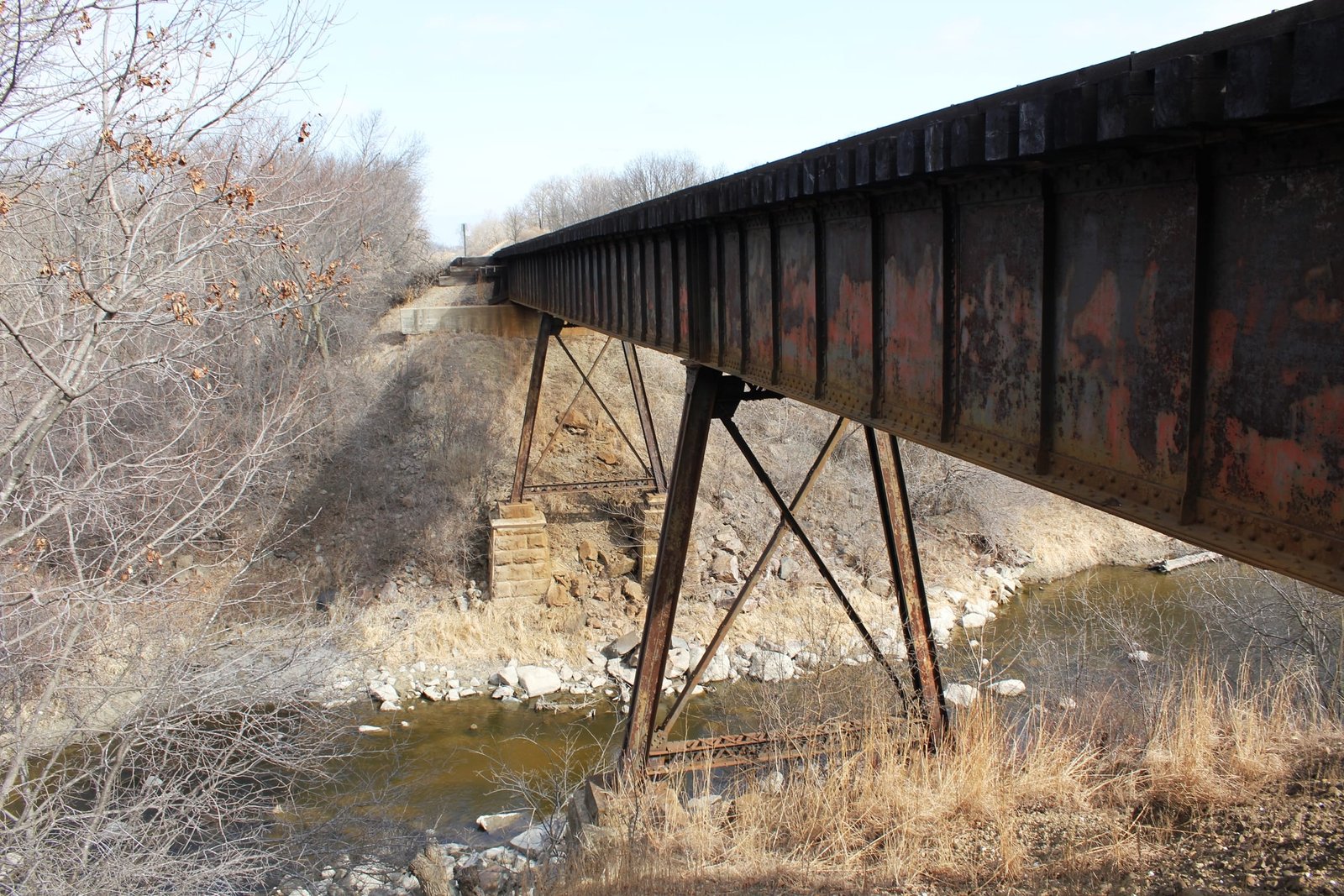


Click the photo to view the full-size version
| Name | BNSF Redwood River Bridge #5 Great Northern Railway Bridge #72.6 |
| Built By | Great Northern Railway |
| Currently Owned By | BNSF Railway |
| Superstructure Contractor | American Bridge Company of New York |
| Substructure Contractor | Unknown |
| Length | 208 Feet Total, 67 Foot Largest Span |
| Width | 1 Track |
| Height Above Ground | 40 Feet (Estimated) |
| Superstructure Design | Deck Plate Girder and Timber Pile Trestle |
| Substructure Design | Stone Masonry, Steel Tower, Concrete and Timber Pile |
| Date Built | 1902, Approaches Rebuilt 1951 |
| Traffic Count | 10 Trains/Day (Estimated) |
| Current Status | Open to Traffic |
| Great Northern Railway Bridge Number | 72.6 (Old #130) |
| BNSF Railway Bridge Number | 72.6 |
| Significance | Local Significance |
| Documentation Date | 3/18/2012 |
In 1887, the Willmar and Sioux Falls Railway Company (W&SF) began construction on a new 147 mile railroad line between Willmar, Minnesota and Sioux Falls, South Dakota. Construction would be completed by 1888. The following year, the Sioux City and Northern Railroad (SCN) Company began construction on 96 miles of new railroad, starting at Garretson, South Dakota and extending south to Sioux City, Iowa. An additional extension would be made in 1893, when the Sioux Falls, Yankton and South Western Railway Company (SFY&SW) constructed 58 miles of new railroad to Yankton, South Dakota. The SFY&SW would be sold to the W&SF in 1893, and the SCN would be sold to the W&SF in 1900. In 1907, Great Northern Railway (GN) purchased the W&SF. GN built and acquired an extensive railroad network throughout Minnesota.
GN operated this route as a mainline. The Sioux City leg of the route provided an important and competitive connection for stock yards at Sioux City to the Twin Cities. In 1970, GN merged with rival Northern Pacific Railway and Chicago, Burlington & Quincy Railroad to form Burlington Northern Railroad. The segment between Yankton and Irene was abandoned in 1981, and the segment between Irene and Sioux Falls was abandoned in 1982. BN was in turn merged with Atchison, Topeka & Santa Fe Railway in 1996, to form BNSF Railway. BNSF currently operates the Marshall Subdivision over the Willmar to Sioux City segment of this line, and the Corson Subdivision over the Garretson to Sioux Falls segment of this line.
Located in Camden State Park north of Russell, this deck girder viaduct is the fifth bridge carrying a former Great Northern Railway mainline across the Redwood River. The first bridge at this location likely consisted of a large timber pile trestle bridge, constructed when the line was first built. Around the turn of the 20th Century, the GN invested significant capital into this line, replacing timber bridges with steel, stone and concrete structures. In 1902, a new deck plate girder viaduct supported by stone substructures was constructed at this location. In 1950, the ends of the bridge were reconstructed with timber pile trestle spans to stabilize the slopes, giving the bridge its present configuration. Currently, the bridge consists of one 67-foot and two 48-foot deck plate girder spans, approached by two timber pile trestle spans on either end. The bridge is set onto steel bents, stone footings, concrete abutments and timber pile bents. The main spans follow a standard design, with two heavy plate girders per span and an open deck. The bents are formed by two posts, which form an "A" shape. These posts are constructed of two parallel channels, which are connected by a V-laced beam at the top and bottom and solid bar lateral bracing. The pedestals consist of massive stone blocks, which are square. Originally, the abutments likely consisted of a standard design with stepped diagonal wing walls. When the bridge was altered in 1950, the original abutments were converted to piers and encased with concrete. Stone for the substructures consists of Kettle River sandstone, likely quarried at Sandstone, Minnesota. American Bridge Company fabricated the superstructure, while unknown contractors constructed the stone pedestals and concrete abutments. Deck plate girder spans were popular for railroad use, as they were durable and easy to construct. Several similar viaducts were constructed along this line, as deck girder viaducts provided the most economical design for long and tall bridges. Today, the bridge remains in regular use. Overall, the bridge appears to be in fair to good condition, with no significant deterioration noted. The author has ranked the bridge as being locally significant, due to the common design.
Citations
| Build date and builder (superstructure) | Great Northern Willmar Division Bridge Index, located at the Minnesota Historical Society |
| Railroad History Citation | ICC Valuation Information, Compiled by Richard S. Steele |