
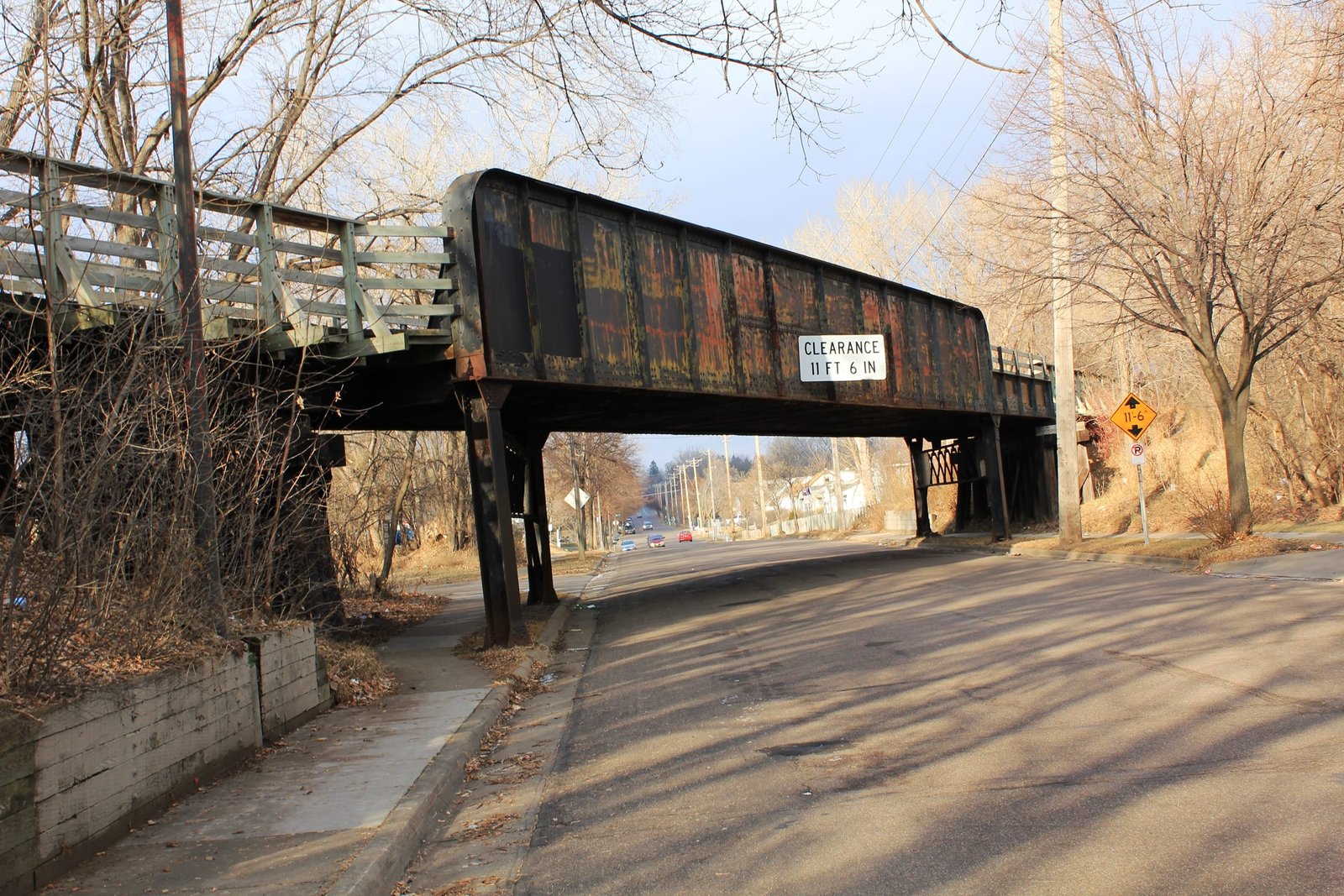


Click the photo to view the full-size version
| Name | Gateway State Trail - Westminster Street Bridge |
| Built By | Minneapolis, St. Paul & Sault Ste. Marie Railway |
| Currently Owned By | Minnesota Department of Natural Resources (DNR) |
| Superstructure Contractor | Wisconsin Bridge & Iron Company of North Milwaukee, Wisconsin |
| Length | 210 Feet Total, 92 Foot Main Span |
| Width | 1 Track |
| Height Above Ground | 11 Feet 6 Inches |
| Superstructure Design | Through Plate Girder and Timber Pile Trestle |
| Substructure Design | Steel Bent and Timber Pile |
| Date Built | 1919 |
| Date Replaced | 2023 |
| Traffic Count | 0 Trains/Day (Bridge has been Replaced) |
| Current Status | Replaced by a new bridge |
| Significance | Local Significance |
| Documentation Date | 12/17/2011; 7/2/2017 |
In 1880, the Wisconsin and Minnesota Railroad (W&M) would complete 54 miles of new railroad extending from Abbotsford to Chippewa Falls, Wisconsin. By 1885, 109 additional miles would be completed from Chippewa Falls to St. Paul, Minnesota. In 1888, the W&M would be acquired by the Wisconsin Central Railroad, which would be renamed the Wisconsin Central Railway (WC) in 1899. The WC had previously completed a mainline, extending from Chicago to Abbotsford. In 1909, the WC would be leased by the Minneapolis, St. Paul & Sault Ste. Marie Railway (Soo Line), which itself was controlled by the Canadian Pacific Railway (CP). The Soo Line had constructed a large network of railroads, connecting the Upper Midwest with Canadian Railroads.
In 1910, the WC began a series of projects to reconstruct the route. The largest project was a new 18-mile alignment between Withrow and New Richmond, Wisconsin and the bridge over the St. Croix River, which opened in 1911. This new alignment reduced the amount of grades and curves, and provided a connection to the Soo Line tracks at Withrow. Additional relocations included 19 miles between Owen and Spencer which bypassed Abbotsford, and 11 miles between Colfax and Howard. The old St. Croix River bridge would be scrapped in 1916, the Abbotsford to Curtiss segment abandoned in 1934, and the Curtiss to Owen segment abandoned in 1938. By 1961, the WC, Soo Line and Duluth, South Shore & Atlantic would be merged to form Soo Line Corporation, a holding company controlled by Canadian Pacific Railway. The segment between St. Paul and Carnelian Junction would be abandoned in 1980, and acquired by the Minnesota DNR. In 1984, the Soo Line would be reorganized as the Soo Line Corporation in advance of a pending purchase of the Chicago, Milwaukee, St. Paul & Pacific Railroad (Milwaukee Road).
After the Soo Line acquired the Milwaukee Road in 1986, this route became less important, as the Milwaukee Road purchase provided Soo with additional connections between Chicago and St. Paul. In 1987, the route would be sold to Wisconsin Central, Ltd. Known as the "new" Wisconsin Central, the railroad acquired several excess rail lines from the Soo Line and C&NW, before being acquired as the American subsidiary of Canadian National Railway in 2001. Today, the Gateway Trail utilizes the line between Carnelian Junction and St. Paul, while CN operates the remainder of the line as the Minneapolis Subdivision, part of the principal CN connection between Minneapolis and Chicago.
Located east of Interstate 35E, large through plate girder bridge once carried a former Minneapolis, St. Paul & Sault Ste. Marie Railway (Soo Line) mainline across Westminster Street. The first bridge at this location was likely a timber pile trestle bridge, constructed in the late 19th or early 20th century. In 1919, the bridge was reconstructed with a new through plate girder bridge. The bridge consisted of a heavily skewed 92-foot and 28-foot through plate girder span, set onto steel bents and approached by timber pile trestle spans on either end. The superstructure followed a continuous design, with one large girder and one small girder on each face. The larger girder consisted of two massive plate girders with rounded ends and a floor constructed of several parallel beams, while the smaller girders were considerably shallower with square girder ends. The smaller girder was used to give the span a relatively square end and was placed across from the end of the larger girder on the opposite face. The two spans were supported by a steel bent, which was placed from one end of the large girder to the joint between small and large at the opposite face. This pier was made up of two large columns, connected by a lattice beam at the top and set onto concrete pedestals. At each end, a triangular timber brought the ends of the bridge back to square, and multiple timber pile trestle spans were used at either end. Wisconsin Bridge & Iron Company fabricated the superstructure, while the timber components were likely constructed by railroad company forces. Through plate girder spans were popular for railroad use, as they were durable, versatile and easy to construct. Heavy skews could easily be overcome by using complex span geometry, such as was seen in this bridge. After abandonment, the bridge was reused as part of the Gateway State Trail, and a wooden deck and railings were added to the bridge. In 2023, the bridge was replaced by a prefabricated pedestrian bridge. The bridge was replaced by a Overall, the bridge appeared to be in fair to poor condition at the time of replacement, with some deterioration to the substructures. The author has ranked this bridge as being locally significant, due to the common design.
Citations
| Builder and build date | Wisconsin Bridge & Iron Company plaque |
| Railroad History Citation | ICC Valuation Information, Compiled by Richard S. Steele |