
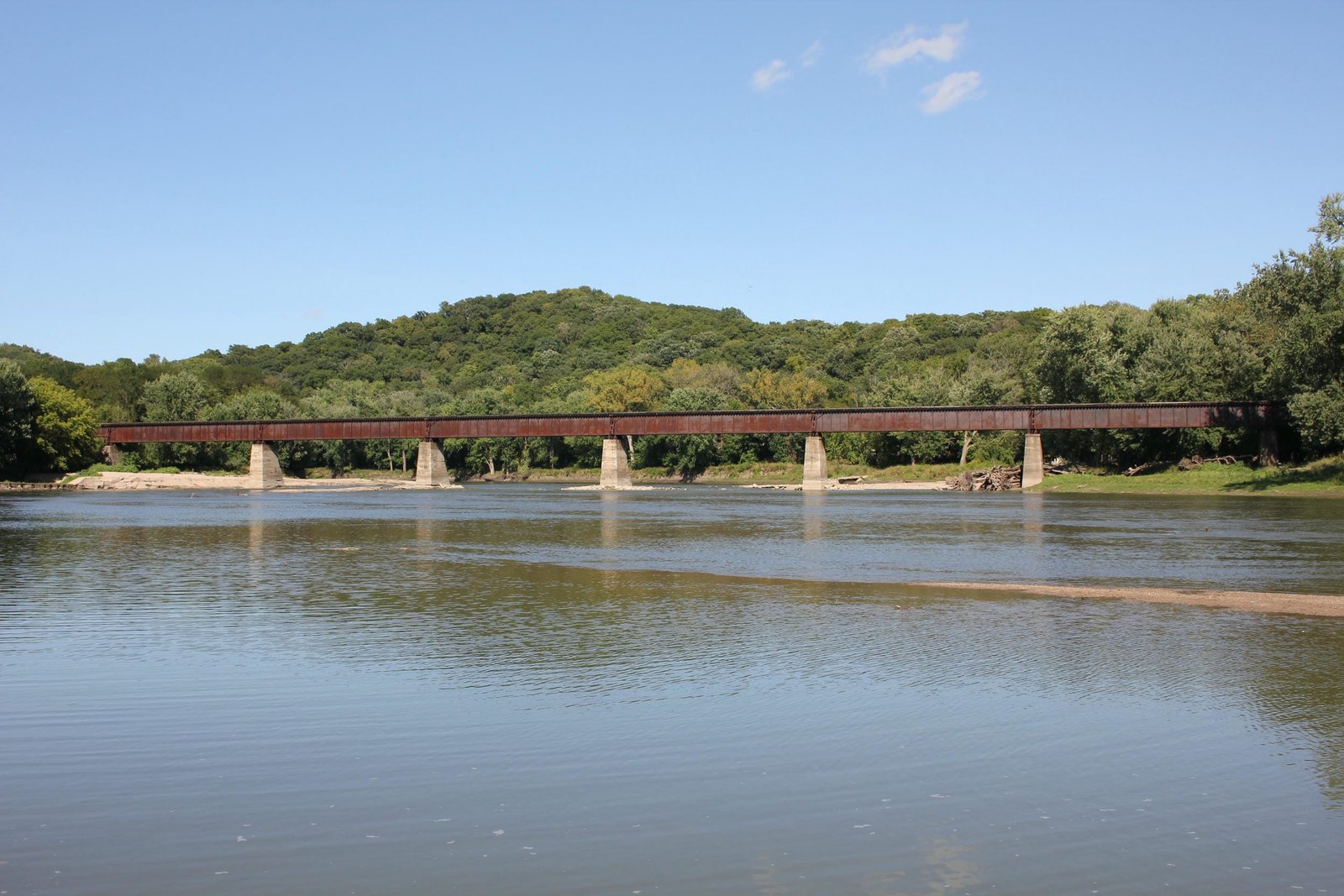


Click the photo to view the full-size version
| Name | BSVY Des Moines River Bridge |
| Built By | Fort Dodge, Des Moines & Southern Railroad |
| Currently Owned By | Boone and Scenic Valley Railroad |
| Superstructure Contractor | American Bridge Company of New York |
| Substructure Contractor | Ferro Construction Company of Chicago, Illinois (South Abutment and Piers #5, #6 and #7) Unknown (North Abutment and Piers #1 Through #4) |
| Consulting Engineer | William M. Hughes |
| Length | 732 Feet Total, 96 Foot Main Spans |
| Width | 1 Track |
| Height Above Ground | 20 Feet (Estimated) |
| Superstructure Design | Deck Plate Girder |
| Substructure Design | Concrete |
| Date Built | 1915 and 1923 |
| Traffic Count | 2 Trains/Day (Estimated) |
| Current Status | In Use |
| Significance | Moderate Significance |
| Documentation Date | 8/22/2017 |
In the late 19th and early 20th Centuries, electric interurban railways became popular throughout the United States, particularly in suburban and rural areas. In rural areas, the interurban represented a reliable form of transportation, independent of the steam railroads. Unlike other interurbans in the United States, the Fort Dodge, Des Moines and Southern Railroad (FDDM&S) began as a series of small coal hauling railroads in central Iowa. In 1876, the Crooked Creek Railroad (CCR) constructed a short narrow gauge line, extending from the Dubuque & Sioux City Railroad (Illinois Central Railroad) mainline east of Fort Dodge, Iowa to coal mines near Lehigh, Iowa. In 1886, the Webster City & Southwestern Railroad (WC&SW) constructed a 14-mile line between the CCR near Lehigh and Webster City, Iowa, and the CCR was standard gauged at this time. The WC&SW purchased by the CCR in 1890 to streamline operations. In 1893, the Boone Valley Coal & Railway Company (BVCRC) constructed a short line, extending from Fraser, Iowa to the Minneapolis & St. Louis Railway west of Fraser. The owners of the BVCRC charted the Marshalltown & Dakota Railway (M&D) in 1899 to further expand the coal line. A segment between Fraser and Gowrie, Iowa was completed that year. The railroad was renamed the Newton & Northwestern (N&NW) in 1902. A large segment between Newton, Iowa and Rockwell City, Iowa (using the Fraser to Gowrie line); as well as a branch to Colfax, Iowa were opened in 1905. The railroad was sold to new owners in 1905, and renamed the Fort Dodge, Des Moines and Southern Railroad (FDDM&S).
After the FDDM&S was formed, the new owners realized the potential In 1906, the FDDM&S purchased the Ames & College Street Railway (A&C); and constructed a new mainline into Ames. The A&C had been constructed between 1890 and 1891 to connect downtown Ames to the Iowa State University campus. Electrified lines were opened between Des Moines and Midvale, Iowa and between Boxholm, Iowa and Fort Dodge in 1907. In 1911, the Midvale to Newton line was abandoned, rendering much of the system electrified. Also in 1911, a segment of the line near Ankeny, Iowa was relocated to be roughly parallel to the existing Chicago & North Western Railway (C&NW) line and better serve interchange partners. The original line south of Ankeny was abandoned the next year. In 1916, the CCR was formally purchased by the FDDM&S. A short segment between Fort Dodge and Brushy, Iowa was opened in 1917 to serve gypsum mines in the area. The FDDM&S was successful during the early 20th Century, due to its many steam railroad interchange partners and focus on both passenger service and freight. In 1930, the FDDM&S entered receivership, and reemerged as the Fort Dodge, Des Moines & Southern Railway (FDDM&S) in 1942.
By the mid-20th Century, operations over the railroad were beginning to slow down. In 1954, the FDDM&S fell under control of the Des Moines & Central Iowa Railway (DCI), and in 1955 passenger service ended and the line was converted to diesel locomotives. In 1962, the lines towards Lehigh were abandoned. In 1965, the Gowrie to Rockwell City segment and the Ames branch were abandoned. In 1968, the FDDM&S and DCI were acquired by the C&NW. The C&NW operated parallel tracks at many points, rendering the FDDM&S lines excess. The Boxholm to Gowrie segment was abandoned in 1972, and the Webster City branch was abandoned in 1979. In 1983, the C&NW sought to abandon the remainder of the line, except for a short segment on the north side of Des Moines. A 12-mile section between Boone and Fraser Junction was sold to a private group in 1983, and the Boone & Scenic Valley Railroad (B&SV) was formed to begin tourist operations over the line. In 1995, the C&NW was purchased by Union Pacific Railroad (UP). Today, the B&SV continues to be a major attraction as a tourist railroad, and operates the segment between Boone and Fraser Junction. UP still owns segments on the north side of Des Moines and east side of Fort Dodge. The remainder of the line has been abandoned and largely reverted to adjacent property owners.
View a historic article discussing the construction of this bridge (digitized by Google)
Located south of Fraser, this large deck plate girder bridge carries a former Fort Dodge, Des Moines & Southern Railroad line over the Des Moines River. The first bridge at this location was constructed in 1903, and consisted of an entirely timber structure. This bridge had one 150-foot and two 104-foot combination Howe through truss spans, set onto timber pile piers and approached by 568 feet of timber pile trestle approach on the south end and 124 feet of timber pile trestle approach on the north end. Combination trusses were popular in the 19th Century, and used timber compression members with iron rod tension members. By 1910, the railroad began a program to upgrade the remaining timber bridges along the line. Between late 1914 and early 1915, the southern 280 feet of approach was filled, and three new deck plate girder spans installed on three new concrete piers and a concrete south abutment. It was originally intended to replace the truss spans soon after, but this project was delayed for several years. In 1923, the remainder of the bridge was reconstructed with five additional deck plate girder spans, set onto four concrete piers and a concrete north abutment.
Currently, the bridge consists of seven 96-foot deck plate girder spans and a 60-foot deck plate girder span on the north end. The entire bridge is set onto concrete substructures, which are founded on timber piles. The 96-foot spans use a standard design, with two heavy plate girders and an open deck; while the 60-foot span uses slightly shallower girders. The southern three piers (piers #5, #6 and #7) use a rectangular shape, while the northern four piers (piers #1 through #4) use a rectangular shape with an angled upstream nose. The two abutments use slightly different standard designs, with the south abutment using sloped wing walls which extend diagonally from the bridge and the north abutment using sloped wing walls which extend perpendicular to the bridge. American Bridge Company fabricated all eight spans, which were shipped to the site and assembled upon installation. Ferro Construction Company constructed the south abutment and piers #5, #6 and #7; while an unknown contractor constructed the north abutment and piers #1 through #4. The bridge was designed by William M. Hughes, who served as a consulting engineer for the FDDM&S. Hughes had served as a consulting engineer for several interurban projects in the Midwest, and also had designed portions of the "L" system in Chicago.
Deck plate girder spans were popular for railroad use, as they were durable and easy to construct. In 1982, the Chicago & North Western Railway planned to abandon and scrap this line. A local group called "Save The Tracks" used $50,000 in donations to acquire the railroad line between Boone and Fraser, and the Boone and Scenic Valley Railroad (BSVY) began operations in October 1983. The BSVY was created to preserve historic railroad equipment and offer tourist rides over the scenic line. Today, the bridge remains a highlight of the railroad, which continues to see thousands of visitors every year. Since the 1923 construction, the bridge has seen no significant alterations, and remains in use. Overall, the bridge appears to be in fair to good condition, and appears to be well maintained. The author has ranked this bridge as being moderately significant, due to the size of the main girders.
Citations
| Build date and superstructure builder (spans #6, #7 and #8) | Engineering News; Volume 75, Issue 21 |
| Builder (piers #5, #6 and #7 and south abutment) | Engineering News; Volume 75, Issue 23 |
| Build date and superstructure builder (spans #1 through #5) | American Bridge Company plaque |
| Railroad History Citation | ICC Valuation Information, Compiled by Richard S. Steele |