

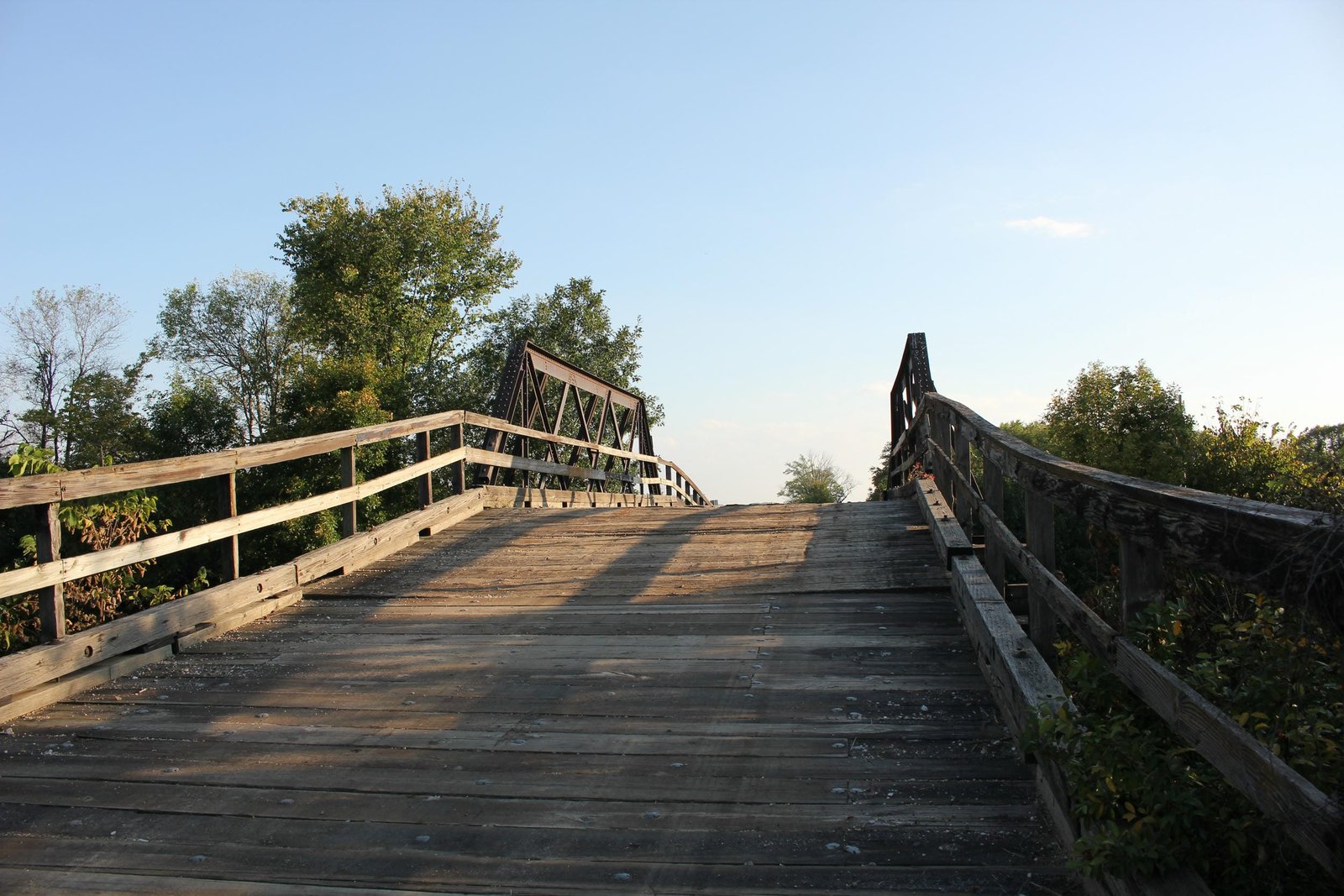


Click the photo to view the full-size version
| Name | L Avenue Overpass Chicago & North Western Railway Bridge #613 |
| Built By | Chicago & North Western Railway |
| Currently Owned By | Union Pacific Railroad |
| Superstructure Contractor | Alden and Lassig Bridge & Iron Works of Chicago, Illinois Unknown (1900 Reconstruction) |
| Substructure Contractor | Widell Company of Mankato, Minnesota Unknown (Concrete Encasement) |
| Length | 130 Feet Total, 49 Foot Main Span |
| Width | 18 Feet |
| Height Above Ground | 25 Feet (Estimated) |
| Superstructure Design | Double Intersection Warren Pony Truss and Timber Pile Trestle |
| Substructure Design | Stone Masonry, Concrete and Timber Pile |
| Date Built | 1900, Using a Span Fabricated 1882 |
| Original Location | Bridge #1657; Cedar Creek Bridge; Jackson, Wisconsin |
| Traffic Count | 40 Vehicles/Day (2019) |
| Current Status | Open to Automobile Traffic |
| Chicago & North Western Railway Bridge Number | 613 |
| Union Pacific Railroad Bridge Number | 206.64 |
| Significance | High Significance |
| Documentation Date | 9/23/2016 |
In 1867, the Cedar Rapids & Missouri River Railroad (CR&MR) continued constructing a mainline westward from Boone, Iowa. In the late 1850s and early 1860s, the CR&MR had participated in constructing a line from Clinton, Iowa to Boone. The CR&MR was leased by the Chicago & North Western Railway (C&NW), which was seeking a route connecting Chicago to the Missouri River. In 1867, an impressive 150 miles were constructed between Boone, Iowa and Council Bluffs, Iowa, completing a connection between Chicago and the Missouri River. The line also allowed for a short spur from Missouri Valley, Iowa to the Missouri River opposite of Blair, Nebraska. This spur would eventually be extended across the Missouri River and into Nebraska. Between 1869 and 1872, Union Pacific Railroad (UP) constructed a bridge across the Missouri River between Council Bluffs and Omaha, Nebraska; and the C&NW obtained trackage rights over the bridge to reach Omaha. During the second half of the 19th Century, the C&NW had constructed and acquired a large amount of trackage throughout the Midwest. In 1884, the CR&MR was formally purchased by the C&NW; and this line quickly became a core asset of the C&NW system.
By the late 19th Century, traffic over this line had increased to the point significant upgrades were required. In 1893, a 5-mile section of railroad was relocated west of Jefferson, Iowa to improve grades and eliminate curves. One of the most significant barriers to efficient operation over this line was the Des Moines River Valley between Boone and Ogden, Iowa. The original route crossed the Des Moines River at Moingona, which was approached by winding and steep approaches on each bank. In 1899, C&NW subsidiary Boone County Railway (BCR) began construction on a more direct route between Boone and Ogden, Iowa; including a massive viaduct across the Des Moines River. The BCR was consolidated into the C&NW in 1900, and the new cutoff was completed in May 1901. The new alignment shortened the route by 3 miles, cut grades in half and only required two small curves. The original mainline through Moingona was maintained as an emergency backup and to serve industries in the area. Between 1901 and 1902, a second track was also constructed between Ogden and Council Bluffs, including a 5-mile realignment near Arcadia, Iowa. The double tracking of this line provided the C&NW with a well constructed double track mainline between Chicago and Council Bluffs.
By the 20th Century, the C&NW was operating an extensive railroad network, which radiated north and west from Chicago. The original mainline into Moingona was abandoned in 1930. This line served as the backbone of the C&NW, connecting transcontinental freight and passengers at Omaha to Chicago. Known as the Overland Route, this line became one of the most significant railroad routes in the United States. This route saw continuous upgrades during the 20th Century, including significant bridge, rail, tie and signal upgrades. In 1995, the C&NW was purchased by UP, which provided UP with a mainline into the railroad hub of Chicago. Into the 21st Century, the line has seen continuous upgrades, and remains one of the most significant railroad lines in the United States. Today, UP operates this line as the Boone Subdivision between Boone and Missouri Valley; and the Omaha Subdivision between Missouri Valley and Council Bluffs.
Located west of Boone, this historic pony truss bridge carries L Avenue over a former Chicago & North Western Railway mainline. Originally, the C&NW line turned southwest at Boone, following the Honey Creek valley, crossing the Des Moines River at Moingona and turning northwest towards Ogden. This original line had steep grades, several curves and was overall poor for operations. Starting in 1899, the C&NW sought to double track the line between Cedar Rapids, Iowa and Council Bluffs, Iowa. As part of the project, a double track cutoff was planned between Boone and Ogden, which would include a tall viaduct over the Des Moines River. Work on the cutoff began in 1899, and the line was opened in early 1901. To safely carry wagon traffic over the new railroad, two pony truss overpasses were constructed at L Avenue east of the viaduct and J Avenue west of the viaduct. The overpass at L Avenue was constructed in 1900, using a secondhand pony truss span which was reconstructed to handle a wider deck.
The overpass consists of a 49-foot, 5-panel, riveted double intersection Warren pony truss span, set onto timber pile piers supported by concrete encased stone pedestals. Each end of the pony truss is approached by three timber pile trestle spans, giving the bridge a distinct "humpback" shape. In addition, the truss is set at a slight 7-degree left skew, and the deck is constructed at a width of 18 feet. The truss span was originally fabricated in 1882 for use at Bridge #1657, which carried the Milwaukee Division across Cedar Creek near Jackson, Wisconsin. That bridge originally consisted of a 75-foot and a 49-foot span, which were replaced by heavier through plate girder spans in 1899. While the 49-foot span was reused here, it is unclear where the 75-foot span was reused. Upon reuse at this location, the truss span was heavily altered, including the complete replacement of the original floor system and the addition of outriggers to help support the reconstructed floor. It is believed that the truss was originally fabricated by Alden and Lassig Bridge & Iron Works, using wrought iron. The C&NW extensively contracted with this firm for bridges in the early 1880s. An unknown contractor reconstructed the truss span upon relocation, and it is unclear if the alterations were made in the field or at a shop. The Widell Company constructed the original stone pedestals, using yellow limestone quarried at Mankato, Minnesota. These stone pedestals were encased in concrete in approximately 1930, with the work having been completed by an unknown contractor. The original approaches consisted of two spans, but were lengthened to three spans, likely around the same time the pedestals were encased with concrete.
The truss span follows a standard design for the era, with light members and riveted connections. The top chord, bottom chord and endposts all use T-shaped beams, which have been extensively strengthened and repaired. L-shaped bars have been added to the endposts and bottom chord to provide greater strength, and are fastened with a combination of rivets and bolts, likely indicating the span was strengthened at more than one time. The diagonal members consist of two L-shaped bars, which are riveted together. The only exception is the center diagonal, which consists of only one bar. Hip verticals are present on this span, and consist of two L-shaped bars which are riveted together. The floor system consists of numerous parallel timber beams, which are supported on the bottom chord by use of brackets, which were installed during the 1900 reconstruction. The entire truss is held together by three sets of outriggers, which connect the top chord to thin transverse I-beams, which are riveted to the bottom chord. Originally, the piers consisted of a single bent supported by two stone pedestals. However, when the pedestals were encased in concrete, a transverse concrete beam was added to connect them, and an additional bent was added behind the original at each pier. The piers and first bent on the approaches consist of square lumber, while the outer bent and abutments use round piles. The approach spans consist of timber stringers, which are supported by bents. The entire deck of the bridge consists of wooden planks, and wooden railings are present on the structure. In addition, timber curbing is used at the edges of the roadway.
This type of span was popular with the C&NW from the mid-1870s into the late 1880s. This design provided a sufficiently strong iron span for early mainline use, and was particularly popular before heavier plate girders were developed in the early 1880s. A number of different variations of these spans were constructed, typically in standard 64-foot, 72-foot and 84-foot lengths. This span is unique for having used a 49-foot length, a non-standard design. Early versions of this design used exclusively rolled members and did not have any significant lattice or built-up beams. Spans of this design were nearly exclusively constructed by the Leighton Bridge & Iron Works, and later the Alden and Lassig Bridge & Iron Works. This particular design was also popular for reuse as an overpass, as it could be easily modified to serve roadway use. Railroads often reused steel and iron spans, as it provided a cost effective way to construct bridges without requiring large amounts of new material. Like many railroads, the C&NW reused steel and iron girder and truss spans for roadway overpasses, as these spans could easily be reconstructed and adapted for roadway use. Since the mid-20th Century, a vast majority of these historic overpasses have been removed or replaced. Unfortunately, many of these overpasses used some of the oldest truss and girders available for reuse, with many dating to the early 1880s or before. Since the original construction, the bridge has seen numerous alterations, including the encasement of the pedestals in concrete, reconstruction of the approaches, repairs to the truss span and replacement of the original deck planks. Today, the bridge remains in use, serving a limited amount of automobile traffic. Overall, the bridge appears to be in fair to poor condition, with many of the timber components showing signs of fire damage. However, the original iron components of the truss span remain in fair to good condition. It is likely that this bridge will eventually be demolished and replaced. If this bridge is demolished, the truss span could feasibly be repaired for pedestrian or light motorized vehicle use. The author has ranked this bridge as being highly significant, due to the age and design.
Citations
| Erection date and relocation history | Chicago & North Western Railway Drawing Collection at the Chicago & North Western Historical Society Archives |
| Fabrication date | Chicago & North Western Railway Valuation Notes at the Chicago & North Western Historical Society Archives |
| Builder (substructure) | Mankato Free Press; May 5, 1899 |
| Builder (superstructure) | Based on other iron bridges fabricated for the Chicago & North Western Railway during 1882-83 |
| Railroad History Citation | ICC Valuation Information, Compiled by Richard S. Steele |