
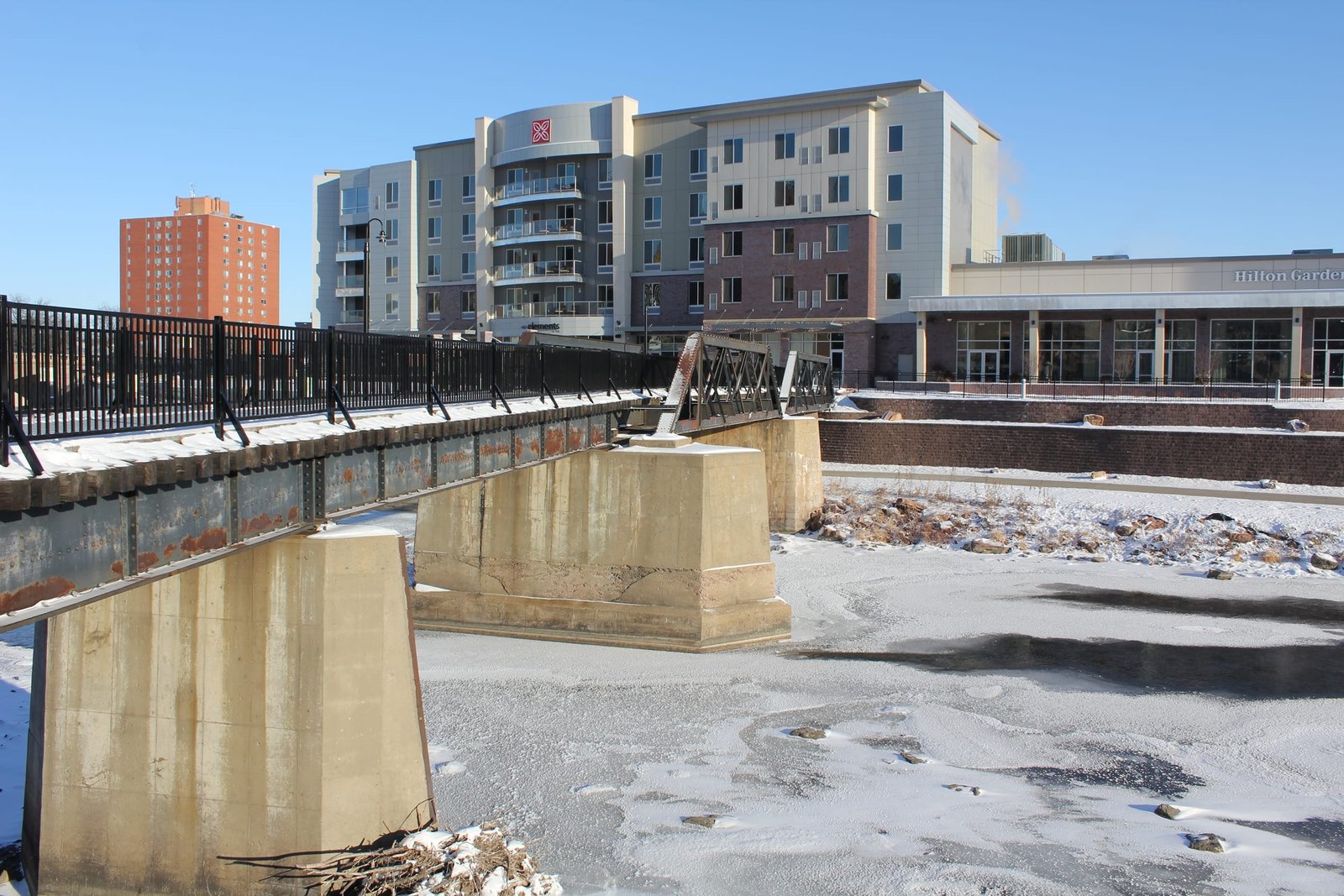


Click the photo to view the full-size version
| Name | Rock Island Big Sioux River Bridge |
| Built By | Chicago, Rock Island & Pacific Railway |
| Currently Owned By | City of Sioux Falls |
| Superstructure Contractor | Unknown |
| Substructure Contractor | Unknown |
| Length | 220 Feet Total, 60 Foot Main Spans |
| Width | 1 Track |
| Height Above Ground | 20 Feet (Estimated) |
| Superstructure Design | Double Intersection Warren Pony Truss and Deck Plate Girder |
| Substructure Design | Concrete |
| Date Fabricated | c. 1885 (Trusses) c. 1900 (Girders) |
| Date Erected | c. 1930 |
| Original Location | Unknown (Trusses) Unknown (Girders) |
| Traffic Count | 0 Trains/Day (Bridge is a Trail) |
| Current Status | Open to Trail Traffic |
| Significance | Regional Significance |
| Documentation Date | 12/30/2014 |
In 1886, the Cedar Rapids, Iowa Falls & Northwestern Railway (CRIF&NW) constructed 42-mile branch line, extending from Ellsworth, Minnesota, through Rock Rapids, Iowa, to Sioux Falls, South Dakota. By 1888, the CRIF&NW was leased by the Burlington, Cedar Rapids & Northern Railway (BCR&N), which operated a modest railroad network throughout eastern and northern Iowa. This line provided a growing BCR&N network with access to terminals and interchange at Sioux Falls. The CRIF&NW was outright purchased by the BCR&N in May 1902. The BCR&N was in turn purchased by the Chicago, Rock Island & Pacific Railway (Rock Island) in June 1903. The Rock Island operated a large railroad network through the central United States, serving diverse industries.
The Rock Island struggled financially throughout much of its history, experiencing repeated bankruptcies and chronic instability. After World War II, the Rock Island struggled to survive, proposing mergers and deferring maintenance on their routes. The railroad reorganized as the Chicago, Rock Island & Pacific Railroad in 1948. The segment between Rock Rapids and Sioux Falls would be abandoned in 1972. By the mid-1970s, the railroad was in serious decline. The railroad secured loans to eliminate slow orders, acquired new equipment, and attempted to restore profitability. In 1977, the remainder of the line was abandoned in an effort to eliminate poorly preforming branch lines. Today, much of the right-of-way has been converted to farm fields. However, sections in Rock Rapids and Sioux Falls have been converted to trail use.
Located near the Hilton Garden Inn in downtown Sioux Falls, this pony truss bridge carries a pedestrian walkway across the Big Sioux River. Little is known about the history of this bridge, although it is believed that the bridge was constructed of secondhand (relocated) parts. The bridge appears to have been constructed in approximately 1930, using two 60-foot riveted double intersection Warren pony truss spans and two 50-foot shallow deck plate girder spans. These spans are set onto concrete substructures, and the bridge has a slight curve at the south end. It is currently unknown where the spans may have been reused from. The two pony truss spans appear to have been fabricated in approximately 1885, and utilize a design commonly used by the Rock Island. These particular spans appear lighter and are considerably shorter than spans constructed in the late 1880s. The two deck plate girder spans are shallow design, and appear to have potentially been twinned. Railroads often reused steel and iron spans, as it was a cost effective way to replace bridges along branch lines. Often, when a span became unsuitable at one location, it could feasibly be reused at another location, with or without modifications. Overall, the bridge appears to be in good condition, with no significant deterioration noted. The bridge has been incorporated into a riverwalk area near the hotel. The author has ranked the bridge as being regionally significant, due to the truss design and possible old age.
Citations
| Railroad History Citation | ICC Valuation Information, Compiled by Richard S. Steele |