
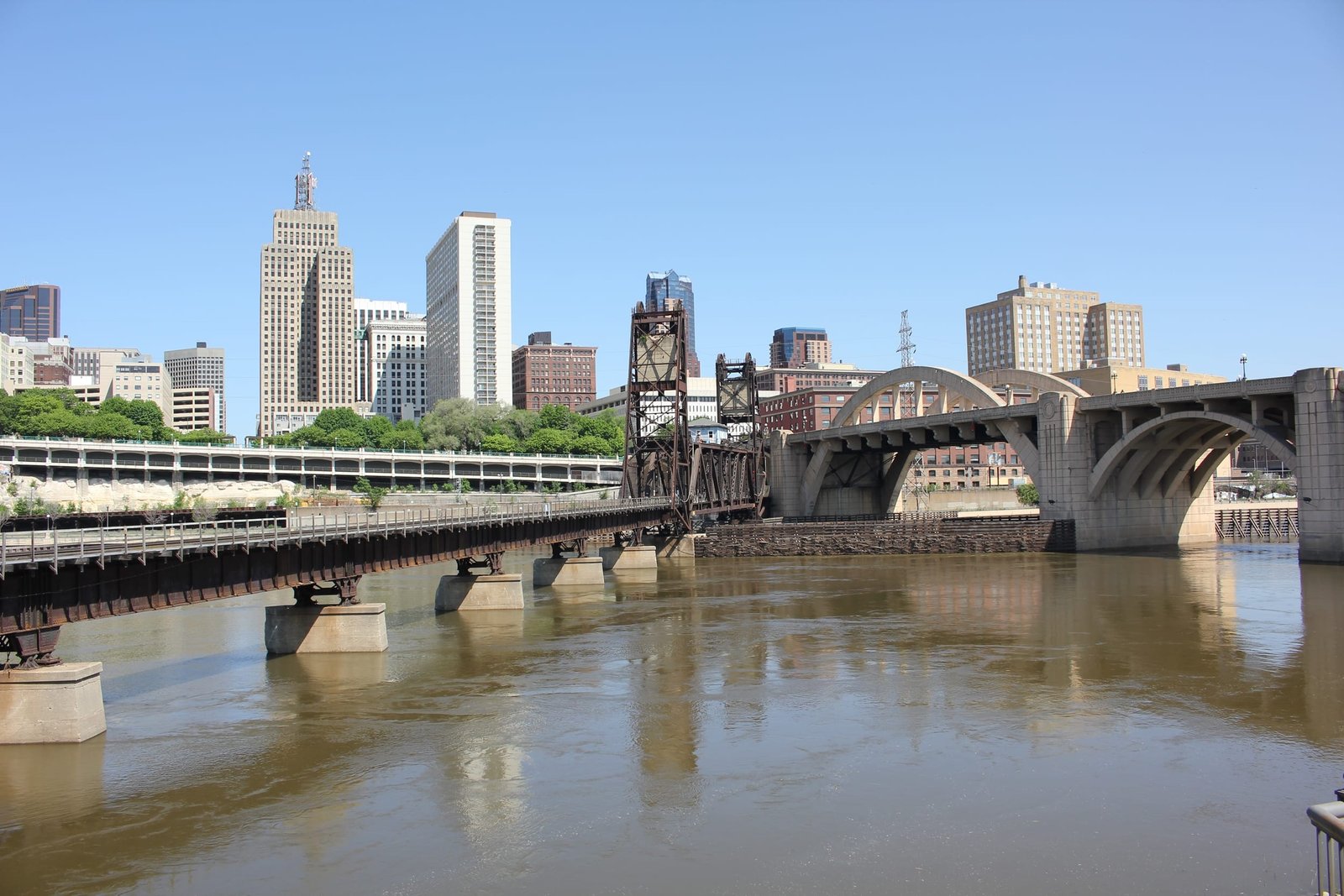


Click the photo to view the full-size version
| Name | Robert Street Lift Bridge Chicago Great Western Bridge #424.50 |
| Built By | Chicago Great Western Railway |
| Currently Owned By | Union Pacific Railroad |
| Superstructure Contractor | American Bridge Company of New York Bethlehem Steel Company of Bethlehem, Pennsylvania (North Approach) |
| Substructure Contractors | Widell Company of Mankato, Minnesota Unknown (North Approach) |
| Erection Contractors | Unknown |
| Engineer | Waddell & Harrington of Kansas City, Missouri |
| Length | 960 Feet Total, 192 Foot Lift Span |
| Width | 1 Track |
| Height Above Ground | 15 Feet (Estimated) |
| Superstructure Design | Pratt Through Truss, Deck Plate Girder and Steel Stringer |
| Substructure Design | Concrete and Steel Bent |
| Date Built | 1912, Raised 1926; North Approach Added 1955 |
| Traffic Count | 5 Trains/Day (Estimated) |
| Current Status | In Use |
| Great Northern Railway Bridge Number | 424.50 |
| Union Pacific Railroad Bridge Number | 529.52 |
| Significance | High Significance |
| Documentation Date | 6/3/2012; 12/27/2017; 5/27/2023 |
In 1885, the Minnesota and Northwestern Railway (M&NW) constructed 129 miles of new railroad, extending from St. Paul, Minnesota to Manly, Iowa. In 1885, the built 129 miles of new railroad between St. Paul, Minnesota and Manly, Iowa; running through towns such as Austin, Minnesota. By 1887, the M&NW would be merged with the Chicago, St. Paul and Kansas City Railway Company (CStP&KC), which would in turn be purchased by the Chicago Great Western Railway (CGW) in 1893. In 1901, 9 additional miles would be constructed between Manly and Mason City, Iowa by the Mason City & Fort Dodge Railway (MC&FD). The MC&FD would be leased by the CGW the same year. In 1902, the CGW would sell the Hayfield, Minnesota to Manly segment to the leased MC&FD. In 1909, the CGW was reorganized as the Chicago Great Western Railroad.
The CGW had acquired and constructed a modest railroad network throughout Illinois, Iowa, Minnesota and Missouri; connecting major cities in these states. The CGW was one of the smaller railroads in the area, and was late to develop lines. As a result, the railroad never saw the fortunes of other railroads in the area. This line served as a principal mainline for the CGW, connecting St. Paul to the Council Bluffs, Iowa mainline and several branch lines. In the early 20th Century, the CGW was often surviving on razor-thin profit margins. In 1940, the CGW entered bankruptcy, and was again reorganized as the Chicago Great Western Railway. After the bankruptcy, the CGW became an innovative railroad, pioneering intermodal service and becoming one of the first railroads to completely switch to diesel locomotives. A capital improvement program was launched in 1949, which sought to rebuild and rehabilitate deteriorated infrastructure.
In 1968, the CGW was purchased by the Chicago & North Western Railway (C&NW). The C&NW already owned a better constructed route between the Twin Cities and Mason City. As a result, track conditions on this line deteriorated, and the line was reduced to a secondary line for the C&NW. In 1977, a segment between Hayfield, Minnesota and Austin, Minnesota was abandoned; followed by the Austin to Manly segment in 1981. After the C&NW purchased the largely parallel Rock Island "Spine Line" in 1981, this line became excess. The Randolph, Minnesota to Hayfield segment was abandoned in 1982, followed by the Roseport, Minnesota to Randolph segment in 1984. In 1995, the C&NW was purchased by the Union Pacific Railroad, which continues to operate two of the segments in 2023. The Mason City to Manly segment is operated as part of the Albert Lea Subdivision, and the St. Paul to Roseport segment as the Roseport Industrial Lead. The remainder of the route has been abandoned, with many sections completely removed without a trace.
Likely the most iconic railroad bridge in St. Paul, this large lift bridge crosses the Mississippi River at an angle below Robert Street. The previous bridge here was built in 1885, and consisted of Whipple through trusses and a swing span. In 1912, it was desired to replace the bridge with a heavier structure. In response, a 192-foot vertical lift span would be constructed, with a deck plate girder approach. The main span of the bridge is a 192-foot riveted Pratt through truss span, with A-frame portal bracings, laced members and 7 panels. The lift span is supported by two large steel towers, which utilize concrete blocks for counterweights to raise and lower the span. The bridge was originally approached by seven 79-foot deck plate girder spans on the south side, and one 79-foot deck plate girder span on the north side. The bridge originally was set onto concrete substructures. The lift span was designed by Waddell & Harrington of Kansas City, Missouri; and the bridge was fabricated by American Bridge Company.
When the new St. Paul Union Depot was constructed, it was necessary to raise the grade of this bridge. The profile grade of the bridge was changed from -0.80% to +0.80% by adding steel bent risers on the existing concrete piers. Further changes were made to the bridge in 1955, when two steel stringer spans on concrete substructures were added on the north end of the bridge to cross Warner Drive. Since the initial construction, the lift span of the bridge has been strengthened, with new bolts and plates. This style of bridge was preferred by railroads for navigable rivers, as it provided a clearance without the need for a center pier.
As of January 2024, plans are underway to replace the lift span of this bridge with a new bascule span. The current lift span is in poor condition, and has become a maintenance issue for the railroad. It is currently unknown when this work will be completed, but a Section 106 evaluation is underway as of September 2021. Overall, the bridge appears to be in fair to poor condition. While the approach spans appear to be in acceptable condition, the lift span is in poor condition, with significant section loss and deterioration throughout the towers and span. The author has ranked this bridge as being highly significant, due to it being one of only a handful of vertical lift spans in Minnesota.
Citations
| Builder and build date | American Bridge Company plaque |
| Builder (Approach) | Bethlehem Steel Company plaque |
| Builder (Substructure) | Engineering Record, Building Record and Sanitary Engineer, Volume 68 |
| Railroad History Citation | ICC Valuation Information, Compiled by Richard S. Steele |