
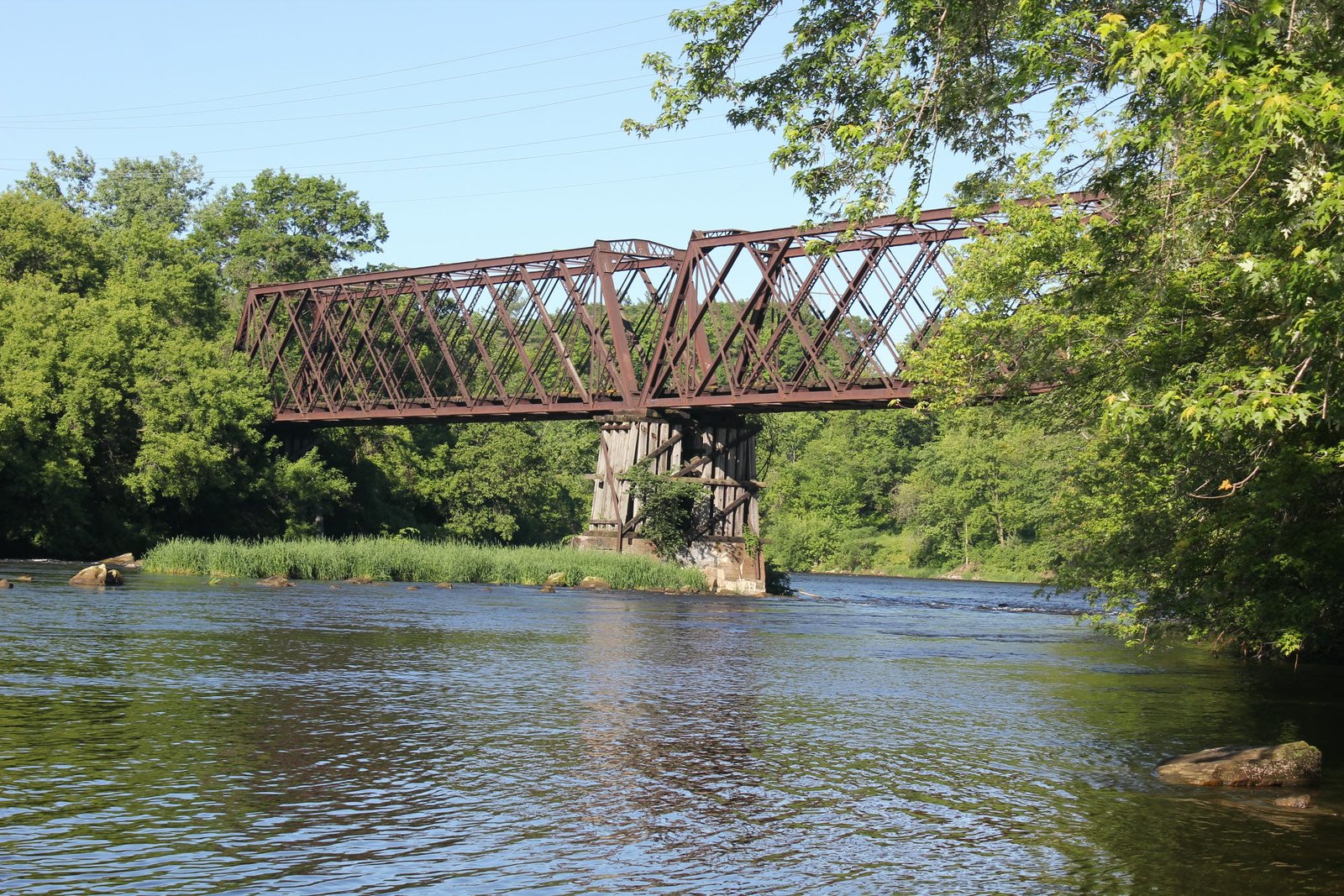


Click the photo to view the full-size version
| Name | C&NW Red Cedar River Bridge Chicago & North Western Railway Bridge #D-5 |
| Built By | Chicago, St. Paul, Minneapolis & Omaha Railway |
| Currently Owned By | City of Menomonie |
| Superstructure Contractor | Lassig Bridge & Iron Works of Chicago (Truss Spans) Unknown (Steel Stringer Span) |
| Length | 553 Feet Total, 150 Foot Main Spans |
| Width | 1 Track |
| Height Above Ground | 30 Feet (Estimated) |
| Superstructure Design | Quadrangular Lattice Through Truss, Steel Stringer and Timber Pile Trestle |
| Substructure Design | Concrete and Timber Pile |
| Date Fabricated | c. 1890 (North Truss Span) 1892 (South Truss Span) 1951 (Steel Stringer Span) |
| Date Erected | 1921 (Truss Spans) 1941 (Timber Trestle Spans) 1951 (Steel Stringer Span) |
| Original Locations | Unconfirmed - See Below (Truss Spans) Unknown (Steel Stringer Span) |
| Traffic Count | 0 Trains/Day (Bridge is Abandoned) |
| Current Status | Abandoned |
| Chicago & North Western Railway Bridge Number | D-5 |
| Union Pacific Railroad Bridge Number | 2.38 |
| Significance | Regional Significance |
| Documentation Date | 5/12/2012; 6/16/2013; 8/7/2014 |
In 1880, the Menomonie Railway Company constructed a short 3 mile branch from the existing mainline at Menomonie Junction, Wisconsin into downtown Menomonie. This line was financed by the Chicago, St. Paul, Minneapolis & Omaha Railway (Omaha Road) to serve industries located in Menomonie. The railroad would be fully acquired by the Omaha Road in 1893. The Omaha Road had been controlled by the Chicago & North Western Railway (C&NW) since 1882. The C&NW constructed and acquired a large amount of trackage through the Midwest, and the Omaha Road provided additional lines in western Wisconsin, southern Minnesota and parts of Iowa, Nebraska and South Dakota. This line served mainly as a short spur, serving a diverse industrial base in Menomonie. By the early 20th Century, the Omaha Road operated a respectable network of railroad lines, serving in conjunction with the C&NW lines. The Omaha Road would formally be merged into the C&NW in 1959. In 1995, the C&NW was purchased by Union Pacific Railroad (UP). UP operated this line until 2002, when it would be abandoned. The railroad grade was acquired by the City of Menomonie. Today, portions of the line have been reused as a trail, and some portions remain abandoned.
Located in Menomonie, this lattice through truss bridge carries the former Chicago, St. Paul, Minneapolis & Omaha Railway Menomonie branch over the Red Cedar River and Stokke Trail (former Chicago, Milwaukee, St. Paul & Pacific Railroad). The first bridge at this location consisted of two 150-foot timber Howe through truss spans, approached by timber pile trestle spans. This bridge was last upgraded in 1893 with new trusses. As railroad traffic became heavier, wooden trusses were no longer suitable, and a permanent structure was desired. In 1921, the two truss spans would be replaced by a pair of secondhand steel through truss spans. The piers and timber approaches were renewed in 1941, and a steel stringer span was installed over the Milwaukee Road line in 1951, giving the bridge its present configuration. Currently, the bridge consists of two 150-foot, riveted quadrangular lattice through truss span, approached by four timber pile trestle spans on the south end. The north approach is comprised of seven timber pile trestle spans, a 35-foot steel stringer, and seven more timber pile trestle spans. The main piers of the bridge are set onto concrete pedestals, while the remaining substructures are composed of timber piles. The north end of the bridge is set onto a sweeping curve, and the steel stringer span is set at a heavy skew. Railroad company forces constructed the concrete bases for the piers.
The two truss spans are slightly different, reflecting different fabrication dates. The south truss span was originally fabricated in 1892, and is believed to have come from Bridge #698 across the Red Cedar River at Rice Lake, Wisconsin. The northern truss is believed to have been fabricated in 1890 to cross the St. Croix River at Bridge #849 near Gordon, Wisconsin. Those two bridges were replaced with girder spans in approximately 1920, and are the only known 150-foot on the Omaha Road system that would've been available for reuse in 1921. Both spans use a standard design for the era, including a pedimented portal bracing with decorative heel bracing, a combination of built-up and solid members and a traditionally composed floor. Both spans use a bottom chord constructed of two parallel beams and a top chord constructed of a channel connected by thin plates. The southern span uses X-lacing on the back of the endposts, while the north span uses thin plates on the back of the endposts. Both spans use solid compression members near the ends of the truss, while inner compression members are constructed of V-laced beams. The tension members of both spans are constructed of L-shaped bars. The floor of both spans is composed of two plate girder stringers and plate girder floorbeams. Slightly different variations of portal bracing are visible on the two spans. Both spans use a pedimented lattice portal bracing with a solid plate in the middle. The southern span uses triangular plates with four decorative cutouts for the heel bracing, while the northern span only uses three cutouts. The steel stringer span is traditionally composed for the era, using four shallow beams, arranged into two sets of two. It is possible that this span was reused from another location.
This type of truss design is relatively uncommon throughout the United States. However, a few railroads preferred the design, such as the Chicago, Rock Island & Pacific Railway (Rock Island), the Chicago & North Western Railway (C&NW) and the Omaha Road. Spans constructed in the early 1880s for the Omaha Road featured an arched and pedimented lattice portal bracing, light sway bracing and laced members. The second generation was nearly exclusively constructed by Lassig Bridge & Iron Works between 1884 and 1900, and featured heavier members and a pedimented portal bracing. While the design fell out of favor for the Rock Island and Omaha Road around the turn of the 20th Century, the design remained popular with the C&NW into the 1920s. The discontinuance of the lattice design is one of the few examples of the Omaha Road and C&NW bridge engineers having differing thoughts on bridge designs. This particular span uses a design typical for the second generation of quadrangular lattice through trusses. Railroads often reused steel and iron spans, as it provided a cost effective way to rebuild bridges on branch lines without requiring large amounts of new material. Overall, the bridge appears to be in fair condition, with no significant deterioration noted. The bridge has been acquired by the City of Menomonie for potential future trail use. The author hopes that this bridge will be reused and preserved for generations to come. The author has ranked this bridge as being regionally significant, due to the truss design, age, size and unclear history.
Citations
| Builder (south span) | Missing Lassig Bridge & Iron Works plaque |
| Builder (north span) | Based on identical lattice through truss spans |
| Fabrication dates and erection dates | Historic Report - Docket AB-33 (190X); prepared by Union Pacific Railroad, August 2002 |
| Railroad History Citation | ICC Valuation Information, Compiled by Richard S. Steele |