
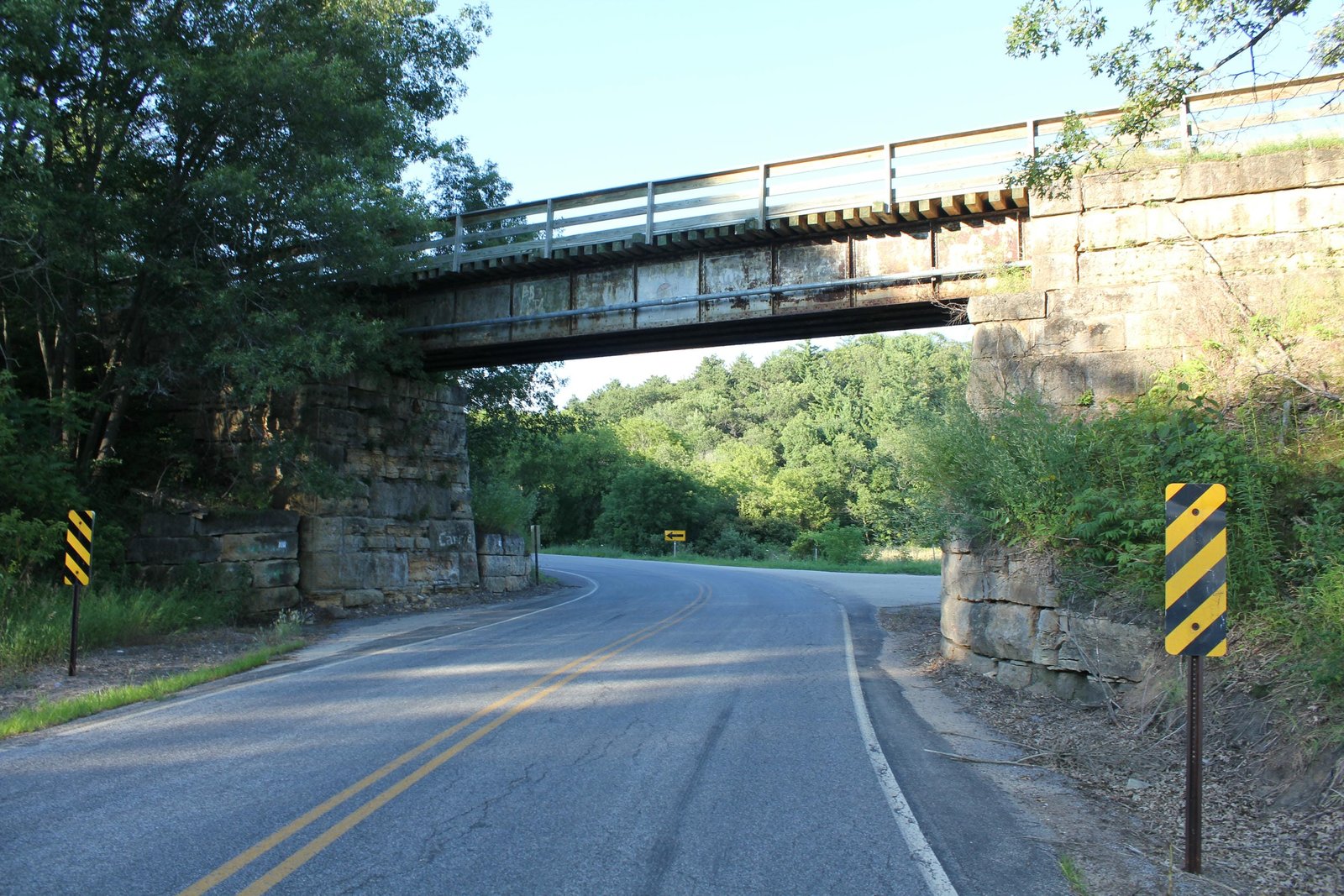


Click the photo to view the full-size version
| Name | Omaha Trail - County H Bridge Chicago & North Western Railway Bridge #28 |
| Built By | Chicago, St. Paul, Minneapolis & Omaha Railway |
| Currently Owned By | Juneau County Parks Committee |
| Superstructure Contractor | Lassig Bridge & Iron Works of Chicago (Initial Construction) Unknown (Additional Girders) |
| Substructure Contractor | Unknown |
| Length | 54 Feet Total |
| Width | 1 Track |
| Height Above Ground | 15 Feet (Estimated) |
| Superstructure Design | Deck Plate Girder |
| Substructure Design | Stone Masonry |
| Date Fabricated | 1892 c. 1890 (Additional Girders) |
| Date Erected | 1892 (Initial Construction) c. 1920 (Additional Girders) |
| Traffic Count | 0 Trains/Day (Bridge is Open to Pedestrian Traffic) |
| Current Status | Open to Pedestrian Traffic |
| Chicago & North Western Railway Bridge Number | 28 |
| Significance | Local Significance |
| Documentation Date | 7/21/2015 |
In 1867, the West Wisconsin Railway (WW) constructed 10 miles of new railroad, extending from Tomah to Warrens, Wisconsin. The following year, 21 additional miles would be completed to Black River Falls, Wisconsin; 34 additional miles were completed to Augusta, Wisconsin in 1869; 46 additional miles would be constructed to Eau Claire, Wisconsin in 1870, and 44 miles between Eau Claire and Hudson, Wisconsin completed in 1871. In 1871, the St. Paul, Stillwater & Taylors Falls Railroad (StPS&TF) completed 22 miles from St. Paul, Minnesota to Hudson in 1871. During 1872, the WW completed 32 miles of additional railroad between Elroy and Warrens, Wisconsin; and the previous alignment between Tomah and Warrens would be abandoned. The WW would be acquired by the Chicago, St. Paul & Minneapolis Railway in 1878, which was acquired by the Chicago, St. Paul, Minneapolis & Omaha Railway (Omaha Road) in 1880. The StPS&TF would be acquired by the St. Paul & Sioux City Railroad (StP&SC) in 1880, and the StP&SC would be purchased by the Omaha Road in 1881. By acquiring this route, the Omaha Road had completed a mainline extending from Elroy, Wisconsin through St. Paul, Minnesota to Sioux City, Iowa.
The first significant improvement to this line was a new bridge and alignment at Hudson, Wisconsin; completed in 1881. At the same time, the Omaha Road was working to replace major bridges with new iron and stone structures. In 1883, the Omaha Road would come under control of the Chicago & North Western Railway (C&NW). The C&NW operated numerous routes throughout the Upper Midwest, and the Omaha Road served as a principal component of the system. As traffic increased on this route, significant improvements would be made. Realignments would be completed in 1885 near Augusta and Merrillan; between Millston and Warrens in 1886; between Baldwin and Hersey and Altoona and Fall Creek in 1891; between Hudson and Roberts in 1898, and between Hersey and Knapp and west of Millston in 1899. Further realignments would occur in 1901, when a new cutoff around Black River Falls was completed. In 1903, more improvements were made between Roberts and Hammond; around Woodville; west of Menomonie; west of Elk Mound and near Truax. A second track was constructed between Augusta and Altoona in 1907. In 1911 ans 1912, the remaining second track would be constructed from Wyeville to Menomonie, including realignments near Eau Claire and Menomonie. The second track would be completed to St. Paul in 1913. In 1915, the original alignment in Black River Falls would be abandoned.In 1957, the C&NW leased the Omaha Road. Between 1957 and 1962, most of the second track would be removed. In 1971, the Sheppard to Black River Falls spur would be abandoned. By 1972, the Omaha Road was fully absorbed into the C&NW. In 1986, the Levis to Black River Falls spur would be abandoned. The Camp Douglas to Elroy segment would be abandoned in 1986, and purchased by Juneau County in 1972. The Omaha Trail would open on the former railroad in 1992. In 1992, the original alignment in Eau Claire would be abandoned. In 1995, the C&NW would be purchased by Union Pacific Railroad. Today, UP operates the Altoona Subdivision from St. Paul to Altoona; the Wyeville Subdivision from Altoona to Wyeville; and the Camp Douglas Industrial Lead from Wyeville to Camp Douglas.
Located near Hustler, this deck plate girder bridge carries the former Chicago, St. Paul, Minneapolis & Omaha Railway across County Road H. The first bridge at this location was a timber pile trestle, constructed when the line was constructed. During the 1890s and early 1900s, the Omaha Road invested significant capital into this line, replacing timber bridges with stone and metal bridges. In 1890, new stone abutments were constructed at this location, and in 1892, iron deck girder spans were installed. In approximately 1920, additional girders were installed to strengthen the existing span, giving the bridge its present configuration. Currently, the bridge consists of a 54-foot deck plate girder span, set onto stone abutments. The superstructure consists of a standard girder span, which has been strengthened with two additional girder spans. The stone abutments use a standard elongated design, and are constructed with limestone quarried at Mankato, Minnesota. Lassig Bridge & Iron Works fabricated the initial span, and an unknown contractor constructed the stone abutments. The additional girders were fabricated in approximately 1890 at an unknown location, and fabricated by an unknown contractor. Railroads often strengthened steel girder spans by adding additional girders, as it was a cost effective way to repair existing bridges. Deck plate girder spans were commonly used by railroads, as they were durable and easy to construct. Currently, the bridge is owned by Juneau County, and is used by the Omaha Trail. Overall, the bridge appears to be in fair to good condition, with no significant deterioration. The author has ranked this bridge as being locally significant, due to the common design and unknown history.
Citations
| Builder and build date | Lassig Bridge & Iron Works plaque |
| Railroad History Citation | ICC Valuation Information, Compiled by Richard S. Steele |