


Click the photo to view the full-size version
| Name | Le Roy Trail Bridge Chicago Great Western Railway Bridge #W-184 |
| Built By | Chicago Great Western Railway |
| Currently Owned By | Minnesota Department of Natural Resources |
| Superstructure Contractor | Wisconsin Bridge & Iron Company of North Milwaukee, Wisconsin |
| Length | 340 Feet Total, 50 Foot Main Spans |
| Width | 1 Track |
| Height Above Ground | 15 Feet (Estimated) |
| Superstructure Design | Deck Plate Girder and Timber Pile Trestle |
| Substructure Design | Timber Pile |
| Date Built | 1936 Using Spans Fabricated 1903; Approaches Replaced c. 1980 |
| Traffic Count | 0 Trains/Day (Bridge is a Trail) |
| Current Status | Open to Trail Traffic |
| Chicago Great Western Railway Bridge Number | W-184 |
| Significance | Local Significance |
| Documentation Date | 7/13/2015; 4/1/2021 |
In 1890, the Winona & Southwestern Railway (W&SW) began construction of 114 miles of new railroad extending from Winona, Minnesota to Osage, Iowa. The new line would be completed in 1891, and the W&SW would be sold to the Winona & Western Railway Company in 1894. The W&W would be sold to the Wisconsin, Minnesota & Pacific (WM&P) Railroad Company in 1901. The WM&P was subsequently leased by the Chicago Great Western Railway (CGW) the same year. The CGW would be reorganized as the Chicago Great Western Railroad (CGW) in 1909. The CGW had acquired and constructed a modest railroad network throughout Illinois, Iowa, Minnesota and Missouri; connecting major cities in these states. The CGW was one of the smaller railroads in the area, and was late to develop lines. As a result, the railroad never saw the fortunes of other railroads in the area.
This line served as a secondary route for the CGW, and was never extended further. In 1920, the WM&P was consolidated into the CGW. By 1936, a segment from Winona to Altura would be abandoned. In the early 20th Century, the CGW was often surviving on razor-thin profit margins. In 1940, the CGW entered bankruptcy, and was again reorganized as the Chicago Great Western Railway. After the bankruptcy, the CGW became an innovative railroad, pioneering intermodal service and becoming one of the first railroads to completely switch to diesel locomotives. A capital improvement program was launched in 1949, which sought to rebuild and rehabilitate deteriorated infrastructure. The segment from Altura to Utica was abandoned in 1962, and the segment from McIntyre, Iowa to Osage in 1964. In 1968, the CGW would be purchased by the Chicago & North Western Railway (C&NW). Further abandonments were made between Utica and Simpson in 1969 and Stewartville and McIntyre in 1977. Today, the entirety of the line has been abandoned, although many remains of the line can still be found.
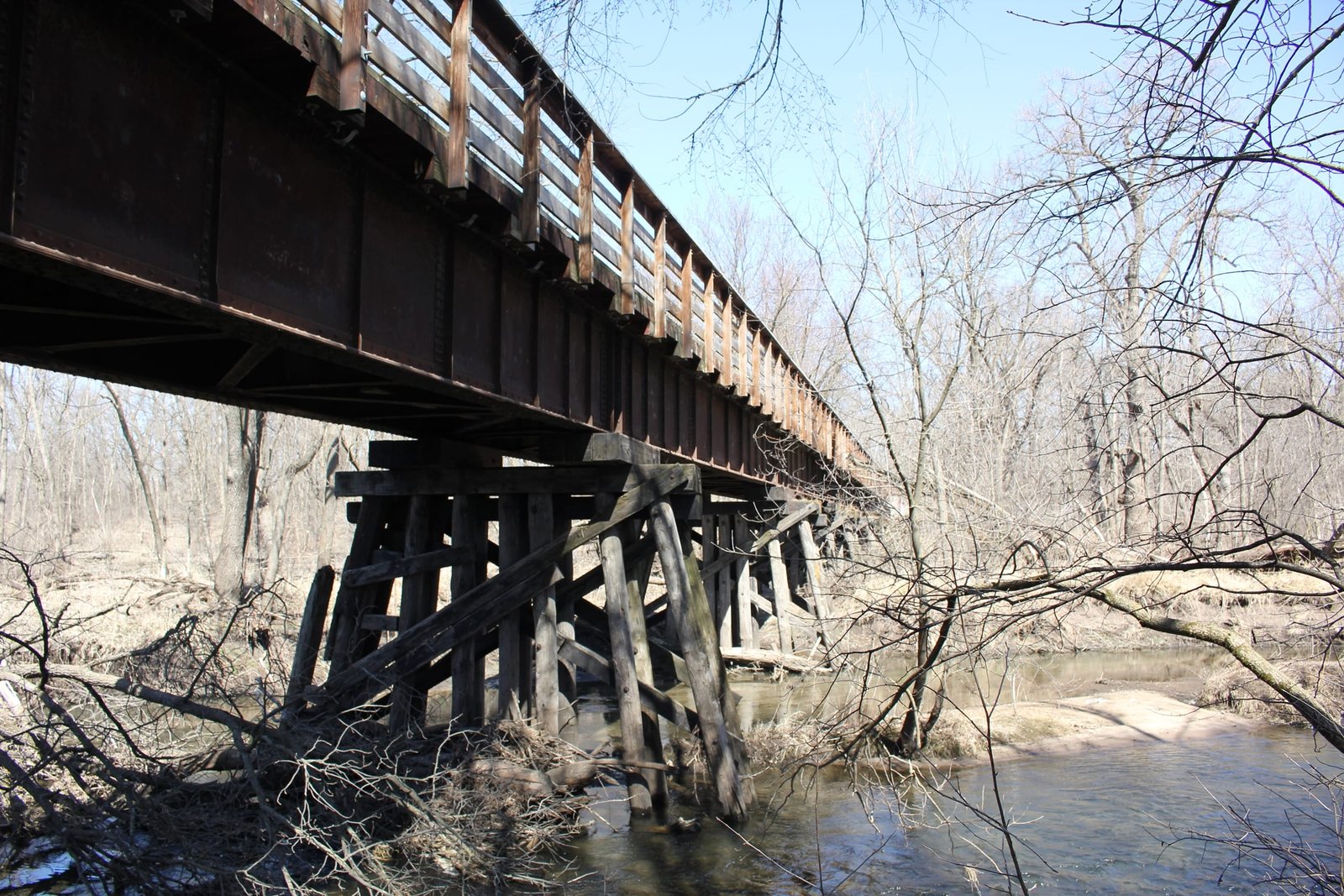
Located in Le Roy, this deck plate girder bridge carries the former Chicago Great Western Railway over the Upper Iowa River. The first bridge at this location consisted of a long timber pile trestle bridge, constructed when the line was first built. In 1936, the bridge was rebuilt with several secondhand deck plate girder spans. Originally, the bridge consisted of six 50-foot deck plate girder spans, set onto timber pile piers and approached by timber pile trestle spans on either end. The deck girders were fabricated in 1903, and were reused from unknown location(s). A portion of this line near Winona was abandoned in 1936, and it is possible that the girders were reused from somewhere on that line. The girders follow a standard design, with two heavy girders and typical internal bracing. Wisconsin Bridge & Iron Company is believed to have fabricated all six spans. After the bridge was abandoned, the original timber pile trestle spans at each end were replaced with a concrete abutment and timber beam span as part of the conversion to trail use. Deck plate girder spans were commonly used by railroads, as they were durable and easy to construct. Railroads often reused steel spans, as it was a cost effective way to replace bridges. If a steel span became inadequate at one location, it often could be feasibly repaired, and installed at another location. Overall, the bridge appears to be in fair condition, with no significant deterioration noted. The author has ranked this bridge as being locally significant, due to the common design.
Citations
| Builder and fabrication date | Wisconsin Bridge & Iron Company plaque |
| Erection date | Chicago Great Western Railway Record of Property Changes at the Chicago & North Western Railway Historical Society Archives |
| Railroad History Citation | ICC Valuation Information, Compiled by Richard S. Steele |