


Click the photo to view the full-size version
| Name | Elmen Park Railroad Bridge Chicago & North Western Railway Bridge #P-131 |
| Built By | Chicago, St. Paul, Minneapolis & Omaha Railway |
| Currently Owned By | Ellis & Eastern Railroad |
| Superstructure Contractor | Lassig Bridge & Iron Works of Chicago |
| Substructure Contractor | James McClure of St. Paul, Minnesota |
| Length | 319 Feet Total, 100 Foot Main Span |
| Width | 1 Track |
| Height Above Ground | 20 Feet (Estimated) |
| Superstructure Design | Quadrangular Lattice Through Truss and Concrete Modular Girder |
| Substructure Design | Stone Masonry and Steel Pile |
| Date Built | 1892, Approach Reconstructed 2024 |
| Traffic Count | 2 Trains/Day (Estimated) |
| Current Status | In Use |
| Chicago & North Western Railway Bridge Number | P-131 |
| Significance | Moderate Significance |
| Documentation Date | 12/30/2014 |
In 1876, the Worthington and Sioux Falls Railroad Company (W&SF) would begin construction on a new railroad line, extending 58 miles from Org, Minnesota to Sioux Falls, South Dakota. The line would be completed in 1878, and the W&SF would become part of the Saint Paul and Sioux City Railroad Company (StP&SC) in 1879. The StP&SC would construct an additional 40 miles to Salem, South Dakota in 1880. In 1881, the StP&SC would be sold to the Chicago, St. Paul, Minneapolis & Omaha Railway (CStPM&O), also known as the Omaha Road. The Omaha Road would come under control of the Chicago & North Western Railway (C&NW) the next year. The line would be completed to Mitchell in 1887.
This route served as a branch line for the Omaha Road, connecting to agricultural markets in South Dakota. The Omaha Road would formally be merged into the C&NW in 1959. Because of the branch line status of this line, the C&NW deferred maintenance on the route. In 1981, the Ellis to Mitchell segment of the line would be abandoned. The remainder of the line was abandoned in 1987, but would be sold to the Buffalo Ridge Railroad Authority and the Ellis & Eastern Railroad. Through the 1990s, a number of railroads operated the Buffalo Ridge segment between Org and Manley. In 2001, Minnesota Southern Railway began operations between Org and Manley, and it would be acquired by the Ellis & Eastern Railroad (EE) in 2017. Today, the route is being upgraded by EE to secure future operations.
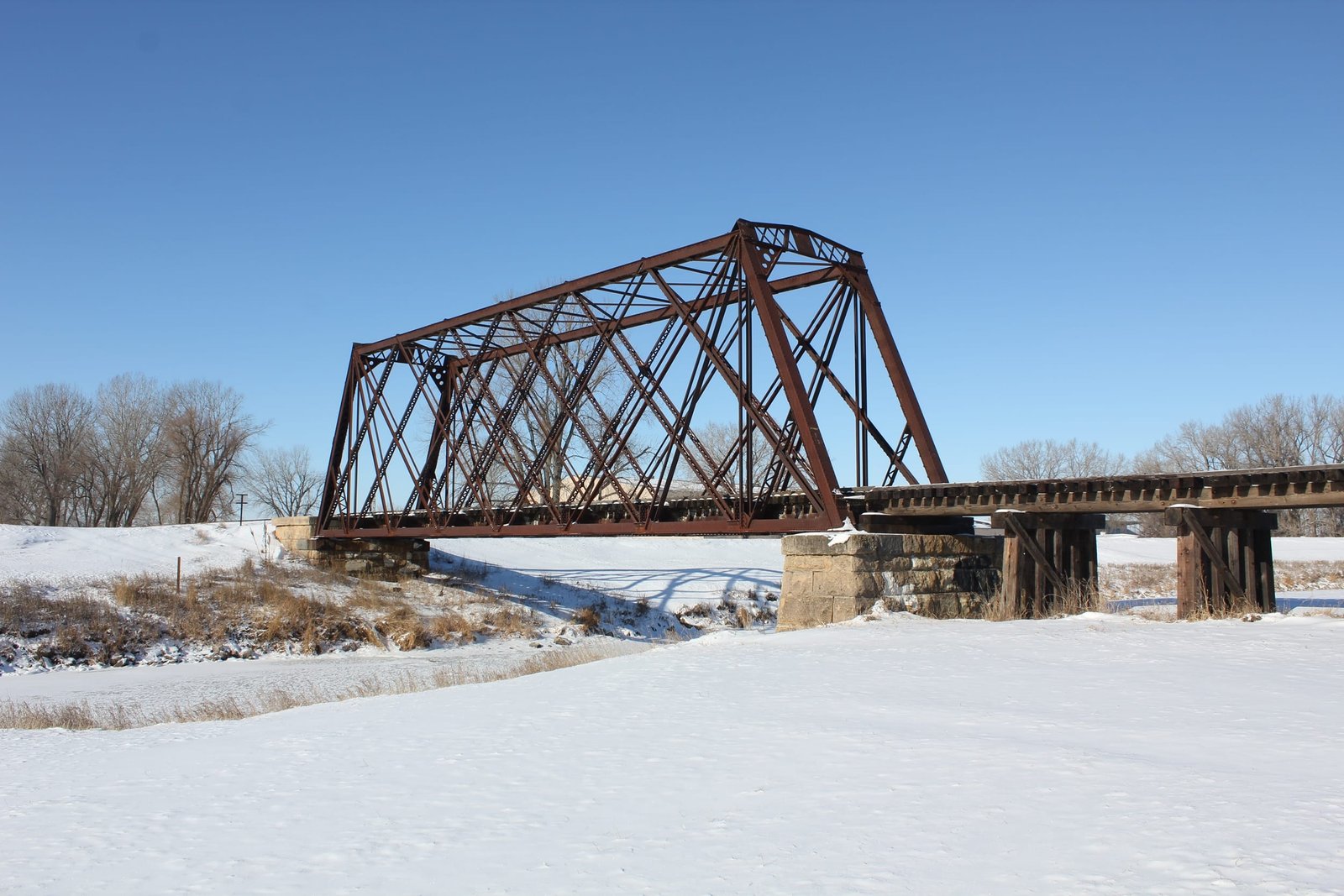
Located in Sioux Falls, this quadrangular lattice through truss bridge carries the former Chicago, St. Paul, Minneapolis & Omaha Railway (Omaha Road) across the Big Sioux River near Elmen Park. The first bridge at this location was likely a timber pile trestle or wooden truss bridge, constructed when the line was first built. In the late 1880s and early 1890s, the Omaha Road invested significant capital into this line, replacing aging timber bridges with stone and iron structures. In 1892, the original wooden bridge would be replaced by the present structure. The bridge consists of a 100-foot, riveted quadrangular lattice through truss span, set onto stone substructures and originally approached by timber pile trestle spans on the east end. The main span uses a standard design for the era, including a pedimented portal bracing with decorative heel bracing, a combination of built-up and solid members and a traditionally composed floor. Typical of this type of span, the bottom chord is constructed of two parallel beams. The endposts and top chord are also composed of built-up beams, with the endposts using an X-lacing on the back side while the top chord uses thin plates spaced throughout the member. X-laced members are used for the compression members near the ends of the truss, while inner compression members are constructed of V-laced beams. The tension members are exclusively constructed of L-shaped bars. The floor follows a standard design, with two plate girder stringers and plate girder floorbeams spaced throughout the structure. The portal bracing uses a typical lattice pedimented design and solid triangular heel bracings with flower-shaped cutouts. Lassig Bridge & Iron Works fabricated the main span, while the piers were constructed by James McClure.
This type of truss design is relatively uncommon throughout the United States. However, a few railroads preferred the design, such as the Chicago, Rock Island & Pacific Railway (Rock Island), the Chicago & North Western Railway (C&NW) and the Omaha Road. Spans constructed in the early 1880s for the Omaha Road featured an arched and pedimented lattice portal bracing, light sway bracing and laced members. The second generation was nearly exclusively constructed by Lassig Bridge & Iron Works between 1884 and 1900, and featured heavier members and a pedimented portal bracing. While the design fell out of favor for the Rock Island and Omaha Road around the turn of the 20th Century, the design remained popular with the C&NW into the 1920s. The discontinuance of the lattice design is one of the few examples of the Omaha Road and C&NW bridge engineers having differing thoughts on bridge designs. This particular span uses a design typical for the second generation of quadrangular lattice through trusses. Overall, the bridge appears to be in fair to good condition, with no significant deterioration noted. The truss was repaired with high strength bolts in about 2010, and the original approach was replaced in 2024. The author has ranked this bridge as being moderately significant, due to the truss design.
Citations
| Build dates and builder (superstructure) | Lassig Bridge & Iron Works plaque |
| Builder (substructure) | Chicago, St. Paul, Minneapolis & Omaha Railway Contract Data at the Chicago & North Western Historical Society Archives |
| Railroad History Citation | ICC Valuation Information, Compiled by Richard S. Steele |