


Click the photo to view the full-size version
| Name | UP Straight River Bridge #8 Chicago, Rock Island & Pacific Railroad Bridge #2991 |
| Built By | Chicago, Rock Island & Pacific Railway |
| Currently Owned By | Union Pacific Railroad |
| Superstructure Contractor | American Bridge Company of New York |
| Length | 176 Feet Total, 44 Foot Spans |
| Width | 1 Track |
| Height Above Ground | 15 Feet (Estimated) |
| Superstructure Design | Deck Plate Girder |
| Substructure Design | Stone Masonry and Concrete |
| Date Built | 1903 |
| Traffic Count | 10 Trains/Day (Estimated) |
| Current Status | In Use |
| Chicago, Rock Island & Pacific Railroad Bridge Number | 2991 |
| Union Pacific Railroad Bridge Number | 299.10 |
| Significance | Local Significance |
| Documentation Date | 11/3/2013 |
In 1895, the South St. Paul Belt Railroad (SSPB) constructed a short 5 mile line and bridge over the Mississippi River, extending from Newport, Minnesota to South St. Paul, Minnesota. Initially, the line was primarily constructed to provide access from the joint Chicago, Burlington & Quincy Railroad (CB&Q)/Chicago, Milwaukee & St. Paul Railway (Milwaukee Road) line east of the river to the St. Paul Stockyards. In 1900, the Burlington, Cedar Rapids & Northern Railway (BCR&N) began construction on a new railroad line, extending from the current terminus of the system at Albert Lea, Minnesota towards the Twin Cities at St. Paul, Minnesota. The first 54 miles of new railroad were completed later that year, and extended from Albert Lea to Comus, Minnesota. The following year, an additional 11 miles were completed between Rosemount, Minnesota and the west side of the Inver grove Heights bridge. Between Comus and Rosemount, the BCR&N obtained trackage rights over an existing Milwaukee Road mainline. To reach Minneapolis, the BCR&N obtained trackage rights over the Milwaukee Road "Short Line". The line was connected to the existing BCR&N system at Manly, Iowa by use of trackage rights over the Minneapolis & St. Louis Railway (M&StL) between Albert Lea and Manly. The BCR&N was a modest sized railroad in Iowa and Minnesota, connecting several larger cities to small agricultural markets. This line provided the BCR&N with access to new markets, and attracted the attention of a suitor.
In June 1903, the BCR&N was acquired by the Chicago, Rock Island & Pacific Railway (Rock Island), which operated a large railroad network through the central United States. At the same time, the SSPB was consolidated into the Rock Island, and additional industrial trackage was constructed in St. Paul. Similar to the BCR&N, this line allowed for the Rock Island to access industries, terminals and interchange with railroads that it had not previously interchanged with. In the first years after the initial construction, the Rock Island upgraded this route, replacing temporary timber bridges with permanent steel structures. After further expansions in Iowa during the early 1910s, this line became known as the "Spine Line", providing the shortest and most direct route between Kansas City, Des Moines and St. Paul. A connection to Mason City, Iowa was made by trackage rights over the Chicago Great Western Railway (CGW) line. The Rock Island struggled financially throughout much of its history, experiencing repeated bankruptcies and chronic instability. After World War II, the Rock Island struggled to survive, proposing mergers and deferring maintenance on their routes. The railroad reorganized as the Chicago, Rock Island & Pacific Railroad in 1948. By the mid-1970s, the railroad was in serious decline. The railroad secured loans to eliminate slow orders, acquired new equipment, and attempted to restore profitability. In 1978, the railroad came close to profit, but creditors were lobbying for a complete shutdown of the Rock Island. During the fall of 1979, a strike crippled the railroad, and by January of 1980, the entire system was ordered to be shut down and liquidated. Many of the lines and equipment were scrapped. Profitable sections of railroad were prepared for sale.
The bridge across the Mississippi River permanently closed to railroad traffic when the Rock Island shut down, although the bridge remained intact for several years to serve automobile traffic. After the fall of the Rock Island, a bidding war ensued between the Chicago & North Western Railway (C&NW) and the Soo Line for the Spine Line. Ultimately, the C&NW was awarded the rights to purchase the line in 1981. Work on rehabilitating the line began soon after, and by 1983, the entire line had been extensively rebuilt. In 1995, the C&NW was purchased by Union Pacific Railroad (UP). Today, UP operates the Albert Lea Subdivision between Mason City, Iowa and St. Paul, Minnesota. The segment between Comus and Rosemount continues to be used by CPKC, the ultimate successor of the Milwaukee Road. The line continues to see a steady base of freight traffic, and remains an important mainline for UP.
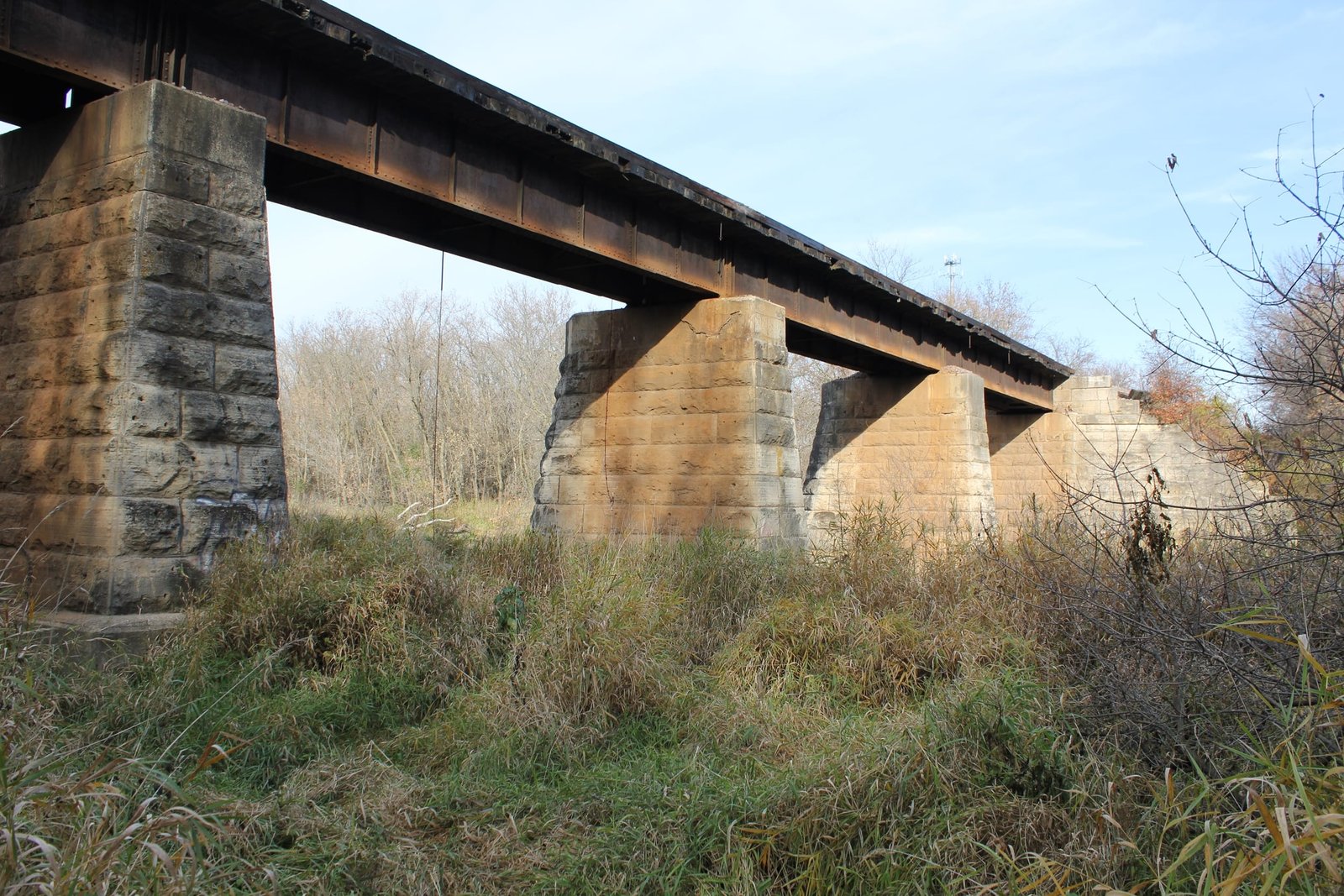
Located on the south side of Faribault, this deck plate girder bridge is the eighth crossing of the Straight River along this route. Built in 1903, the bridge features four 44-foot standard deck plate girder spans, set onto stone substructures. The stone piers are capped with concrete. This bridge is one of several similar bridges across the Straight River in this area. The 44-foot deck plate girder was a standard span for the Rock Island, being used in hundreds of locations. This style of bridge was commonly used by railroads throughout the United States, as it was durable and easy to construct. Overall, the bridge appears to be in fair condition, with some deterioration noted throughout the bridge. The author has ranked this bridge as being locally significant, due to the common design.
Citations
| Builder and build date | American Bridge Company plaque |
| Railroad History Citation | ICC Valuation Information, Compiled by Richard S. Steele |