






Click the photo to view the full-size version
| Name | Split Rock Tunnel |
| Built By | Chicago and Rock Island Rail Road Company |
| Currently Owned By | Iowa Interstate Railroad |
| Contractor | Clark & Mann |
| Length | 165 Feet Total |
| Width | 1 Track |
| Height Above Ground | 20 Feet (Estimated) |
| Superstructure Design | Bored Tunnel |
| Portal Design | Exposed Bedrock |
| Lining Design | Cut Stone and Exposed Bedrock |
| Substructure Design | Bedrock Stone Masonry |
| Date Built | 1853 |
| Traffic Count | 0 Trains/Day (Tunnel has been Bypassed) |
| Current Status | Bypassed and Abandoned |
| Significance | Moderate Significance |
| Documentation Date | 3/22/2025 |
In 1852, the Chicago and Rock Island Rail Road Company (C&RI) constructed 40 miles of new railroad, extending from Chicago, Illinois to Joliet, Illinois. The following year, the railroad constructed an additional 119 miles of new railroad to Geneseo, followed by an additional 22 miles to Rock Island, Illinois in 1854. Work was continued in 1856 by the Mississippi and Missouri Rail Road Company (M&M), which constructed a bridge across the Mississippi River to Davenport, Iowa and continued the line westwards across Iowa. In 1866, the two railroads were consolidated into the Chicago, Rock Island & Pacific Railroad, which was renamed the Chicago, Rock Island & Pacific Railway (Rock Island) in 1880. The line between Chicago and Joliet was double tracked prior to 1874, due to the heavy use. The Rock Island constructed and acquired a large network of railroads, primarily in Iowa during the late 1880s. This line served as a principal mainline for the railroad, connecting Chicago to the network of railroad lines west of the Mississippi River.
In approximately 1892, the remainder of the line would be double tracked, and in the late 1890s, additional tracks were added in Chicago. Track elevation projects within Chicago were made throughout the late 1890s and early 1900s. Throughout the 20th Century, the line continued to be a critical component of the Rock Island system. In 1913, the Rock Island elevated the line through Joliet. The Rock Island was a poor railroad, facing financial trouble regularly and often in bankruptcy. This route hosted passenger trains known as "Rockets" for many years, and the Rock Island offered a suburban commuter service over the line. After World War II, the Rock Island struggled to survive, proposing mergers and deferring maintenance on their routes. By 1964, the Rock Island began attempts to merge with Union Pacific, and restructure railroads west of the Mississippi River. This merger was eventually denied, and Rock Island turned its last profit in 1965.
In the mid-1970s, the
railroad was in serious decline. The railroad received loans to attempt
to fix slow orders, received new equipment and turn a profit. By 1978,
the railroad came close to profit, but creditors were lobbying for a
complete shutdown of the Rock Island. During the fall of 1979, a strike
crippled the railroad, and by January of 1980, the entire system was
ordered to be shut down and liquidated. Many of the lines and equipment
were scrapped. Profitable sections of railroad were prepared for
sale. Between Joliet and Chicago, the line would be sold to the Regional Transportation Authority. From Joliet to Utica, the line would be sold to the Chessie System, which became part of CSX Transportation in 1986. The portion from Utica into Iowa would be sold to the Iowa Interstate Railroad (IAIS). Today, the Chicago to Joliet segment is operated by Metra as the Rock Island District; CSX operates the line between Joliet and Utica as the New Rock Subdivision; and IAIS operates the Rock Island to Utica section as the Blue Island Subdivision.
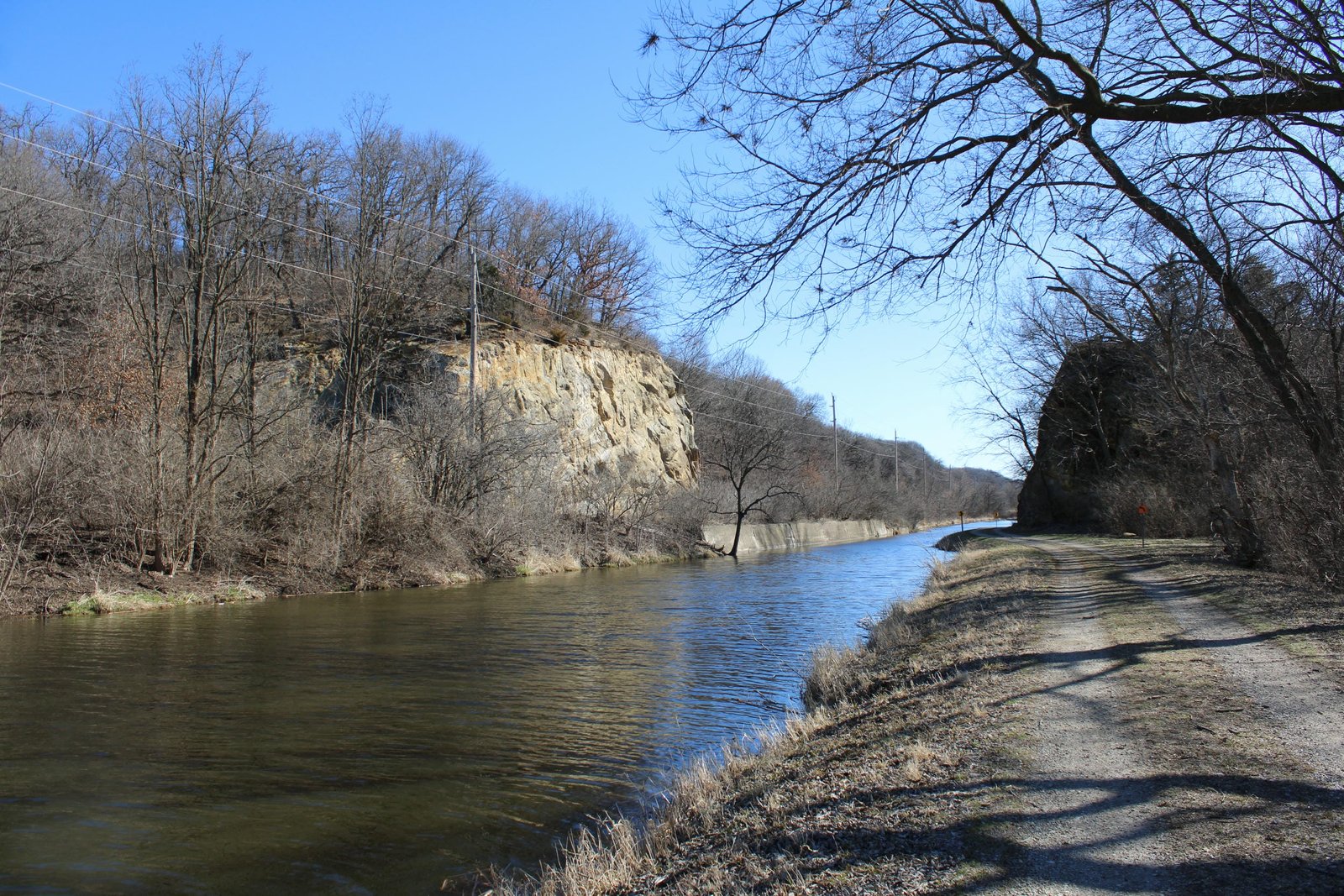
Located between LaSalle and Utica, this short tunnel once carried the Chicago, Rock Island & Pacific Railway under Split Rock. Between 1836 and 1848, the Illinois and Michigan (I&M) Canal was constructed to connect Lake Michigan to the Mississippi River via the Illinois River. East of LaSalle, a large sandstone bluff posed a formidable challenge for the canal, requiring exhaustive labor and primitive construction techniques to blast a cut through the bluff. After the canal was completed, the bluff became known as "Split Rock" due to the nature of the cut. In 1851, the Rock Island began planning a new railroad between Chicago and Rock Island, roughly paralleling the I&M Canal between Joliet to LaSalle. One of the most difficult portions of the new railroad was at Split Rock, which either required removing the bluff or constructing a short tunnel to avoid encroaching on the canal property. In March 1852, a contract was let to Clark & Mann for constructing section 47 of the new railroad, which included a section between Utica and LaSalle, including a tunnel at Split Rock. After a year of difficult construction, the railroad opened between Ottawa and LaSalle in March 1853. In 1882, a second track was constructed by removing a portion of the bluff immediately south of the tunnel.
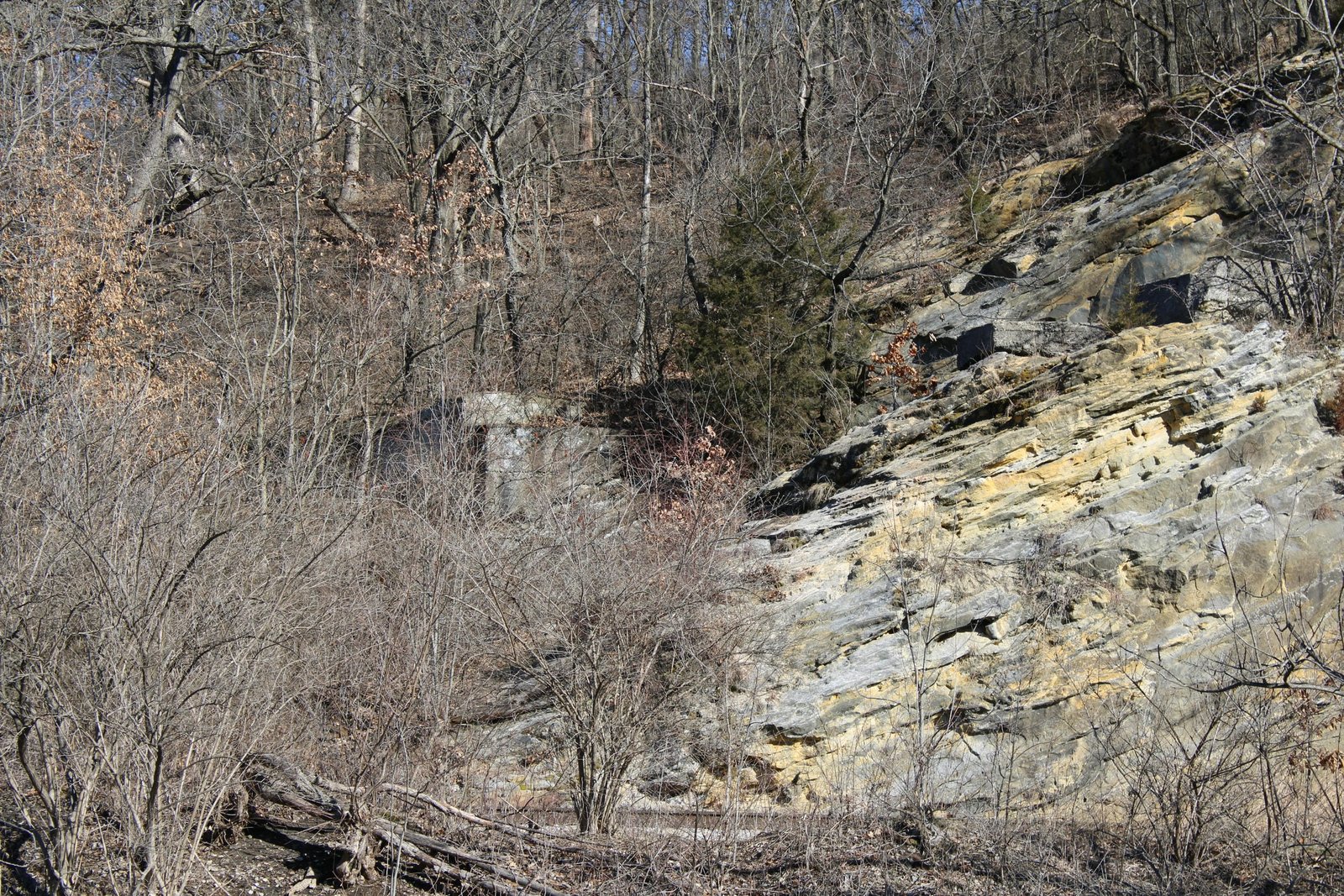
In 1902-03, the Illinois Valley Traction Company, later the Chicago, Ottawa & Peoria Railroad (CO&P) constructed an interurban line between Ottawa and Ladd, Illinois. Due to the limited space available along the canal, it was decided to construct an overpass at this location, including a small through plate girder span over the Rock Island track and a larger 8-panel, pin-connected Pratt through truss span over the canal and second Rock Island track. The truss span was lightly constructed, and possibly reused from a larger steam railroad. To facilitate the construction of the interurban, a portion of the the bluff was blasted away and the interurban tracks were constructed on steep ramps on the northwest and southeast quadrants of the bluff. In 1922, the interurban would become part of the Illinois Traction System (ITC), a large network of interurban lines throughout central Illinois. The interurban bridge was removed in 1934 when the entire line was shut down due to declining demand. Today, one abutment remains on the northwest wall of the tunnel.
The tunnel consists of an approximately 165-foot long tunnel, bored directly through the sandstone bluff. The portals consist of exposed rock, and have not been reinforced with any traditional arch designs. The rock at this location is a yellowish sandstone with large black streaks. Portions of the north wall of the tunnel have been reinforced with cut white limestone. The tunnel was constructed by Clark & Mann, which received the contract for constructing a portion of the Rock Island between Utica and LaSalle. Additional repairs to the tunnel were likely completed by railroad company labor. Since the opening of the tunnel, this point was a significant bottleneck for the Rock Island, restricting equipment operating on a heavily used mainline. After the interurban was abandoned and the north towpath of the canal became disused, the Rock Island acquired an easement to add a second track south of the tunnel, effectively bypassing the tunnel. The southeast wall of the tunnel was encased in concrete when the tracks were relocated, likely to protect it in case of a derailment. The northernmost track around the tunnel was removed shortly after the fall of the Rock Island, and the tunnel has stood abandoned since. Overall, the tunnel appears to be in fair to good condition, with no signs of structural failure. The author has ranked this tunnel as being moderately significant, due to the short length, age and because it is one of the only tunnels in northern Illinois.
Citations
| Builder and build date | Freeport Journal; March 25, 1853 |
| Railroad History Citation | ICC Valuation Information, Compiled by Richard S. Steele |