
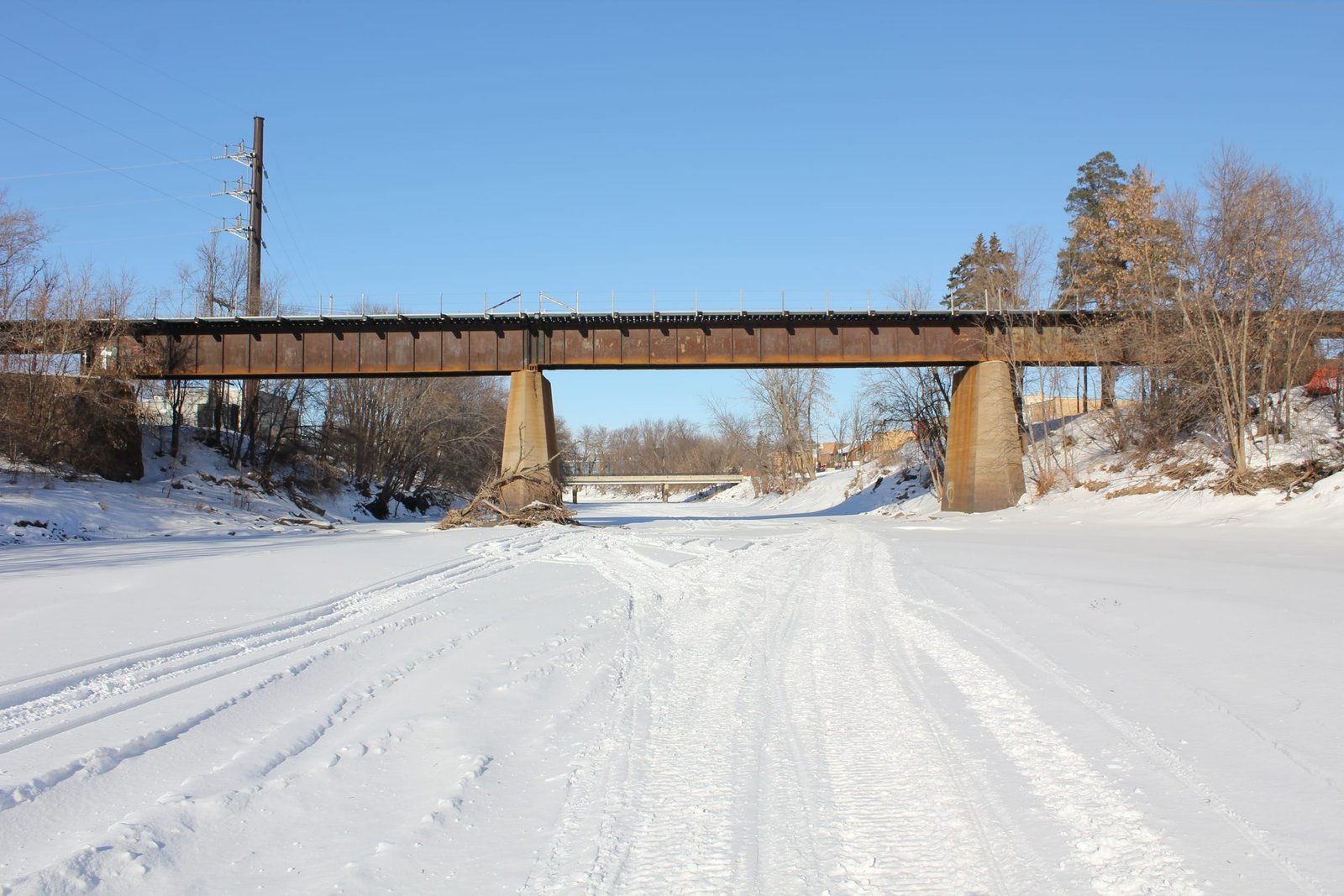


Click the photo to view the full-size version
| Name | Delano Railroad Bridge Great Northern Railway Bridge #38.8 |
| Built By | Great Northern Railway |
| Currently Owned By | BNSF Railway |
| Superstructure Contractor | American Bridge Company of New York (Main Spans) Bethlehem Steel Company of Bethlehem, Pennsylvania (Approach Spans) |
| Substructure Contractor | Unknown |
| Erection Contractor | Frankman Brothers Construction Company of St. Paul, Minnesota |
| Length | 305 Feet Total, 80 Foot Main Span |
| Width | 1 Track |
| Height Above Ground | 40 Feet (Estimated) |
| Superstructure Design | Deck Plate Girder, Steel Stringer and Concrete Slab |
| Substructure Design | Stone Masonry and Concrete |
| Date Built | 1904, Approaches Added 1945 |
| Traffic Count | 15 Trains/Day (Estimated) |
| Current Status | In Use |
| Great Northern Railway Bridge Number | 38.8 |
| BNSF Railway Bridge Number | 38.8 |
| Significance | Local Significance |
| Documentation Date | 1/7/2014 |
In 1867, the First Division of The St. Paul and Pacific Railroad Company constructed 14.70 miles of new railroad between Minneapolis, Minnesota and Lake Junction (Wayzata). Work would continue westward in 1868, with an additional 29 miles constructed to Howard Lake, Minnesota. Work resumed in 1869, with 49 more miles constructed, reaching Willmar, Minnesota. Work resumed in 1870, with 31 more miles constructed to Benson, and an additional 81 miles would be constructed to Breckenridge, Minnesota; located on the western Minnesota border. The railroad would be sold to the St. Paul, Minneapolis & Manitoba Railway (StPM&M) in 1879.
During the 1880s, the StPM&M would acquire and construct a large amount of railroad lines throughout Minnesota. Owned by railroad magnate James J. Hill, the railroad would continue to grow into the 1890s, before being sold to the Great Northern Railway (GN) in 1907. The GN, like the StPM&M, was owned by James J. Hill, and the railroad would eventually reach the Pacific Coast at Seattle in 1893. The GN utilized this as a mainline, connecting the railroad town of Willmar to the Twin Cities, and to agricultural markets in Western Minnesota. In 1970, GN merged with rival Northern Pacific Railway and Chicago, Burlington & Quincy Railroad to form Burlington Northern Railroad. BN was in turn merged with Atchison, Topeka & Santa Fe Railway in 1996, to form BNSF Railway. BNSF currently operates the Minneapolis to Willmar portion of this line as the Wayzata Subdivision.
Located in Delano, this large deck plate girder bridge carries a former Great Northern Railway mainline over the Crow River and River Street. The first bridge at this location was likely a wooden truss bridge, constructed when the line was first built. It is unknown if this bridge was upgraded with an iron bridge or otherwise renewed later in the 19th Century. Between late 1904 and early 1905, the bridge was reconstructed with a new steel bridge on stone and concrete substructures. Heavy alterations were made to the bridge in 1945, which included replacing the east 50-foot through plate girder span with a steel stringer span and concrete slab span. Additional alterations included reconstructing the west end by converting the original stone abutment to a pier and installing an additional steel stringer span, giving the bridge its present configuration. Currently, the bridge consists of two 80-foot and one 60-foot deck plate girder spans, approached by a 31-foot steel stringer span and a 13-foot concrete slab span on the east end and a 39-foot steel stringer span on the west end. The east abutment, pier #2 and pier #5 (former west abutment) are constructed of stone, while the remaining substructures are constructed of concrete. The main spans follow a standard design, with two heavy plate girders per span and an open deck. The steel stringer spans also follow a standard design, with six shallow beams and an open deck. The east abutment and west pier (pier #5) both use stepped wing walls, which extend diagonally away from the bridge. The center three piers consist of large diamond shaped concrete structures, while pier #2 uses a simple square concrete shape. The east pier (pier #1) uses a more decorative concrete design, which is integral with the slab span. American Bridge Company fabricated the main spans, while Bethlehem Steel Company fabricated the approach beams. It is unclear if the substructures were constructed by railroad company forces or by unknown contractors. Deck plate girder spans were popular for railroad use, as they were durable and easy to construct. In addition to the 1945 repairs, several other alterations have been made to the bridge, including the encasement of pier #2 in concrete. It is possible that piers #3 and #4 were also constructed of stone and later encased in concrete. Today, the bridge remains in regular use as part of a BNSF Railway mainline. Overall, the bridge appears to be in fair to good condition, with no significant deterioration noted. The author has ranked the bridge as being locally significant, due to the common design.
Citations
| Build date and builder (deck girder spans) | American Bridge Company plaque |
| Build date and builder (steel stringer spans) | Bethlehem Steel Company plaque |
| Erection contractor | Great Northern Railway Willmar Division Bridge Index, located at the Minnesota Historical Society |
| Railroad History Citation | ICC Valuation Information, Compiled by Richard S. Steele |