
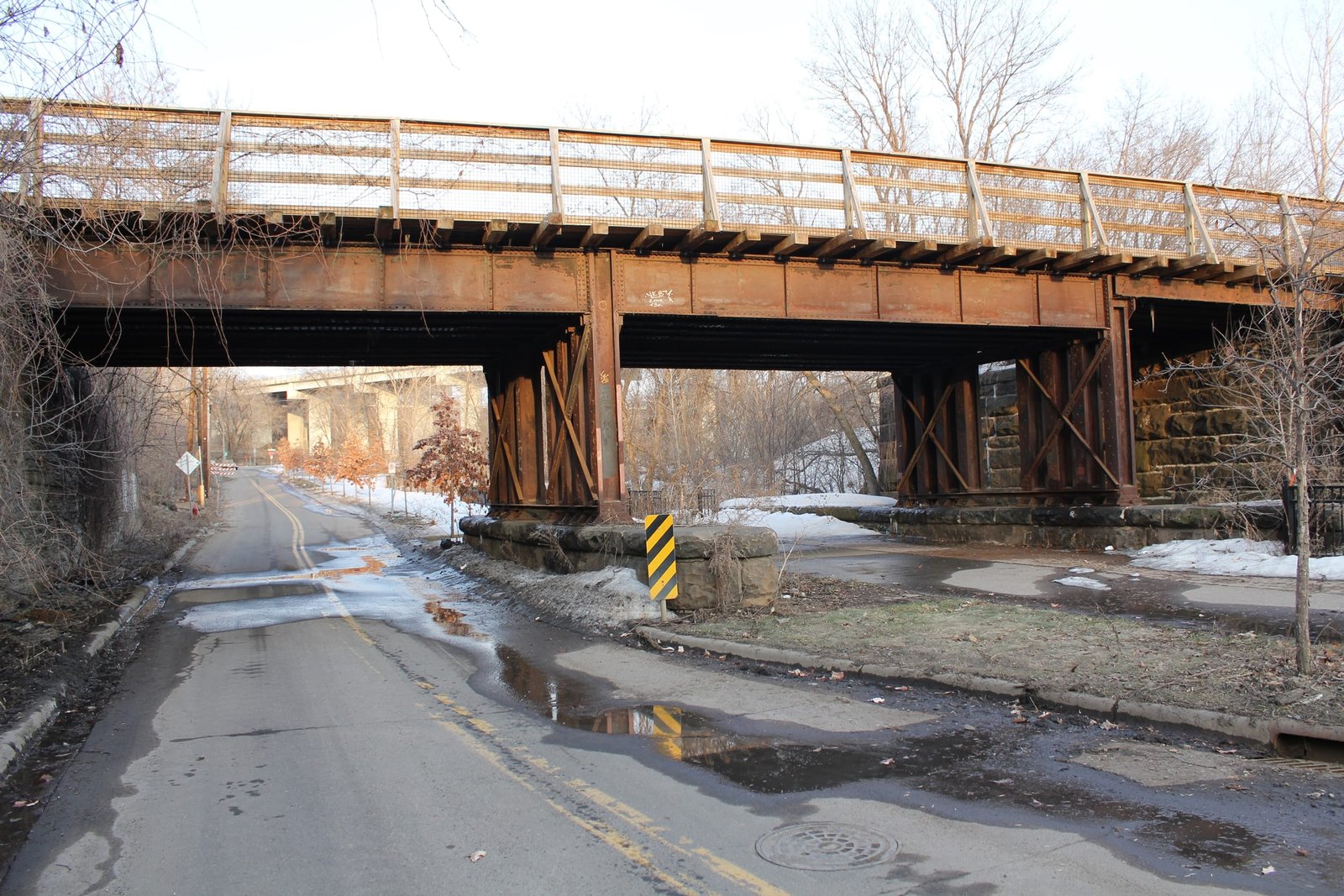


Click the photo to view the full-size version
| Name | Bruce Vento Nature Trail - 4th Street Bridge Northern Pacific Railway Bridge #0.1 |
| Built By | Northern Pacific Railway |
| Currently Owned By | Ramsey County Regional Railroad Authority |
| Superstructure Contractor | Lassig Bridge & Iron Works of Chicago, Illinois (Girder Spans) Unknown (South Span) |
| Substructure Contractor | Unknown |
| Length | 78 Feet Total, 29 Foot Main Spans |
| Width | 2 Tracks |
| Height Above Ground | 15 Feet (Estimated) |
| Superstructure Design | Deck Plate Girder and Steel Stringer |
| Substructure Design | Stone Masonry and Steel Bent |
| Date Built | 1880 (South Span) 1893 (Deck Girder Span) |
| Original Location (South Span) | Unknown |
| Traffic Count | 0 Trains/Day (Bridge is a Trail) |
| Current Status | Open to trail traffic |
| Northern Pacific Railway Bridge Number | 0.1 |
| Significance | Moderate Significance |
| Documentation Date | 3/26/2014 |
In 1867, the Lake Superior and Mississippi Railroad (LS&M) began construction on a new railroad line, extending north from St. Paul, Minnesota to Duluth, Minnesota; a distance of 155 miles. The LS&M was sold to the St. Paul and Duluth Railroad (StP&D) in 1877. Known as the "Skally Line", the line became a principal connection between the Twin Ports of Duluth, Minnesota and Superior, Wisconsin. A major line change was completed in 1888, when the "Duluth Short Line" was constructed between Thomson and Duluth, and the original line reduced to a spur. In addition, this new line involved the construction of a bridge across the St. Louis River at Grassy Point in Duluth. The StP&D would be sold to the Northern Pacific Railway (NP) in 1900. NP operated this as their mainline between the Twin Cities and the Twin Ports. NP had a large network of railroad lines in Minnesota, and also had a network that extended to the Pacific Coast at Seattle.
In 1970, NP would merge with rival Great Northern Railway (GN) and the Chicago, Burlington & Quincy to form Burlington Northern Railroad (BN). The GN had a parallel route, and BN quickly began to favor that route. The first section abandoned was between Carlton and West Duluth in 1976. Further cuts came in 1977, when the segment between Hinckley and Moose Lake was abandoned. By 1980, the Moose Lake to Carlton segment would be abandoned. The segment between Hugo and Forest Lake would be abandoned 1987, and the segments from Forest Lake to North Branch and White Bear Lake to St. Paul abandoned in 1989. All of the abandoned segments would be acquired for recreational trail use. In 1996, BN merged with the Atchison, Topeka & Santa Fe Railway to form BNSF Railway. In 1997, BNSF would sell the Hinckley-North Branch segment to the St. Croix Valley Railroad (SCXY).
Today, the Minnesota Commercial operates a small segment from Hugo to I-694 and SCXY continues to operate the Hinckley-North branch segment. The Bruce Vento Trail utilizes the former railroad grade between St. Paul and I-694, while the Sunrise Prairie Trail utilizes the grade between Hugo and North Branch, and the Willard Munger State Trail utilizes the railroad between Hinckley and West Duluth. BNSF continues to operate small amounts of track in Duluth.
Located in St. Paul, this deck plate girder bridge carries the former Northern Pacific Railway White Bear Lake line across 4th Street and Trout Brook. At this location, several railroads converged on St. Paul and operated extensive terminal facilities. The first bridge at this location likely consisted of a timber truss bridge, set onto stone abutments. In 1893, the bridge was reconstructed with the present steel and iron bridge. Currently, the bridge consists of two 29-foot deck plate girder spans, approached by an 18-foot steel stringer span on the south end. The bridge is set onto stone abutments and steel bents, which are supported by stone pedestals. The main spans each use four modest sized girders per track, which are equally spaced. The south span was originally fabricated in 1880 for use at an unknown location, and uses twelve shallow beams per track, arranged into four sets of three. The bents each use four steel I-beam columns per track, which are connected by light bracing at the bottom, top and diagonally. The girder spans are not directly supported by the bents, but instead are set onto a hanger at the top of the columns. Both abutments use a typical design, with short stepped wing walls. Stone for the abutments consists of both a tan sandstone, as well as a brown limestone at the tops. It is believed that the limestone additions were installed in 1893. Lassig Bridge & Iron Works fabricated the deck girders, while an unknown contractor fabricated the south span. An unknown contractor constructed the abutments, while it is unclear if an additional unknown contractor or railroad forces constructed the stone additions and pedestals. Deck plate girder spans were popular for railroad use, as they were durable and easy to construct. In addition to this bridge, a second steel stringer and timber pile trestle bridge, constructed in 1925 and removed in 2006, connected to a coach yard. Since the initial construction, the only significant alteration to the bridge came in 1941, when it was reinforced. It is unclear if this reinforcement added additional girders or beams. The bridge last served railroad traffic in the 1980s. In 2007, the bridge was rebuilt with a new concrete deck and railings, and now carries the Bruce Vento Nature Trail. Overall, the bridge appears to be in fair condition, with no significant deterioration noted. The author has ranked this bridge as being moderately significant, due to the older age.
Citations
| Build Date | St. Paul Division Bridge Book at the Northern Pacific Railway Historical Association Archives |
| Builder (main span) | Missing Lassig Bridge & Iron Works plaque |
| Railroad History Citation | ICC Valuation Information, Compiled by Richard S. Steele |