





Click the photo to view the full-size version
| Name | Abandoned Fond du Lac River Bridge Chicago & North Western Railway Bridge #304 |
| Built By | Chicago & North Western Railway |
| Currently Owned By | Canadian National Railway |
| Superstructure Contractor | Unknown |
| Adolph Green Construction Company of Green Bay, Wisconsin | |
| Length | 115 Feet Total |
| Width | 2 Tracks, Formerly 3 Tracks |
| Height Above Ground | 10 Feet (Estimated) |
| Superstructure Design | Quadrangular Lattice Through Truss |
| Substructure Design | Stone Masonry |
| Date Built | 1902 |
| Traffic Count | 0 Trains/Day (Bridge is Abandoned) |
| Current Status | Abandoned |
| Chicago & North Western Railway Bridge Number | 304 |
| Significance | Moderate Significance |
| Documentation Date | 8/6/2016 |
In 1854, the Rock River Valley Union Railroad Company (RRVU) constructed 18 miles of new railroad, extending from Chester, Wisconsin to Fond du Lac, Wisconsin. In 1855, the railroad began construction on an additional 11 miles, prior to being consolidated into the Chicago, St. Paul and Fond du Lac Railroad (CStP&FdL) early that year. The CStP&FdL completed the 11 miles south to Minnesota Junction, Wisconsin (present-day Clyman Junction) in 1855. The CStP&FdL was sold to the Chicago & North Western Railway (C&NW) in 1859. The C&NW constructed an additional 57 miles of railroad between Janesville, Wisconsin and Minnesota Junction in 1859. The same year, the C&NW completed 17 additional miles between Fond du Lac and Oshkosh, Wisconsin; followed by 20 miles between Oshkosh and Appleton, Wisconsin in 1861 and an additional 28 miles between Appleton and Green Bay, Wisconsin in 1862. The C&NW was reorganized in 1864, and the line would be extended north into Michigan in the 1860s and early 1870s.
During the second half of the 19th Century, the C&NW had constructed and acquired a large amount of trackage throughout the Midwest. By the 20th Century, the C&NW was operating an extensive railroad network, which radiated north and west from Chicago. This line served as a mainline, connecting the mainline at Janesville to industrial areas along Lake Winnebago and to Lake Michigan at Green Bay. While the line served as a mainline, it was one of two parallel routes between southern Wisconsin and Green Bay, with the other line following the shore of Lake Michigan north from Milwaukee. By the late 20th Century, the C&NW had begun to consolidate operations and abandon excess lines to remain a profitable railroad. The line between Clyman Junction and Fond du Lac would be abandoned in 1985, and purchased for trail use.
In 1988, the C&NW sold the Fond du Lac to Green Bay segment of this line to the Fox River Valley Railroad, which became the Fox Valley and Western Ltd. (FV&W) in 1993. The FV&W was a subsidiary of the successful Wisconsin Central Ltd. (WC), which had acquired a large amount of former Milwaukee Road and Soo Line trackage in Wisconsin. The C&NW was purchased by Union Pacific Railroad (UP) in 1995. The segment between Janesville and Fort Atkinson, Wisconsin would be abandoned in 1998, and portions acquired for trail use. Portions of the line between Oshkosh and Neenah were also abandoned in the late 1990s. In 2001, WC was purchased by Canadian National Railway (CN), and became the American subsidiary of the railroad. After CN acquired the line, portions of the line in Fond du Lac were abandoned in 2003, and the Fond du Lac to Oshkosh segment would be heavily rebuilt. Today, the Fond du Lac to Clyman Junction segment is used as part of the Wild Goose State Trail, and portions near Fort Atkinson and Neenah are also used by trails. UP operates the Clyman Junction to Fort Atkinson segment as the Clyman Industrial Lead, and CN operates the North Fond du Lac to Green Bay segment as the Fox River Subdivision.
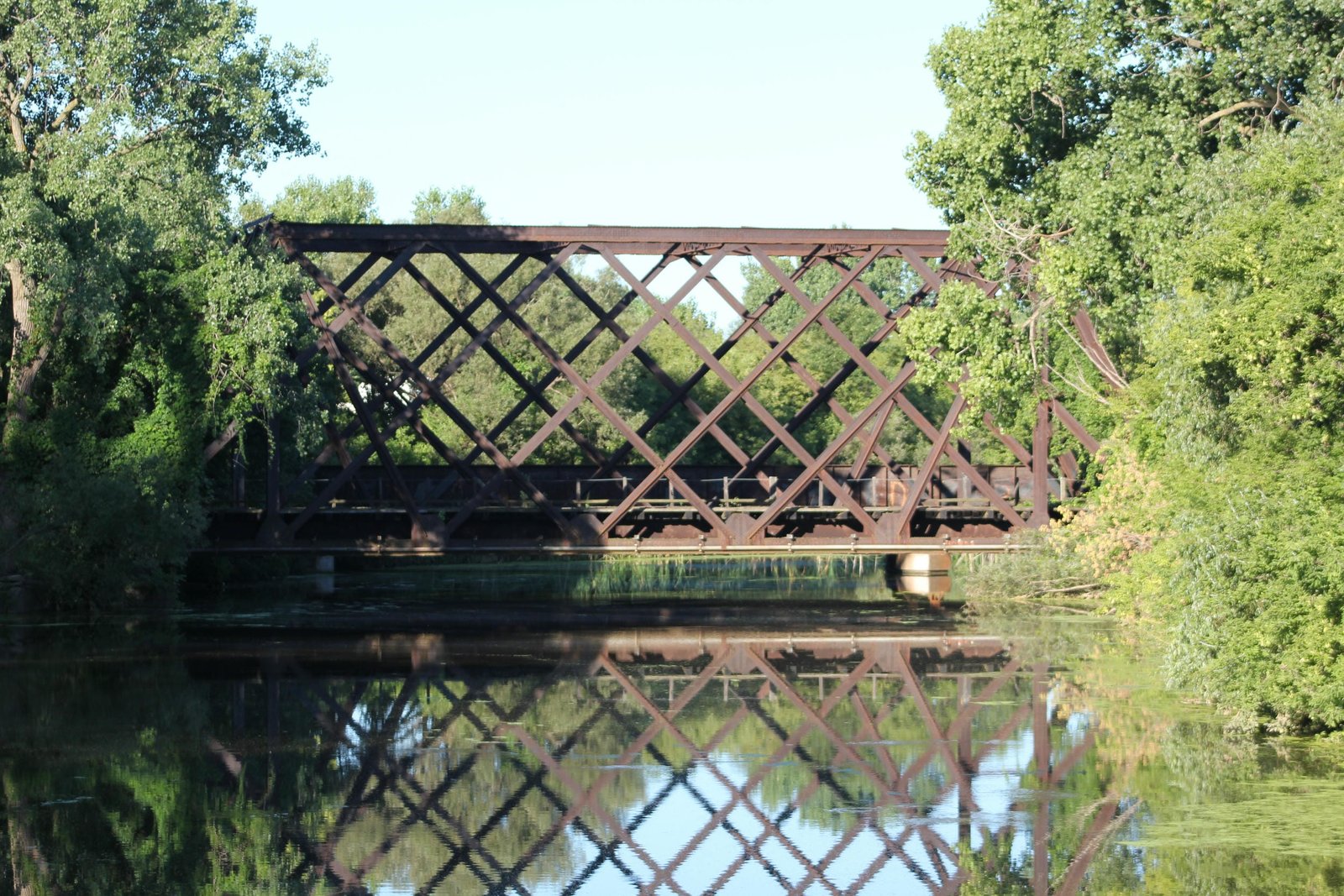
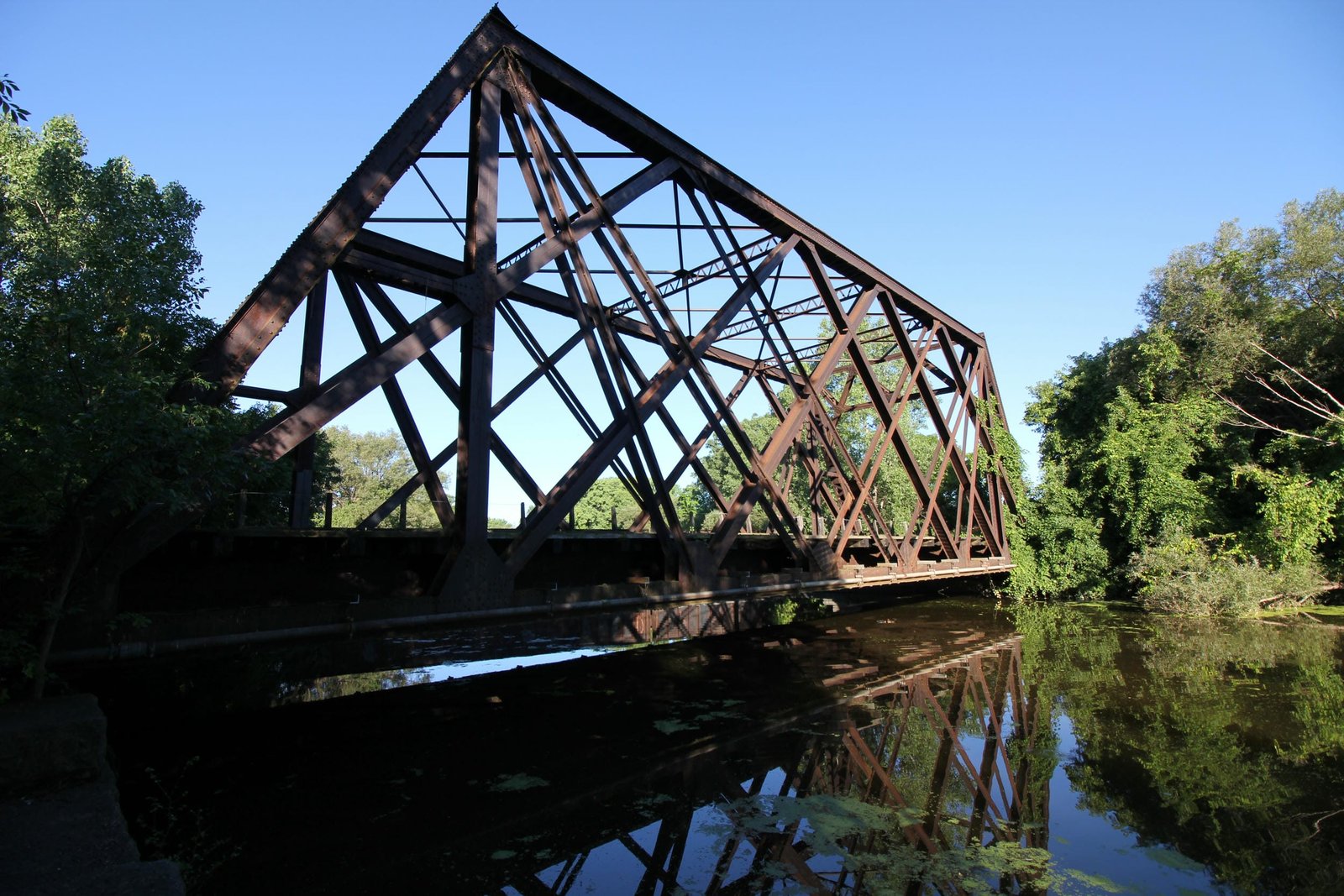
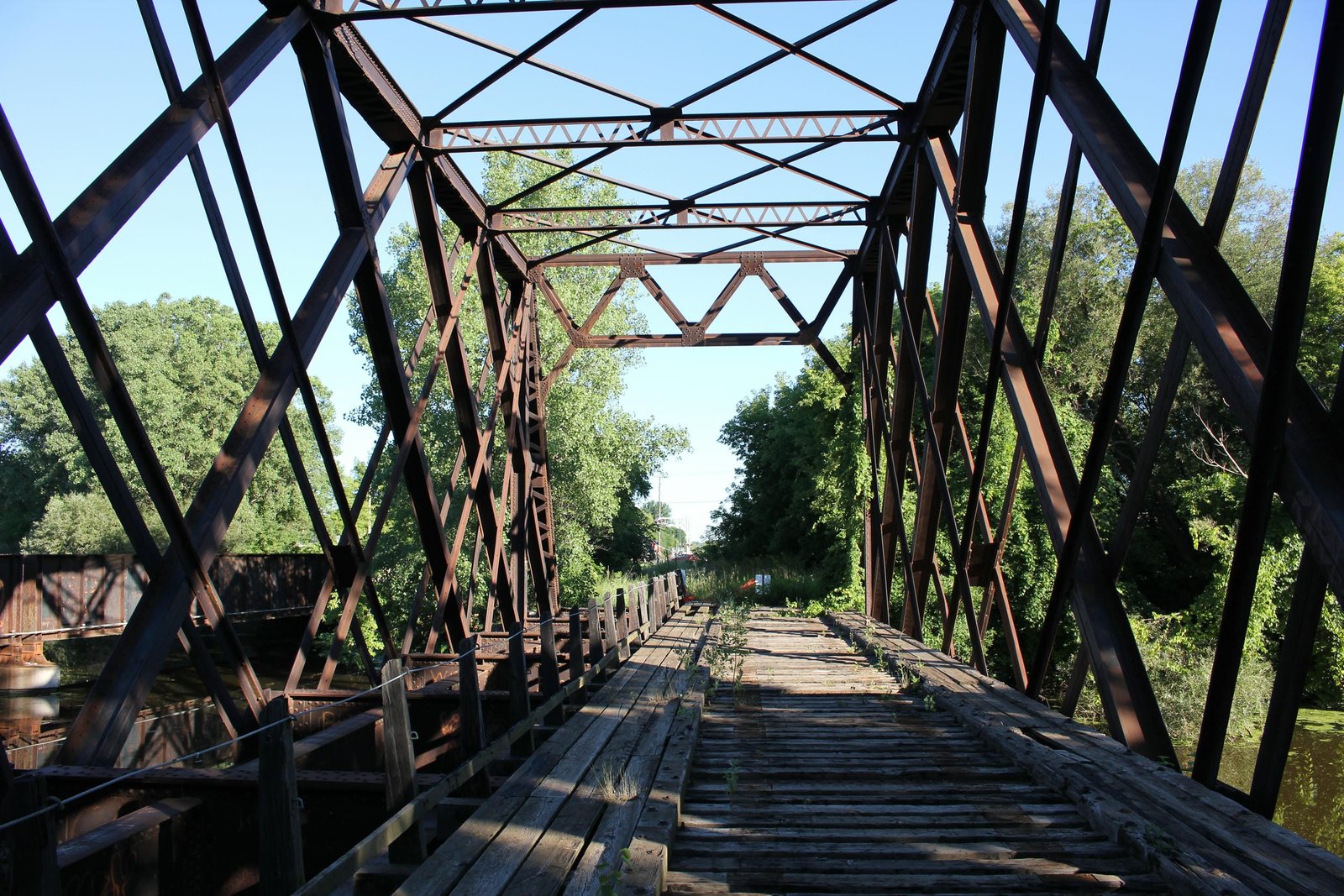
Located near Scott Street on the north side of Fond du Lac, this through truss bridge carries the abandoned Chicago & North Western Railway mainline over the Fond du Lac River alongside the former Soo Line bridge. The first bridge at this location was likely a timber pile trestle or a wooden truss bridge, constructed when the line was first built. It is unclear if this bridge was upgraded in the 1870s or 1880s by an iron span. In 1895, the bridge was rebuilt with a single track quadrangular lattice through truss span, fabricated by Lassig Bridge & Iron Works. This span used a standard design, with built-up members, a standard pedimented portal bracing and was set onto stone abutments. In April 1898, the bridge was severely damaged by a derailment, but miraculously did not collapse. Instead, the span was temporary braced and repaired with new members. During the first years of the 20th Century, the C&NW sought to double track the line between Fond du Lac and Green Bay. As part of the work, a new double track truss span was installed west of the single track span, and new abutments constructed to carry the three track bridge. The bridge retained this configuration until 1940, when the single track span was removed, giving the bridge its present configuration.
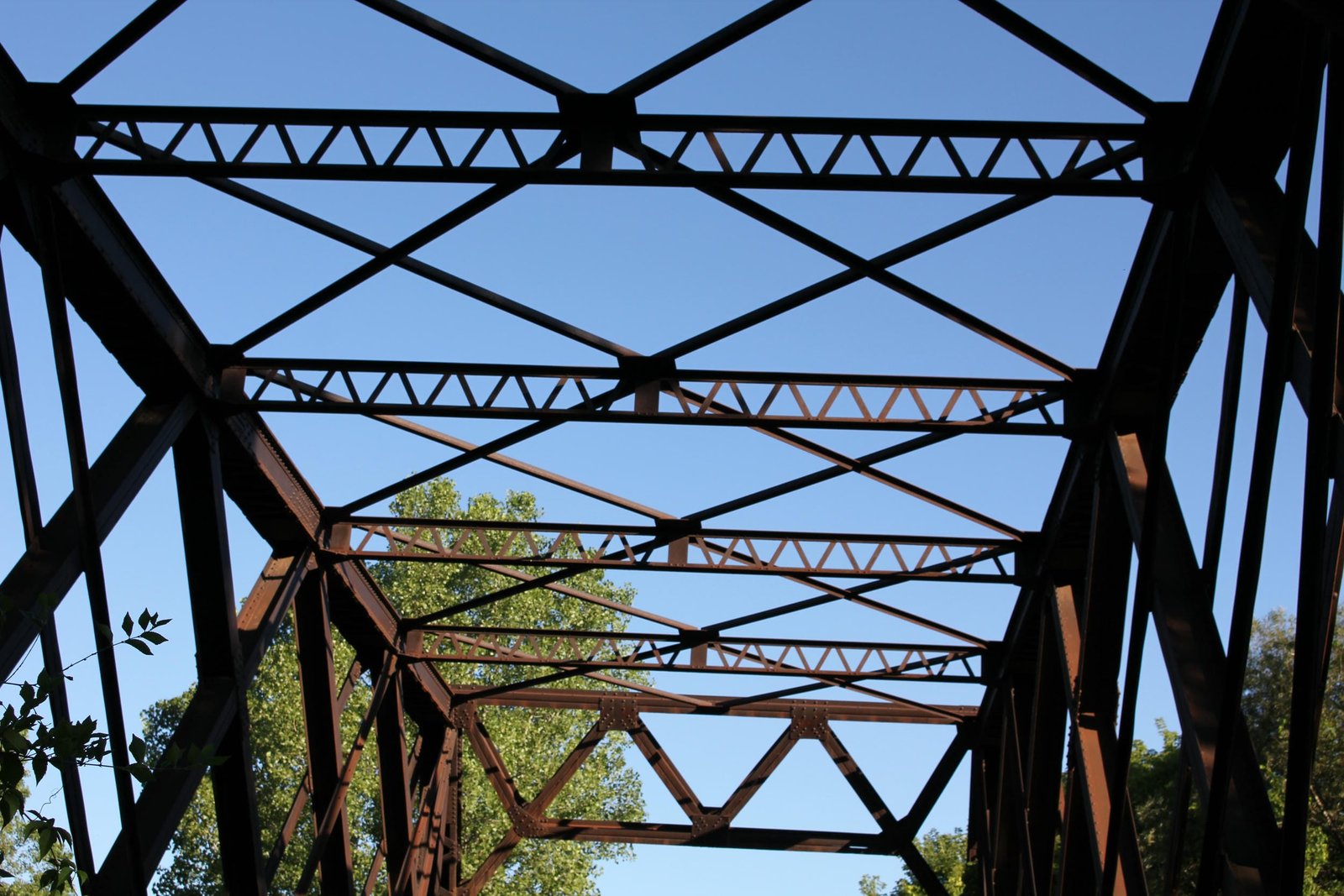
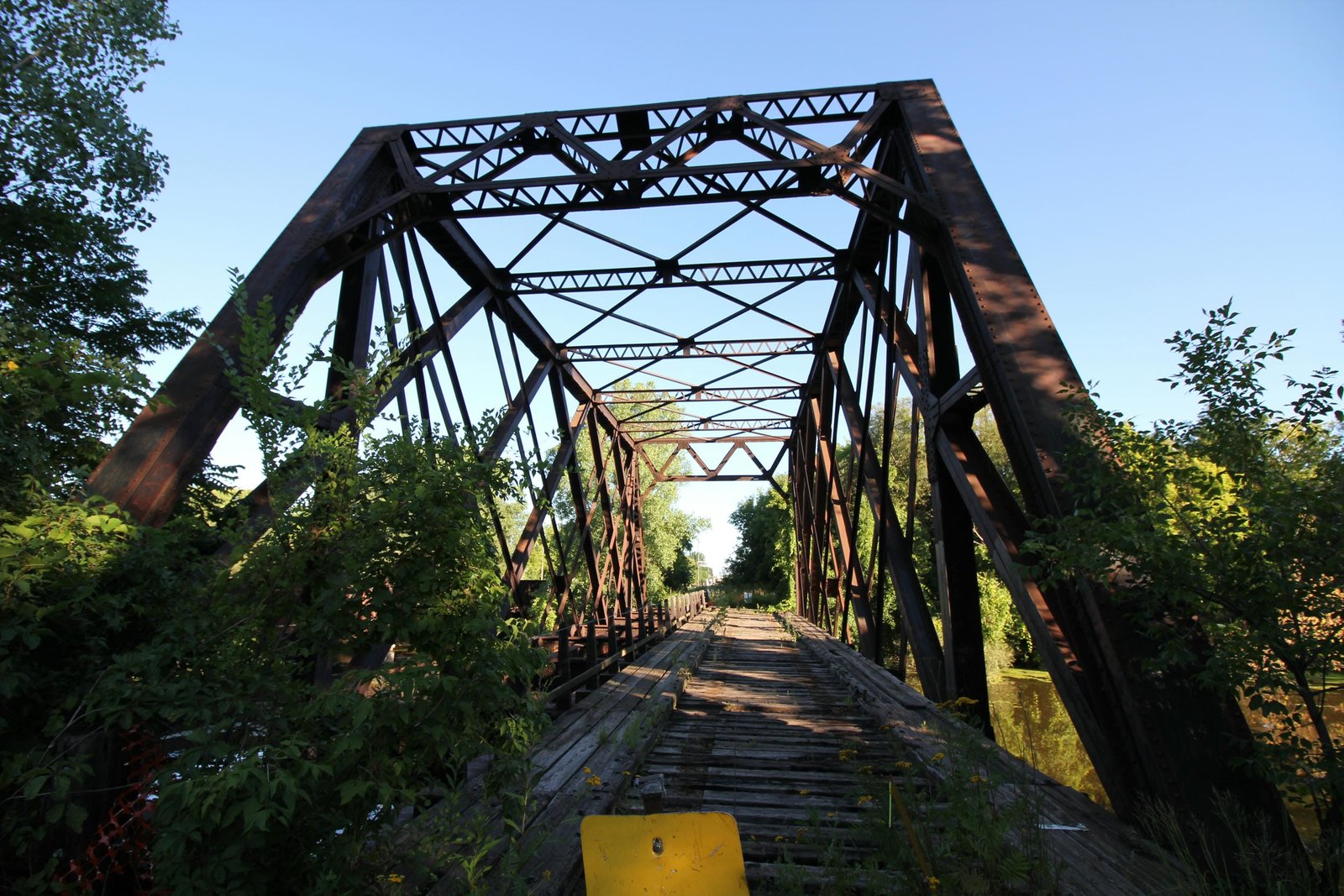
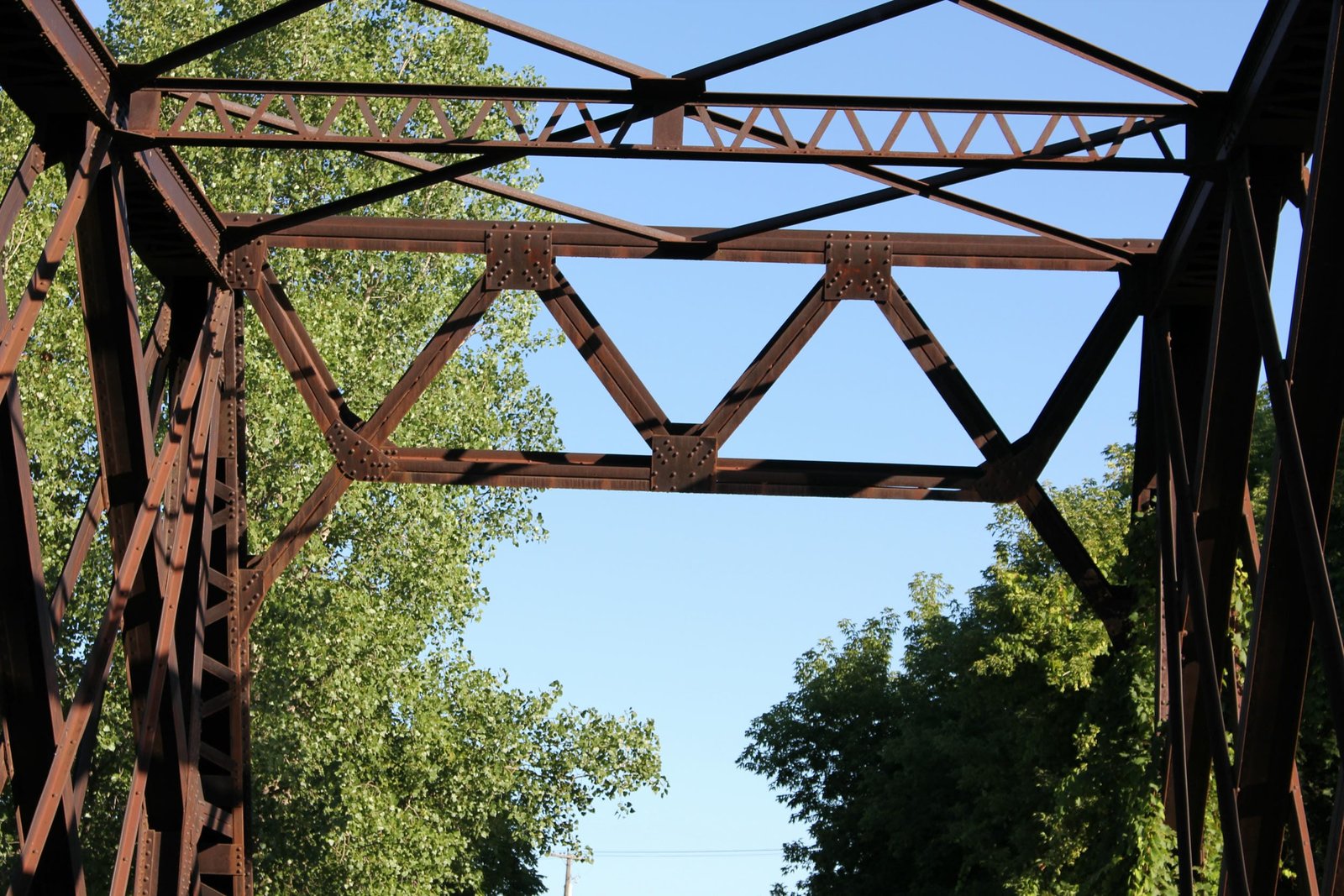
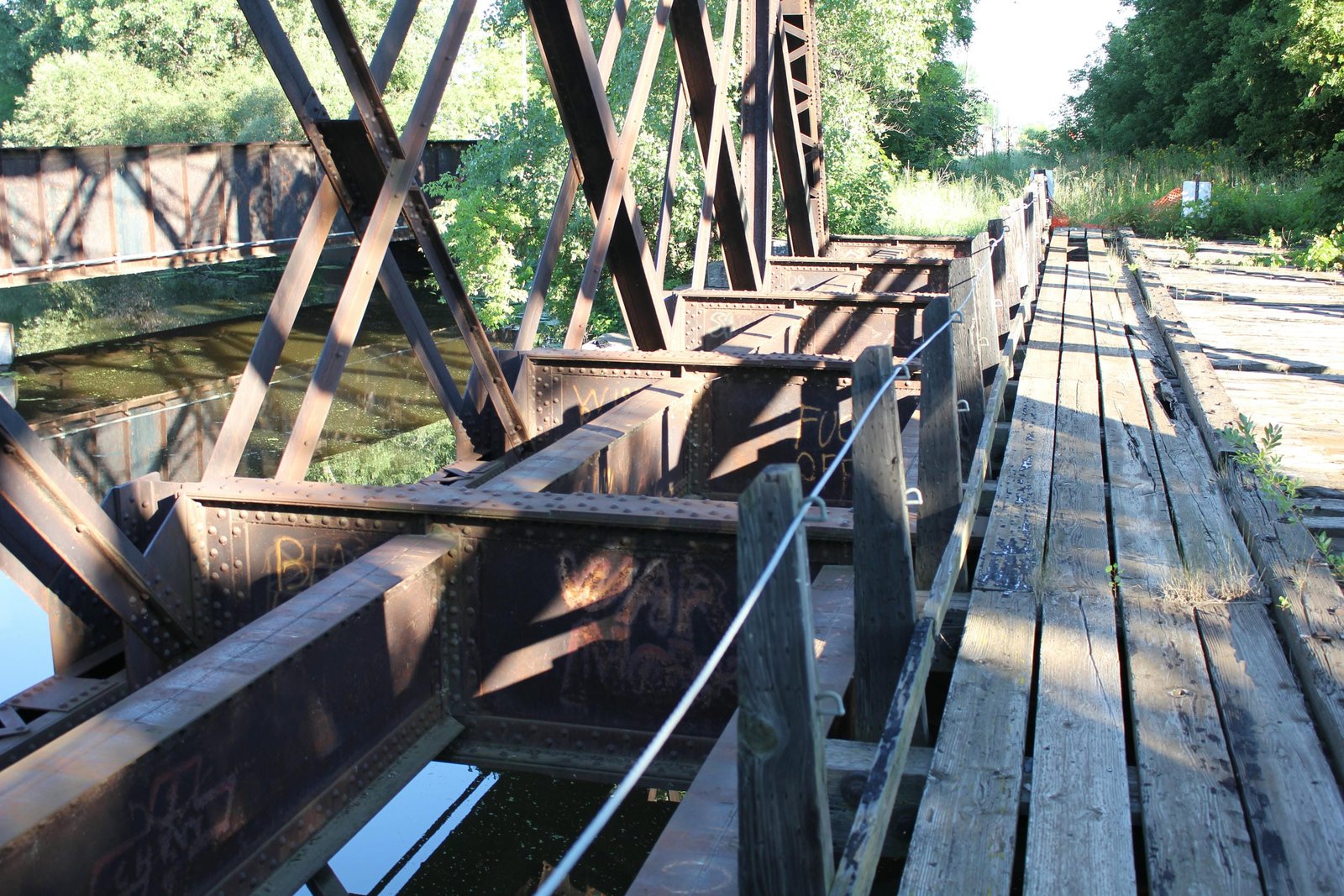
Currently, the bridge consists of a 115-foot, double track, riveted quadrangular lattice through truss span, set onto stone abutments. The truss span follows a design commonly used by the C&NW around the turn of the 20th Century, with heavier members, a standard floor and a utilitarian portal bracing. The top chord and endposts both use a built-up design, with V-lacing on the bottoms and a solid plate on the top. The bottom chord is similarly composed, and uses V-lacing on both sides. The diagonal members are constructed out of solid built-up beams and L-shaped bars, and do not consist of any laced members. The floor system follows a standard design, with two plate girder stringers per track and plate girder floorbeams spaced at panel points. The portal bracing follows an M-frame design, which is constructed using V-laced beams. V-laced beams are also used for the sway bracing. L-shaped steel bars are used for both the upper lateral and lower lateral bracing. The abutments follow a standard design, with short stepped wing walls. Stone for the abutments consists of a white limestone, likely quarried at Duck Creek, Wisconsin. An unknown contractor fabricated the truss span, while Adolph Green Construction Company constructed the abutments. This firm constructed substructures for many C&NW bridges in eastern Wisconsin during the early 20th Century.
This type of truss design is relatively uncommon throughout the United States. However, a few railroads preferred the design, such as the Chicago, Rock Island & Pacific Railway (Rock Island), the Chicago & North Western Railway (C&NW) and the Chicago, St. Paul, Minneapolis & Omaha Railway (Omaha Road). Spans constructed in the late 1870s and early 1880s for the C&NW featured an arched and pedimented lattice portal bracing, light sway bracing and laced members. The second generation was nearly exclusively constructed by Lassig Bridge & Iron Works between 1884 and 1900, and featured heavier members and a decorative pedimented portal bracing. While the design fell out of favor for the Rock Island and Omaha Road around the turn of the 20th Century, the design remained popular with the C&NW into the 1920s. 20th Century versions of this design used significantly heavier members, were taller and contained no decorative features. 19th Century versions of this design were primarily constructed out of wrought iron, while 20th Century versions of this design were constructed of steel. The C&NW preferred this design, as it was both strong and demonstrated great resilience in case of a derailment. Since the removal of the third track, the bridge has seen no significant alterations. The bridge was abandoned in favor of the adjacent Soo Line bridge in the early 2000s, and remains abandoned. The bridge could potentially be reused to provide a short walking path and observation area. Overall, the bridge appears to be in fair to good condition, with no significant deterioration noted. The author has ranked this bridge as being moderately significant, due to the truss design.
Citations
| Build date | Chicago & North Western Railway Valuation Notes at the Chicago & North Western Historical Society Archives |
| Builder (substructure) | The Railroad Gazette; Volume 34, Issue 9 |
| Railroad History Citation | ICC Valuation Information, Compiled by Richard S. Steele |