




Click the photo to view the full-size version
| Name | Shoreland 400 Trail - Sheboygan River Bridge Chicago & North Western Railway Bridge #2012 |
| Built By | Chicago & North Western Railway |
| Currently Owned By | Shrboygan County |
| Superstructure Contractor | American Bridge Company of New York |
| Substructure Contractor | Unknown |
| Length | 328 Feet Total, 162 Foot Main Span |
| Width | 1 Track |
| Height Above Ground | 20 Feet (Estimated) |
| Superstructure Design | Deck Plate Girder and Steel Stringer |
| Substructure Design | Stone Masonry, Concrete and Steel Bent |
| Date Built | 1948 |
| Traffic Count | 0 Trains/Day (Bridge is Open to Pedestrian Traffic) |
| Current Status | Open to Pedestrian Traffic |
| Chicago & North Western Railway Bridge Number | 2012 |
| Significance | Local Significance |
| Documentation Date | 8/5/2016 |
In 1872, the Milwaukee, Manitowoc and Green Bay Railroad (MM&GB) constructed 49 miles of new railroad, extending from Lake Shore Junction on the north side of Milwaukee, Wisconsin to Sheboygan, Wisconsin. The MM&GB changed its name to the Milwaukee, Lake Shore and Western Railroad (MLS&W) after completion of the line. The following year, the MLS&W resumed construction, completing an additional 32 miles to Two Rivers, Wisconsin, via Manitowoc, Wisconsin. The MLS&W was reorganized as the Milwaukee, Lake Shore and Western Railway (MLS&W) in 1885, which again was reorganized with the same name in 1883. The MLS&W had constructed a handful of lines in northeast Wisconsin during the late 19th Century, primarily to connect Lake Michigan and Lake Superior. This line initially provided the MLS&W with a connection to the Chicago & North Western Railway (C&NW) at Milwaukee, which allowed the MLS&W to access Chicago. Due to the success of the MLS&W, the railroad was purchased by the Chicago & North Western Railway in 1893. The C&NW had acquired and constructed a vast network of railroad lines throughout the Midwest during the late 19th Century, and the MLS&W system provided more opportunities for expansion.
During the early 20th Century, the C&NW sought to improve operations by constructing new lines and improving existing lines. The C&NW had become one of the premiere Midwest railroads, and sought to stay profitable and competitive. The Manitowoc, Green Bay and North Western Railway (MGB&NW) was incorporated as a subsidiary of the C&NW in 1904 to construct a new connection between Manitowoc and Green Bay. A 36 mile line was completed between the two cities in 1906, and the MGB&NW was sold to the C&NW in 1909. Also in 1906, a bypass around the west side of Sheboygan was constructed to avoid the congested lakefront line. These new lines provided the C&NW with a faster route between Chicago and Green Bay, serving Milwaukee and bypassing the industrial areas along Lake Winnebago. As traffic on the route grew in the 20th Century, the Village of Whitefish Bay became concerned with the growing amount of trains through the Village. In response, the C&NW constructed a short 4 mile cutoff between the north side of Whitefish Bay and Wiscona, a railroad junction on the north side of Milwaukee in 1929. The portion of the line between Lake Shore Junction and Whitefish Bay would be removed immediately after completion of the cutoff. Throughout the 20th Century, this line remained a core mainline for the C&NW, and was known as the Shoreline Subdivision.
By the late 20th Century, the C&NW sought to consolidate operations and abandon or sell unprofitable lines. In 1988, the C&NW sold the Cleveland, Wisconsin to Green Bay segment and the Two Rivers Branch to the Fox River Valley Railroad, which became the Fox Valley and Western Ltd. (FV&W) in 1993. The FV&W was a subsidiary of the successful Wisconsin Central Ltd. (WC), which had acquired a large amount of former Milwaukee Road and Soo Line trackage in Wisconsin. The C&NW was purchased by Union Pacific Railroad (UP) in 1995. In 1996, the segment between Denmark, Wisconsin and Rockwood, Wisconsin was abandoned and acquired for future trail use. In 2001, WC was purchased by Canadian National Railway (CN), and became the American subsidiary of the railroad. The Two Rivers Branch was abandoned in the 1990s or early 2000s. Much of the original line through Sheboygan was abandoned in approximately 2005, and CN abandoned the line between Manitowoc and Cleveland in 2013. In 2021, the Green Bay to Denmark segment was sold to the Fox Valley & Lake Superior Rail System (FOXY). Today, UP operates the Shoreline Subdivision between Wiscona and Cleveland; and CN operates the Shoreline Subdivision between Manitowoc and Rockwood. FOXY continues to operate the Denmark Branch between Green Bay and Denmark. The Rockwood to Denmark segment is known as the Devils River State Trail, and much of the original line through Sheboygan has been reused as a trail. Much of the UP segment between Sheboygan and Cleveland is out of service, and its future uncertain.
View historic articles discussing the construction of this bridge (digitalized by Google)
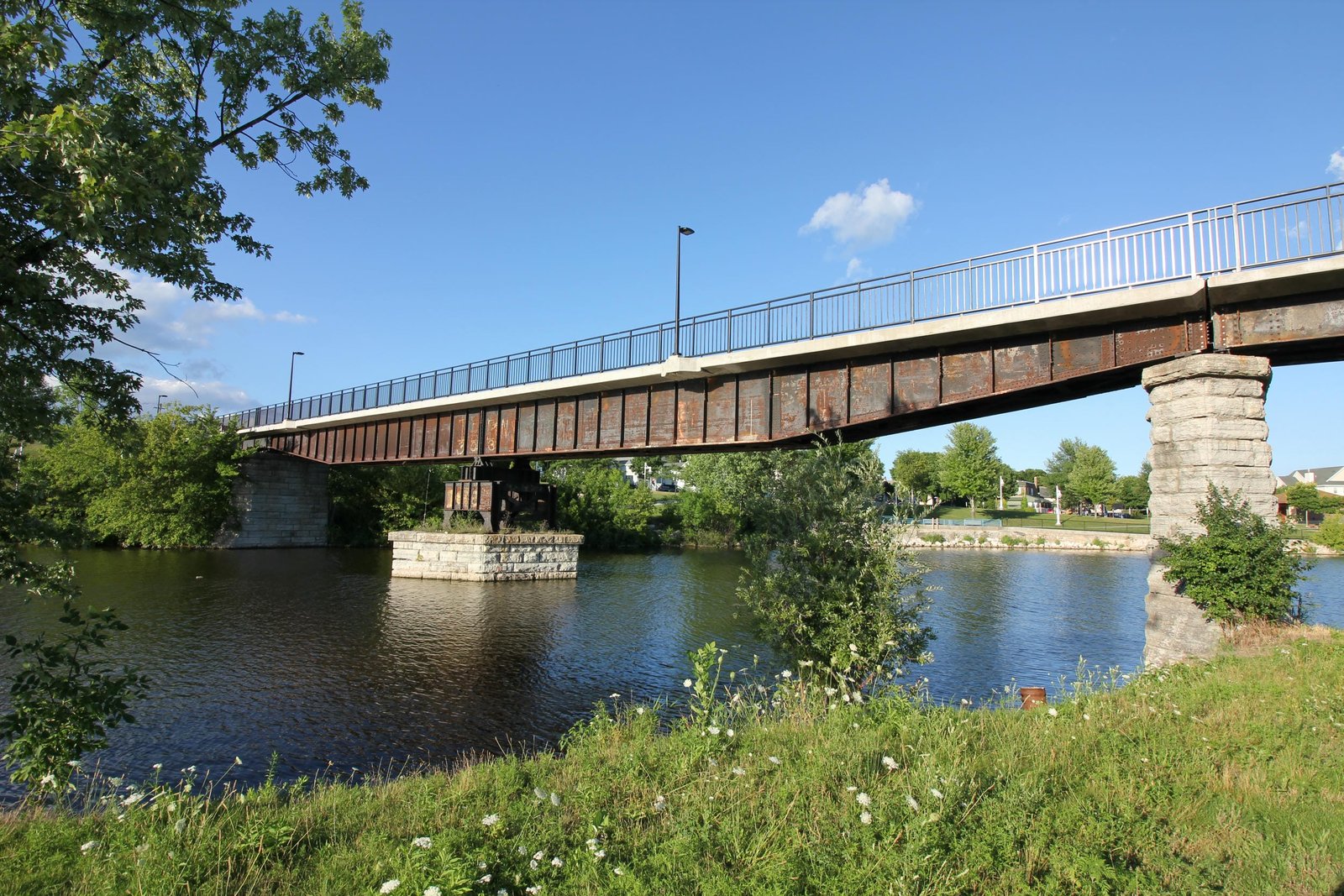
Located in Sheboygan, this large deck plate girder bridge carries the former Chicago & North Western Railway mainline over the Sheboygan River. The first bridge at this location likely consisted of a wooden swing bridge, composed of timber Howe deck truss spans. In the early 1890s, the Milwaukee, Lake Shore and Western Railroad made significant improvements to this line, replacing aging wooden bridges with steel and stone structures. In March 1892, work started on a new steel swing bridge, which was completed in early 1893. This bridge consisted of a 162-foot, 9-panel, pin-connected Pratt deck truss swing span, approached by a 75-foot, 4-panel span of the same design on the south end and a 90-foot, 5-panel span of the same design on the north end. Steel for the bridge was fabricated by the Wisconsin Bridge & Iron Company, which did a significant amount of work for the MLS&W during the early 1890s. The bridge was composed mainly of light built-up members and eyebars, and the swing span used a rim-bearing design. Rim bearing spans consist of a metal drum, which carries the superstructure and rotates about a track of wheels, which are turned by a gear. Upon completion of a new bypass of Sheboygan in 1906, this bridge became less important, but still served as a critical structure on the C&NW system.
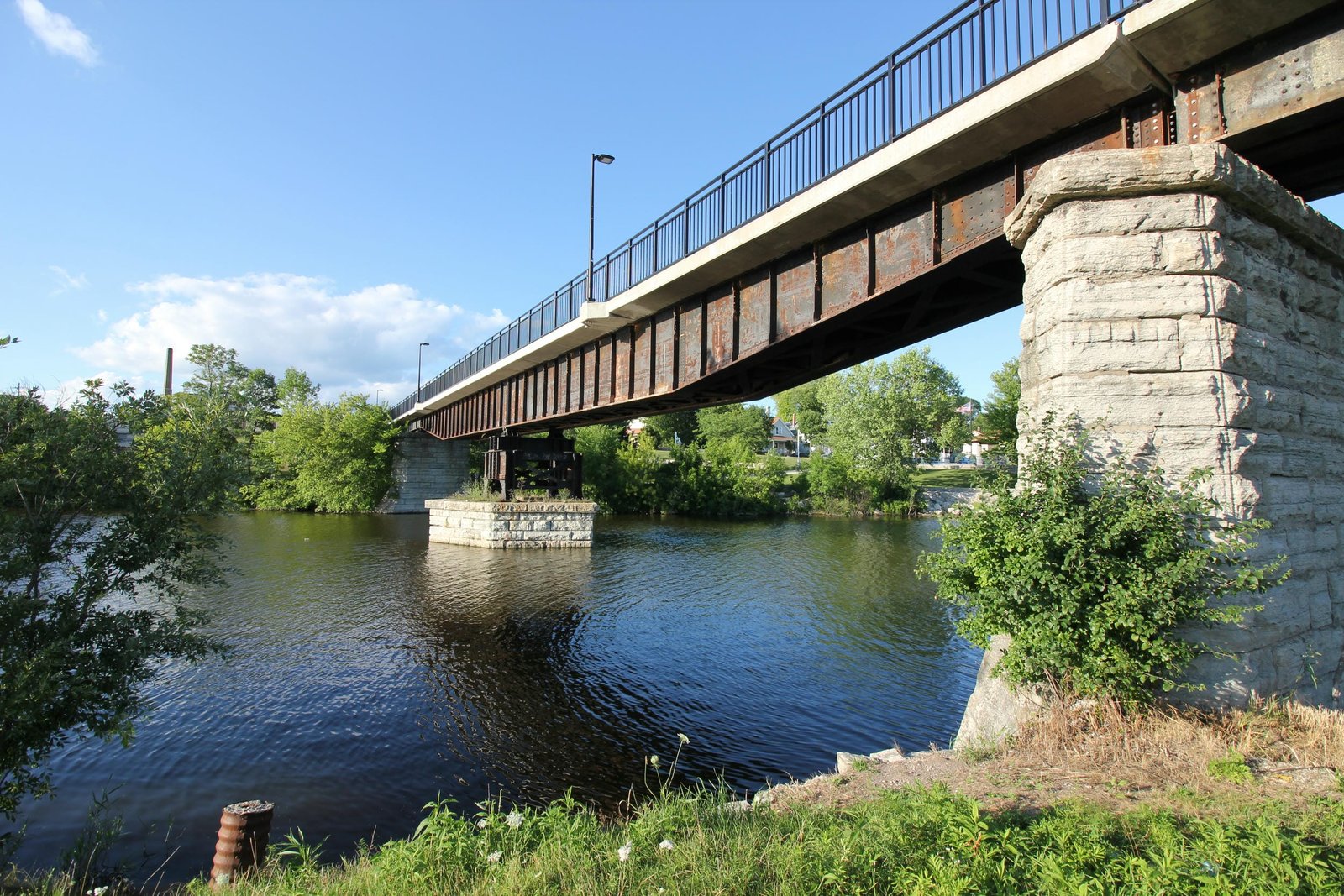
By the mid-20th Century, the 1893-era bridge had become too light for traffic. Planning for the replacement of the bridge began in 1947, with construction taking place in the spring of 1948. To minimize impacts to traffic, it was decided to fabricate the new deck plate girder span in one piece, and ship it to the site using five flat cars to carry the 280,000 pound bridge span. Prior to the installation of the main span, the approach spans were replaced by new steel stringer spans, and temporary timber bents were constructed to facilitate the installation of the new span. A new bent for the center of the bridge was constructed on the temporary timber bents, which allowed it to be slid into place. On April 30, 1948, work took place to install the new span. Work began at 5:00 am, and by 2:30 pm, the new bridge was completed. To install the span, two large wreckers were used to lift each end of the new span and lower it into place. Removing the old span only took 30 minutes, and installing the new span on the permanent bearings only took an hour. As part of the work, the original stone substructures were repaired as necessary, and steel bents were installed at the center pier and at the approach spans. Upon construction, the main span was the largest plate girder bridge ever fabricated or shipped by rail.
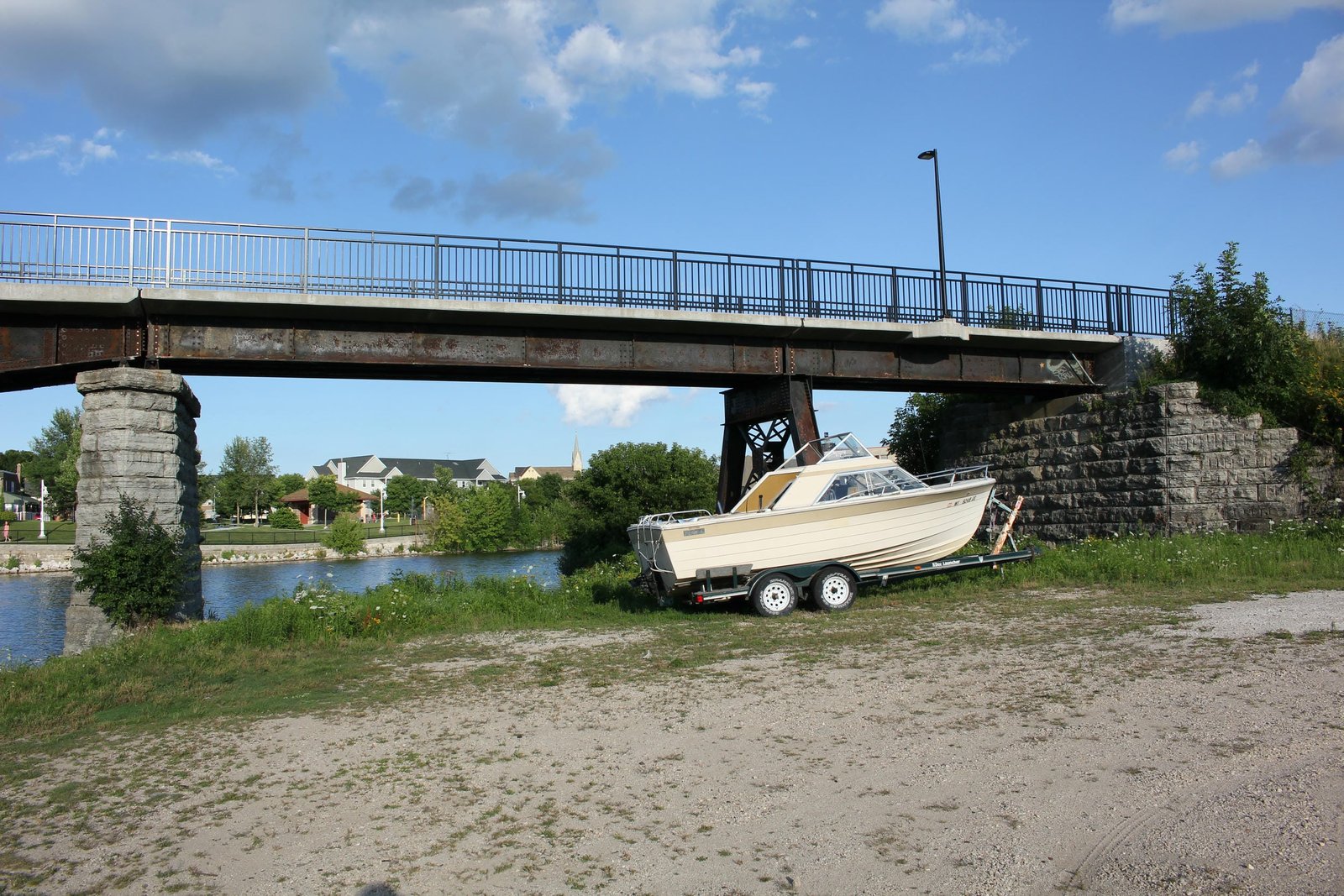
Currently, the bridge consists of a large 162-foot deck plate girder span, approached by a 30-foot and a 45-foot steel stringer span on the south end and two 45-foot steel stringer spans on the north end. The bridge is set onto stone abutments and piers, with steel bents underneath the approaches and the center of the main span. While the main span was never used as a swing span, it was designed so that it could easily be converted to a swing span if necessary. The center span consists of two heavy plate girders, with tapered ends and an open deck. The approach spans use four beams per span, arranged into two sets of two. The abutments use a standard design, with stepped diagonal wing walls. Similar to many bridges, the outer piers use a diamond shape, while the center pier consists of a hexagonal stone structure. The steel bents are composed of solid steel I-beams. American Bridge Company fabricated the superstructure, while the substructures were constructed by an unknown contractor. Deck plate girder spans were commonly used by railroads, as they were durable and easy to construct. Since the initial construction, the bridge has seen no significant alterations. In approximately 2014, a concrete deck and railings were added to the bridge, and it now carries the Shoreland 400 Trail. Overall, the bridge appears to be in good condition, with no significant deterioration noted. The author has ranked this bridge as being locally significant, due to the common design and newer age.
Citations
| Builder and build date | American Bridge Company plaque |
| Railroad History Citation | ICC Valuation Information, Compiled by Richard S. Steele |