


Click the photo to view the full-size version
| Name | CN Killsnake River Bridge Chicago, Milwaukee & St. Paul Railway Bridge #U-142 |
| Built By | Chicago, Milwaukee & St. Paul Railway |
| Currently Owned By | Canadian National Railway |
| Builder | Milwaukee Road Bridge & Building Department Labor |
| Length | 57 Feet Total, 19 Foot Spans |
| Width | 1 Track |
| Height Above Ground | 15 Feet (Estimated) |
| Superstructure Design | Concrete Slab |
| Substructure Design | Concrete |
| Date Built | 1917 |
| Traffic Count | Less Than 1 Train/Day (Estimated) |
| Current Status | In Use |
| Chicago, Milwaukee & St. Paul Railway Bridge Number | U-142 |
| Canadian National Railway Bridge Number | U-142 |
| Significance | Local Significance |
| Documentation Date | 8/5/2016 |
In 1870, the Milwaukee & Northern Railway (M&N) was charted to construct a railroad line between Milwaukee, Wisconsin and the Upper Peninsula of Michigan. Construction began the same year, and by the end of 1870, 13 miles had been constructed to Cedarburg, Wisconsin. In 1872, the railroad extended an additional 73 miles to Hilbert Junction, Wisconsin, and also constructed a branch line to Meshasha, Wisconsin. In 1873, an additional 27 miles would be completed to Green Bay. In 1874, the M&N completed a bridge across the Fox River, reaching Fort Howard, Wisconsin. In 1880, the M&N acquired the Ontonagon & Brule River Railroad (O&BR), which was planning a line through the Upper Peninsula of Michigan. In 1881, the O&BR constructed 20 miles between Rockland, Michigan and Ontonagon, Michigan. An additional 24 miles of track would be constructed by the M&N the same year, reaching a point near Stiles, Wisconsin. The following year, an additional 15 miles would be constructed to near Coleman, Wisconsin; followed by 22 more miles to Wausaukee, Wisconsin in 1883. In 1884, 10 more miles of track were completed to Amberg, Wisconsin, followed by an additional 20 miles to the Menominee River in 1886. In 1887, the M&N extended an additional 58 miles to Champion, Michigan. Between 1888 and 1889, the M&N extended to Sidnaw, Michigan; and in 1889, the O&BR extended an additional 26 miles from Rockland to Sidnaw to complete the line. The following year, the O&BR was fully absorbed by the M&N. In 1893, the M&N was acquired by the Chicago, Milwaukee & St. Paul Railway (Milwaukee Road).
This line quickly became a mainline for the Milwaukee Road, connecting Lake Superior to Milwaukee, and serving valuable metal deposits in the Upper Peninsula of Michigan. Throughout the late 19th and early 20th Century, the Milwaukee Road greatly expanded throughout the Midwest, acquiring and constructing numerous lines. By the early 20th Century, the Milwaukee Road was among the largest railroads in the United States, operating a network of railroad lines over 10,000 miles in length. The Milwaukee Road was often in financial trouble, especially after the costly Pacific Extension was completed in 1909. In 1925, the company declared bankruptcy, and reorganized as the Chicago, Milwaukee, St. Paul and Pacific Railroad in 1928. The railroad remained afloat through much of the 20th Century, although it remained in financial trouble. The railroad again entered bankruptcy in 1977 and was forced to liquidate unprofitable lines. In 1980, the Escanaba & Lake Superior Railroad (E&LS) purchased the line between Iron Mountain, Michigan; followed by the E&LS acquiring the Iron Mountain to Green Bay segment as part of a lease-to-own agreement in 1982. The State of Michigan and the State of Wisconsin both invested significant capital into upgrading the route, including replacing rail and ties.
By 1985, a suitor for the Milwaukee Road was being sought, and the Soo Line Railroad, controlled by Canadian Pacific Railway (CP) purchased the Milwaukee Road in 1986. A connection between the Chicago & North Western Railway (C&NW) and the E&LS was created at Howard, Wisconsin the same year, allowing the E&LS to discontinue use of the line between Howard and Green Bay. In 1987, the Milwaukee to Green Bay segment was sold to the Wisconsin Central, Ltd. (WC). The WC was formed to purchase a number of secondary routes in eastern Wisconsin from the Soo Line, which included Soo Line and former Milwaukee Road trackage. A portion of the route between Greenleaf and Green Bay was abandoned in approximately 2000, followed by the segment between Hilbert and Greenleaf in 2001. In 2001, the WC was purchased by Canadian National Railway. The E&LS abandoned a segment between Rockland and Ontonagon in 2009. In approximately 2004, the State of Wisconsin acquired a segment of line between Saukville, Wisconsin and Kiel, Wisconsin; and leased it to the Wisconsin & Southern Railroad (WSOR). The line between North Milwaukee and Saukville was purchased by the WSOR in 2015. Today, WSOR operates the North Milwaukee to Kiel segment as the Plymouth Subdivision; and CN operates the Hilbert to Kiel segment. A portion of the line from Hilbert to Green Bay is part of the Fox River Trail; and a segment from Rockland to Ontonagon is also used as a trail.
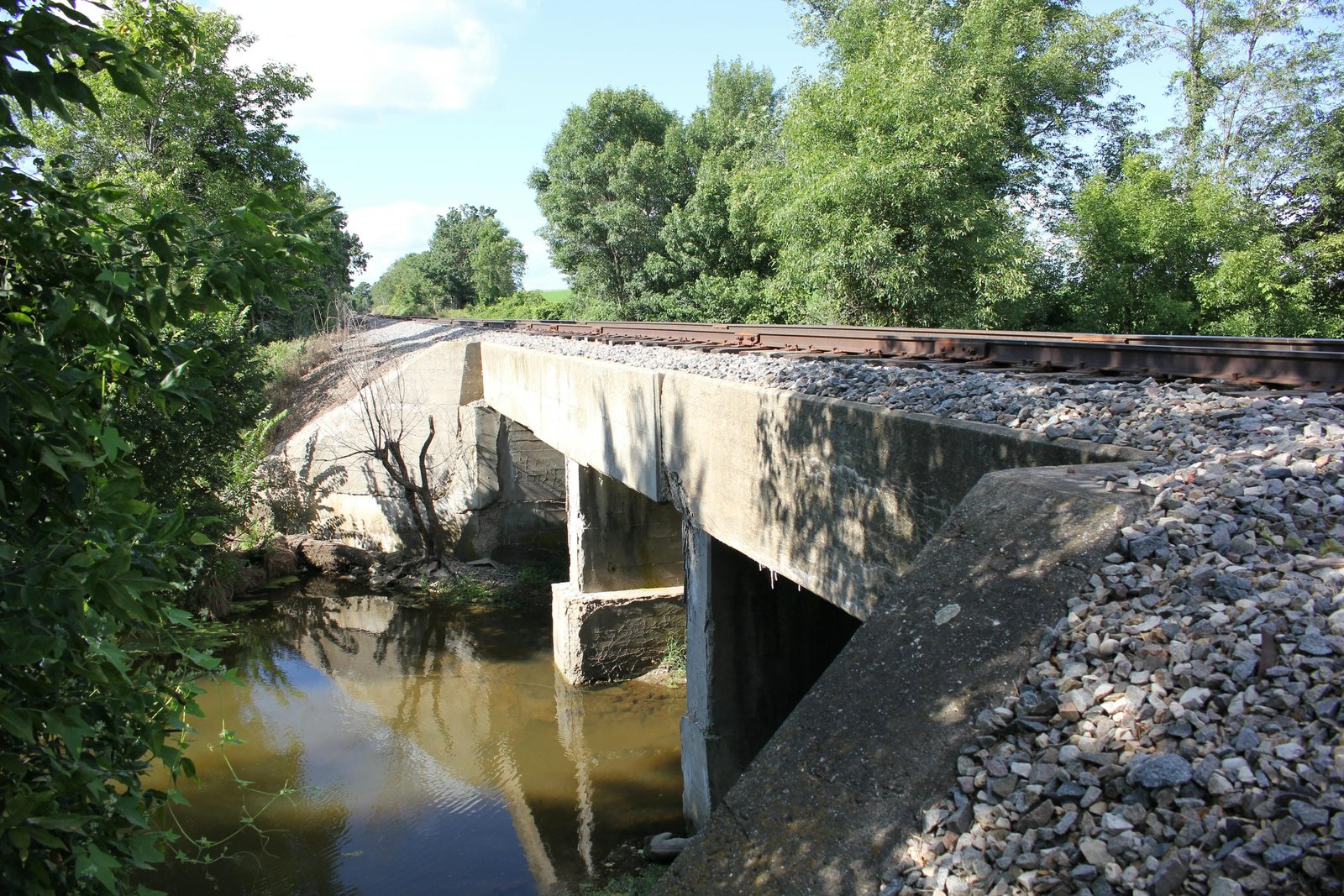
Located north of Chilton, this small concrete slab bridge carries the former Chicago, Milwaukee, St. Paul & Pacific Railroad (Milwaukee Road) mainline over the Killsnake River. The first bridge at this location was likely a timber pile trestle, initially constructed when the line was first built and renewed at various times. In the early 20th Century, the Milwaukee Road made significant improvements to this line, replacing many timber bridges with steel and concrete structures. In 1917, the original structure was replaced by the present concrete slab bridge. Currently, the bridge consists of three 19-foot concrete slab spans, set onto concrete substructures. The slabs use a deep design, and may function more similarly to a girder instead of a true slab. The substructures use a standard design, with rectangular piers and sloped wing walls at the abutments. Similar to many concrete bridges along the Milwaukee Road system, it is believed that this span was constructed by labor employed by the Milwaukee Road Bridge & Building Department. Concrete slab spans were commonly used by railroads, as they were durable and easy to construct. During the early 20th Century, the Milwaukee Road experimented with a number of different reinforced concrete bridge designs. Since the initial construction, the bridge has seen no significant alterations, and remains in occasional use. Overall, the bridge appears to be in fair condition, with some spalling and cracking noted throughout the structure. The author has ranked this bridge as being locally significant, due to the common design.
Citations
| Build date | Date stamp |
| Railroad History Citation | ICC Valuation Information, Compiled by Richard S. Steele |