
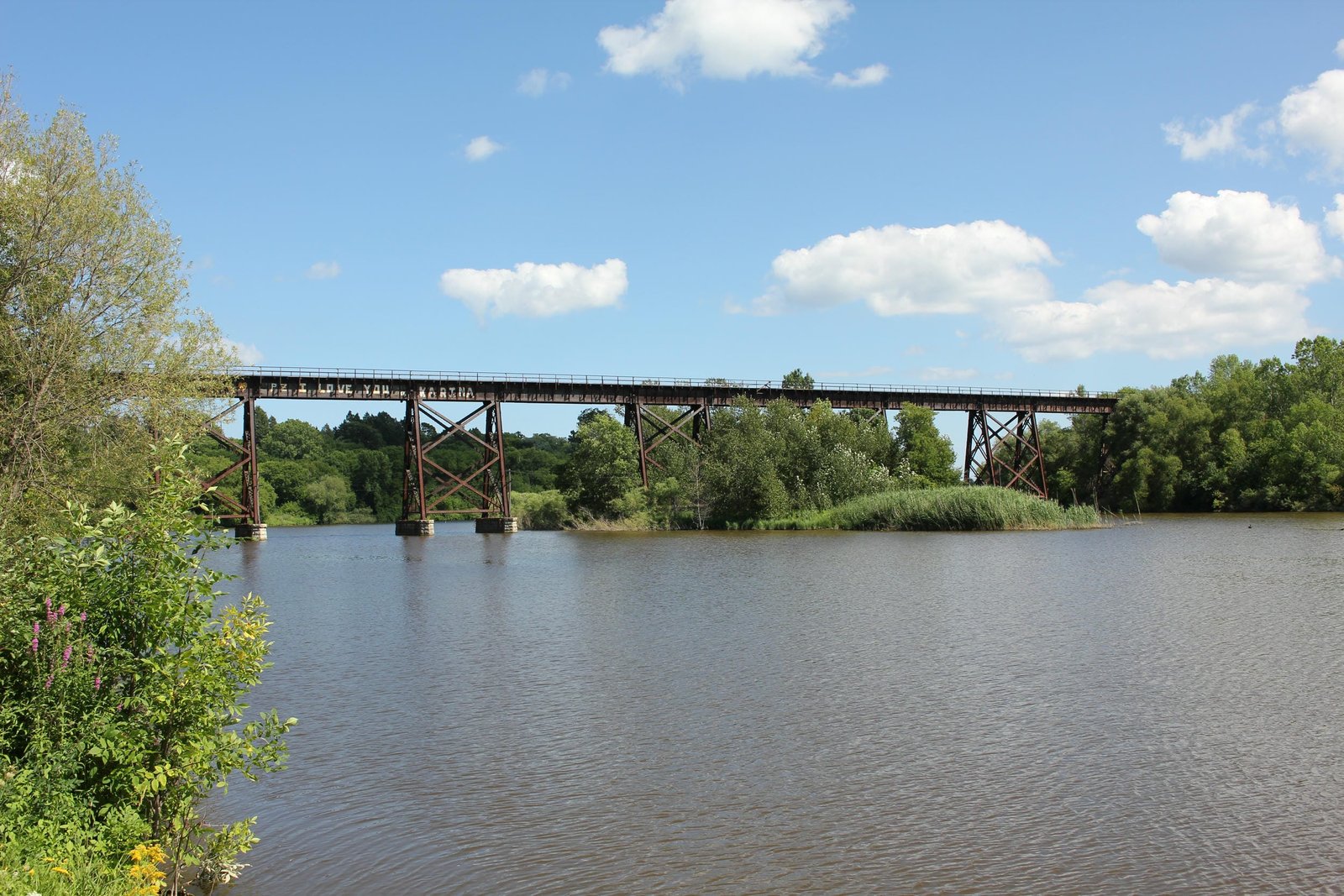


Click the photo to view the full-size version
| Name | Manitowoc High Trestle Chicago & North Western Railway Bridge #U-8 |
| Built By | Chicago & North Western Railway |
| Currently Owned By | Canadian National Railway |
| Superstructure Contractor | American Bridge Company of New York (Spans #3-#17) Unknown (Spans #1-#2 and Spans #18-#20) |
| Substructure Contractor | Adolph Green Construction Company of Green Bay, Wisconsin (Piers #2-#17) Unknown (Piers #1, #18 and #19) |
| Length | 1,009 Feet Total; 100 Foot Largest Span |
| Width | 1 Track |
| Height Above Ground | 70 Feet (Estimated) |
| Superstructure Design | Deck Plate Girder |
| Substructure Design | Stone Masonry and Concrete Pile |
| Date Built | 1906, Approaches Added 1938 Using Spans Fabricated c. 1910 |
| Original Location (Approach Spans) | Unknown |
| Traffic Count | 2 Trains/Day (Estimated) |
| Current Status | In Use |
| Chicago & North Western Railway Bridge Number | U-8 |
| Canadian National Railway Bridge Number | U-8 |
| Significance | Moderate Significance |
| Documentation Date | 8/5/2016 |
In 1872, the Milwaukee, Manitowoc and Green Bay Railroad (MM&GB) constructed 49 miles of new railroad, extending from Lake Shore Junction on the north side of Milwaukee, Wisconsin to Sheboygan, Wisconsin. The MM&GB changed its name to the Milwaukee, Lake Shore and Western Railroad (MLS&W) after completion of the line. The following year, the MLS&W resumed construction, completing an additional 32 miles to Two Rivers, Wisconsin, via Manitowoc, Wisconsin. The MLS&W was reorganized as the Milwaukee, Lake Shore and Western Railway (MLS&W) in 1885, which again was reorganized with the same name in 1883. The MLS&W had constructed a handful of lines in northeast Wisconsin during the late 19th Century, primarily to connect Lake Michigan and Lake Superior. This line initially provided the MLS&W with a connection to the Chicago & North Western Railway (C&NW) at Milwaukee, which allowed the MLS&W to access Chicago. Due to the success of the MLS&W, the railroad was purchased by the Chicago & North Western Railway in 1893. The C&NW had acquired and constructed a vast network of railroad lines throughout the Midwest during the late 19th Century, and the MLS&W system provided more opportunities for expansion.
During the early 20th Century, the C&NW sought to improve operations by constructing new lines and improving existing lines. The C&NW had become one of the premiere Midwest railroads, and sought to stay profitable and competitive. The Manitowoc, Green Bay and North Western Railway (MGB&NW) was incorporated as a subsidiary of the C&NW in 1904 to construct a new connection between Manitowoc and Green Bay. A 36 mile line was completed between the two cities in 1906, and the MGB&NW was sold to the C&NW in 1909. Also in 1906, a bypass around the west side of Sheboygan was constructed to avoid the congested lakefront line. These new lines provided the C&NW with a faster route between Chicago and Green Bay, serving Milwaukee and bypassing the industrial areas along Lake Winnebago. As traffic on the route grew in the 20th Century, the Village of Whitefish Bay became concerned with the growing amount of trains through the Village. In response, the C&NW constructed a short 4 mile cutoff between the north side of Whitefish Bay and Wiscona, a railroad junction on the north side of Milwaukee in 1929. The portion of the line between Lake Shore Junction and Whitefish Bay would be removed immediately after completion of the cutoff. Throughout the 20th Century, this line remained a core mainline for the C&NW, and was known as the Shoreline Subdivision.
By the late 20th Century, the C&NW sought to consolidate operations and abandon or sell unprofitable lines. In 1988, the C&NW sold the Cleveland, Wisconsin to Green Bay segment and the Two Rivers Branch to the Fox River Valley Railroad, which became the Fox Valley and Western Ltd. (FV&W) in 1993. The FV&W was a subsidiary of the successful Wisconsin Central Ltd. (WC), which had acquired a large amount of former Milwaukee Road and Soo Line trackage in Wisconsin. The C&NW was purchased by Union Pacific Railroad (UP) in 1995. In 1996, the segment between Denmark, Wisconsin and Rockwood, Wisconsin was abandoned and acquired for future trail use. In 2001, WC was purchased by Canadian National Railway (CN), and became the American subsidiary of the railroad. The Two Rivers Branch was abandoned in the 1990s or early 2000s. Much of the original line through Sheboygan was abandoned in approximately 2005, and CN abandoned the line between Manitowoc and Cleveland in 2013. In 2021, the Green Bay to Denmark segment was sold to the Fox Valley & Lake Superior Rail System (FOXY). Today, UP operates the Shoreline Subdivision between Wiscona and Cleveland; and CN operates the Shoreline Subdivision between Manitowoc and Rockwood. FOXY continues to operate the Denmark Branch between Green Bay and Denmark. The Rockwood to Denmark segment is known as the Devils River State Trail, and much of the original line through Sheboygan has been reused as a trail. Much of the UP segment between Sheboygan and Cleveland is out of service, and its future uncertain.
Located on the northwest side of Manitowoc, this towering deck plate girder viaduct carries the former Chicago & North Western Railway mainline over the Manitowoc River. When the C&NW decided to construct a new cutoff between Manitowoc and Green Bay, the Manitowoc River Valley represented a significant challenge. Due to the elevations required for the new railroad, it was decided to construct a large deck plate girder viaduct. Work on the bridge began in 1905, and the structure was initially completed in 1906. Initially, the bridge consisted of a 60-foot deck plate girder, a 100-foot deck plate girder, 14 spans of alternating 65-foot spans and 35-foot tower spans and an additional 65-foot deck plate girder span on the north end. The bridge was set onto stone piers and large steel towers, and was approached by short timber pile trestle approaches at either end. Timber approaches were commonly used by the C&NW on new bridges, as it allowed large approach embankments to settle without damaging permanent structures. In 1938, the southern 60-foot and northernmost 65-foot spans were removed, and new deck plate girder approaches were constructed, giving the bridge its present configuration. It is likely that the original 60-foot and 65-foot spans were reused elsewhere on the C&NW system.
Currently, the bridge consists of several different sized deck plate girder spans, set onto stone piers, steel towers and concrete pile piers. The south approach consists of a 45-foot span (span #1), a 50-foot span (span #2) and a 100-foot span (span #3). The main portion of the bridge consists of fourteen alternating 65-foot and 35-foot spans (spans #4-#17), while the north approach consists of a 50-foot span (span #18) and two 30-foot spans (spans #19 and #20). Piers #2 through #17 are constructed of stone masonry founded on timber piles, with piers #4 through #17 serving as footings for the large steel towers. Piers #1, #18 and #19 are constructed of concrete capped concrete pile piers, and the abutments are also constructed of concrete pile structures. The main spans (spans #3 through #17) use a standard design, and are constructed of two heavy plate girders with an open deck. The approach spans appear to use slightly different designs, with shallower girders. It is believed that spans #1, #2, #18, #19 and #20 may have been reused here from other locations, and likely were fabricated in approximately 1910. The towers are heavily constructed, with two trapezoidal bents at each member, which are connected by two levels of longitudinal bracing on either side. All members of the tower are composed of built-up beams constructed with various V-lacing designs. Piers #2 and #3 are constructed using a tall rectangular design, while piers #4 through #17 consist of short rectangular piers with angled fenders on both sides. The superstructure contains a walkway on both sides, which is supported by brackets attached to the girders.
A number of different contractors contributed to constructing the bridge. American Bridge Company fabricated spans #3 through #18 at their Ambridge Plant in Pennsylvania. Unknown contractors fabricated the approach spans, and it is possible that these spans were fabricated by a number of different contractors. Adolph Green Construction Company was awarded a $75,000 contract for constructing the stone piers of the bridge. Stone for these piers appears to be a white limestone, likely quarried at the C&NW-owed quarry in Duck Creek, Wisconsin. It is unknown if the concrete substructures were constructed by an unknown contractor or by railroad company forces. Deck plate girder spans were commonly used by railroads, as they were durable and easy to construct. Large deck plate girder viaducts such as this were the most economical way to carry railroads over large valleys, as they required the least amount of material and had a simple design. Concrete pile foundations became popular in the mid-20th Century, as the piles could be cast off-site and easily installed without significantly impacting railroad traffic. Since the 1938 revisions, the bridge has seen no significant alterations, and remains in use. Overall, the bridge appears to be in fair to good condition, with no significant deterioration noted. The author has ranked this bridge as being moderately significant, due to the size.
Citations
| Build date and builder (superstructure) | Chicago & North Western Railway Valuation Notes at the Chicago & North Western Historical Society Archives |
| Builder (substructure) | The Railroad Gazette; Volume 39, Issue 6 |
| Railroad History Citation | ICC Valuation Information, Compiled by Richard S. Steele |