
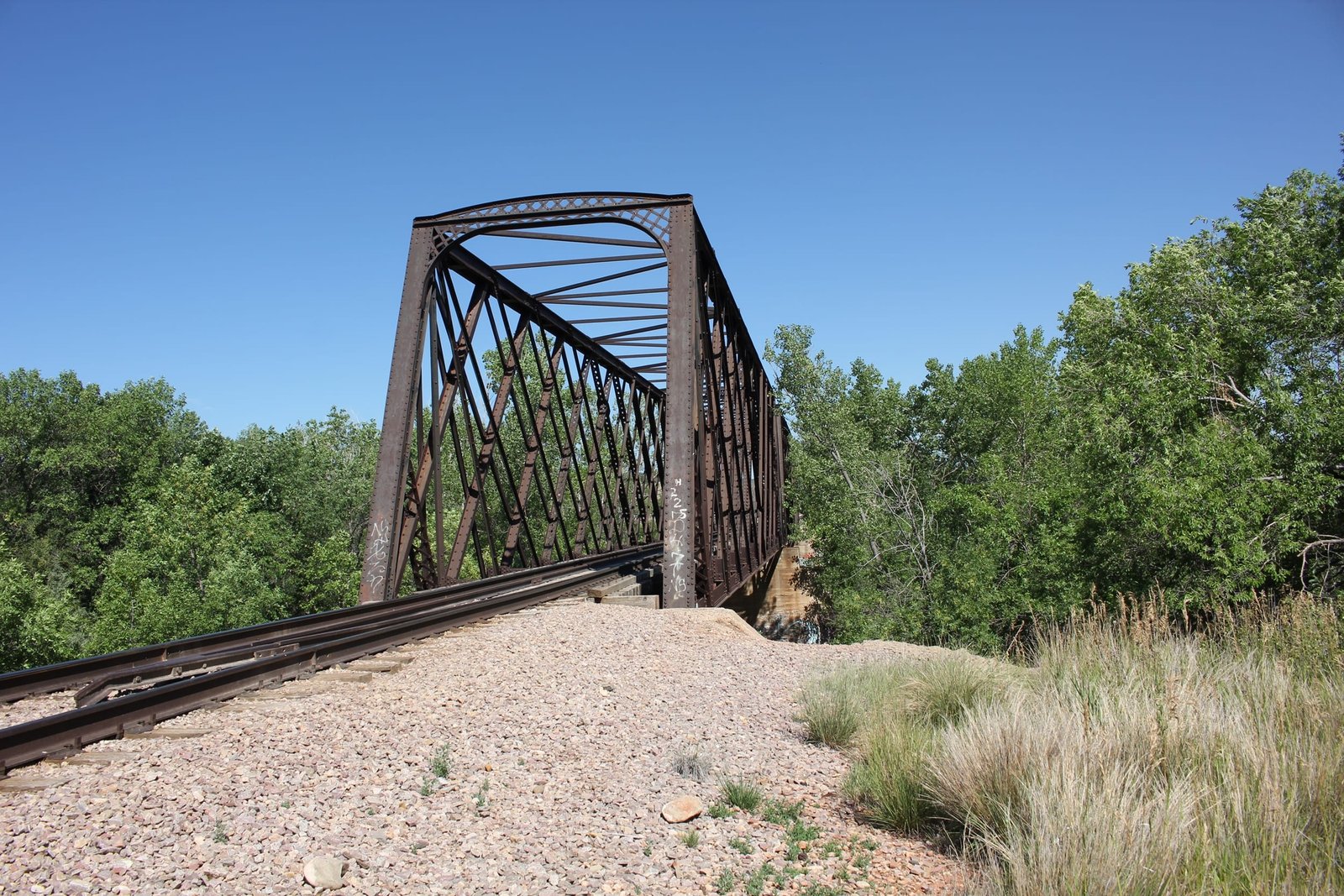


Click the photo to view the full-size version
| Name | RCP&E Boxelder Creek Bridge Chicago & North Western Railway Bridge #H-225 |
| Built By | Chicago & North Western Railway |
| Currently Owned By | Rapid City, Pierre & Eastern Railroad |
| Superstructure Contractor | Unknown |
| Substructure Contractor | Unknown |
| Length | 254 Feet Total, 127 Foot Spans |
| Width | 1 Track |
| Height Above Ground | 20 Feet (Estimated) |
| Superstructure Design | Quadrangular Lattice Through Truss |
| Substructure Design | Concrete |
| Date Built | 1918 Using Spans Fabricated c. 1880 |
| Original Location | Unknown |
| Traffic Count | 2 Trains/Day (Estimated) |
| Current Status | In Use |
| Chicago & North Western Railway Bridge Number | H-225 |
| Rapid City, Pierre and Eastern Railroad Bridge Number | H-225 |
| Significance | High Significance |
| Documentation Date | 7/16/2017 |
In 1885, the Fremont, Elkhorn & Missouri Valley Rail Road Company (FE&MV) began construction on a 240 mile railroad line, extending from Valentine, Nebraska to Rapid City, South Dakota. Work would be completed in 1886. The following year, an additional 30 miles would be constructed from Rapid City, to Whitewood, South Dakota. An additional 21 miles would be constructed to Belle Fourche, South Dakota in 1890. The FE&MV would be reorganized in 1891, and sold to the Chicago & North Western Railway (C&NW) in 1903. The C&NW had constructed and acquired a large number of railroad lines throughout the Midwest, and this line was one of the westernmost lines.
With the discovery of high quality bentonite nearby, the line would be extended 18 miles to Colony, Wyoming in 1948. This line served as a secondary route for the C&NW, connecting numerous industrial and agricultural branches in western South Dakota. In 1995, the line between Chadron and Colony would be sold to the Dakota, Minnesota & Eastern Railroad (DM&E). The DM&E would be purchased by Canadian Pacific Railway (CP) in 2008. In 2014, the DM&E entered into an agreement with the Genesee & Wyoming owned Rapid City, Pierre and Eastern Railroad (RCP&E) to sell 670 miles of track. Today, RCP&E operates the segment between Chadron and Colony as the Black Hills Subdivision.
Located northwest of Rapid City in the town of Black Hawk, this lattice through truss bridge crosses Boxelder Creek. The previous bridge at this location was likely a timber trestle, constructed when the line was first built. In the first decades of the 20th Century, the C&NW invested significant capital into the branch lines in South Dakota, replacing timber bridges with mainly secondhand iron spans. In 1918, the bridge was rebuilt with a pair of secondhand quadrangular lattice through truss spans, set onto new concrete substructures. Currently, the bridge consists of two 127-foot, riveted quadrangular lattice through truss spans, set onto concrete substructures. It is believed that the truss spans were originally fabricated in approximately 1880 by an unknown firm at an unknown location. The author has found two possible locations that the truss spans were reused from. A bridge at Peshtigo, Wisconsin was originally constructed in 1881, and used two 127-foot spans, which were replaced around 1918. An additional 127-foot span was originally fabricated in 1882, before being reused at Owatonna, Minnesota in 1906. This bridge was also replaced in 1918-1919. There also may be additional locations that the truss spans were reused from, as several similar spans were constructed for the C&NW between approximately 1877 and approximately 1882. Railroads often reused steel and iron bridges, as it provided a cost effective way to replace bridges on branch lines. Often, these spans could be reused for lighter traffic with minimal significant alterations.
The truss spans use a design typical for late 1870s and early 1880s lattice truss spans, with light members and a curved lattice portal. The top chords of the spans are composed of a lightly built up beam, composed of two channels connected by thin plates. The bottom chord is constructed of two parallel L-shaped beams. The endposts use a built-up design commonly seen on early truss spans, with two channels connected by Z-bars between the channels. The diagonal members use a combination of L-shaped bars, rolled beams and tightly X-laced built-up beams. The floor system uses a standard design, with four stringers connected to floorbeams. These floorbeams use an unusual shape, which is deeper in the middle with the ends sitting on the bottom chord. Both the upper lateral bracing and the lower lateral bracing are constructed of L-shaped iron bars, which are riveted to the top and bottom chords. The sway bracing of the bridge consists of square bars, while the portal bracing uses a unique curved lattice design. The substructures use a standard design, with sloped wing walls on the abutments and a square pier. These concrete substructures are likely founded on timber piles, typical of bridges from this era. It is believed that the spans were either fabricated by the Leighton Bridge & Iron Works (prior to mid-1881) or the Alden and Lassig Bridge & Iron Works (after mid-1881). An unknown contractor constructed the concrete substructures.
Lattice truss designs are relatively uncommon throughout the United States. However, a few railroads preferred the design, such as the Chicago, Rock Island & Pacific Railway (Rock Island), the Chicago & North Western Railway (C&NW) and the Chicago, St. Paul, Minneapolis & Omaha Railway (Omaha Road). This design was initially perfected in the late 1870s, and the first generation of spans were mostly produced by the Leighton Bridge & Iron Works. The first generation of spans constructed for the C&NW featured an arched and pedimented lattice portal bracing, light sway bracing and laced members. After the Leighton Bridge & Iron Works closed, the shops were sold to the Alden and Lassig Bridge & Iron Works, which continued producing a variant of the first generation of spans with a slightly different portal. The second generation was nearly exclusively constructed by Lassig Bridge & Iron Works between 1884 and 1900, and featured heavier members and a heavier portal bracing. Early spans from this generation included a flat lattice portal and decorative cutouts, while later spans had a pedimented lattice portal with similar cutouts. While the design fell out of favor for the Rock Island and Omaha Road around the turn of the 20th Century, the design remained popular with the C&NW into the 1920s. 19th Century versions of this design were primarily constructed out of iron, while 20th Century versions of this design used much heavier members and were constructed of steel. The C&NW preferred this design, as it was both strong and demonstrated great resilience in case of a derailment. Since the 1918 construction, the bridge has seen a number of alterations, including the addition of high-strength bolts and heavy repairs to the floor system. Currently, the bridge remains in regular use. Overall, the bridge appears to be in fair to good condition, with no significant deterioration noted. The author has ranked this bridge as being highly significant, due to the age and design of the superstructure.
Citations
| Erection date | Chicago & North Western Railway Valuation Notes at the Chicago & North Western Historical Society Archives |
| Railroad History Citation | ICC Valuation Information, Compiled by Richard S. Steele |