
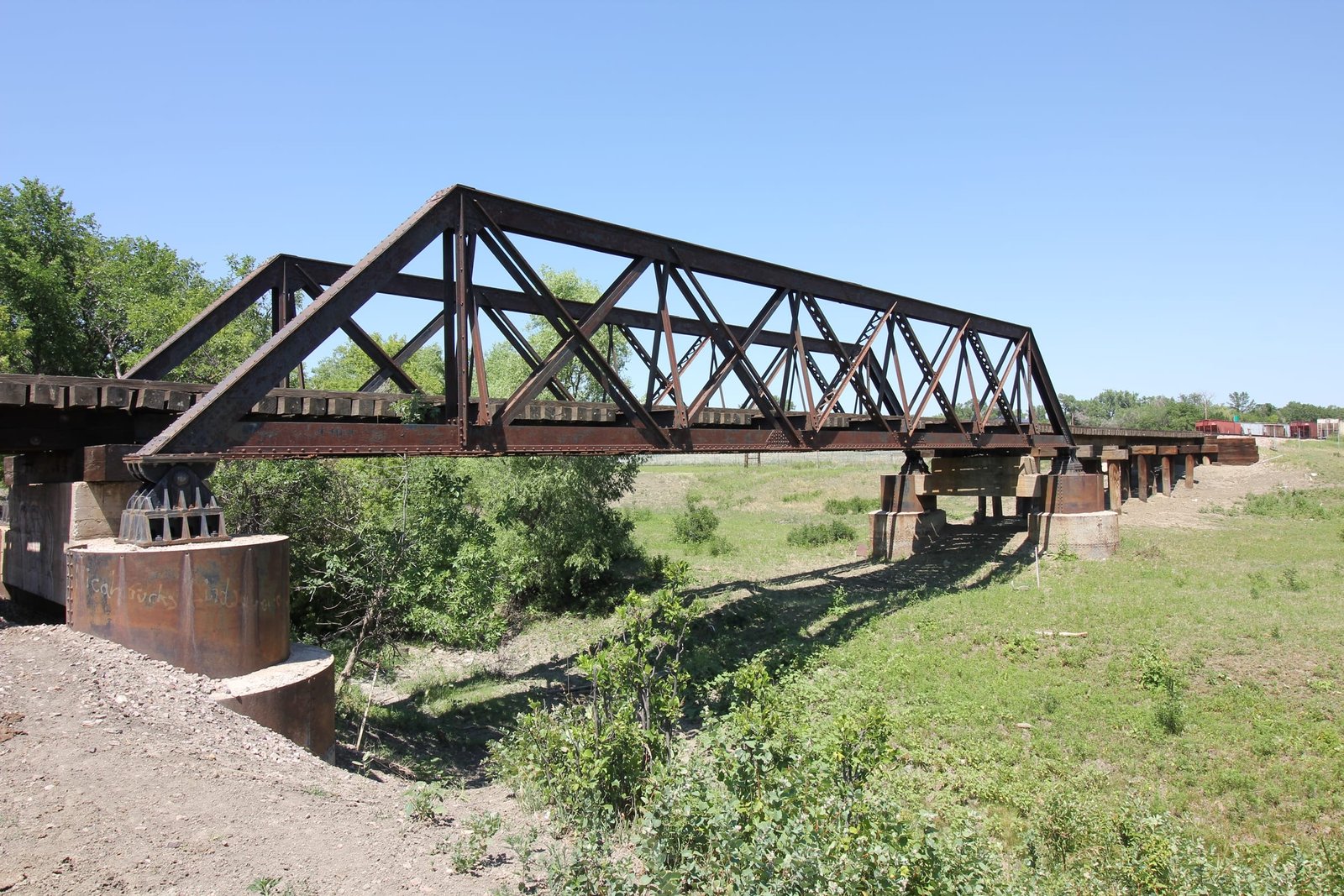


Click the photo to view the full-size version
| Name | RCP&E N. Fork Bad River Bridge Chicago & North Western Railway Bridge #1697 |
| Built By | Chicago & North Western Railway |
| Currently Owned By | Rapid City, Pierre & Eastern Railroad |
| Superstructure Contractor | Unknown |
| Substructure Contractor | Peppard & Burrill of Minneapolis, Minnesota |
| Length | 170 Feet Total, 84 Foot Main Span |
| Width | 1 Track |
| Height Above Ground | 20 Feet (Estimated) |
| Superstructure Design | Double Intersection Warren Pony Truss and Timber Pile Trestle |
| Substructure Design | Steel Caisson and Timber Pile |
| Date Built | 1927 using a span fabricated c. 1885 |
| Date Destroyed | January 27th, 2022 |
| Previous Location | Bridge #K-3A; Deadwood, South Dakota |
| Original Location | Unknown |
| Current Status | Destroyed by Derailment; Replaced by New Bridge |
| Chicago & North Western Railway Bridge Number | 1697 |
| Significance | Regional Significance |
| Documentation Date | 7/15/2017 |
In 1879, the Chicago and Dakota Railway (C&D) completed 46 miles
of new railroad from Tracy, Minnesota to Elkhorn, South Dakota. At
Tracy, the line connected to an existing railroad owned by the Winona
and Saint Peter Railway (W&StP), which was being leased by the
Chicago & North Western Railway (C&NW). At the same time, the
Dakota Central Railway (DC) completed an additional 25 miles from
Elkhorn to Volga, South Dakota in 1879. In 1880, 184 additional miles
would be completed by DC to Pierre. The C&D would come under
control of the Chicago & North Western Railway in 1881, and the
C&D, DC and W&StP would all be merged into the C&NW in 1900.
In 1905, Native American land west of the Missouri River opened to
settlement and development. The C&NW immediately began working on a
new line to reach the Black Hills. In 1906, 76 miles would be
completed from Ft. Pierre to Philip by the Pierre, Rapid City and North
Western Railway (PRC&NW), with 44 additional miles were completed by
the same company between Rapid City and Wasta that year. In 1907, the
bridge across the Missouri River at Pierre and 3 miles of track would be
completed by the Pierre & Ft. Pierre Bridge Railway, and the
remaining 44 miles would be completed from Philip to Wasta by the
PRC&NW. The PRC&NW and Pierre & Ft. Pierre Bridge Railway
were both funded and controlled by the C&NW, and would later be
fully incorporated.
The C&NW operated the route between Winona and Rapid City as the
main line of the Dakota Division, eventually operating the passenger
train the "Dakota 400" over the route. As the line became less
profitable in the 1970s and 1980s, the C&NW was considering
abandoning the route. In 1986, the line between Winona and Rapid City
would be sold to the Dakota, Minnesota & Eastern Railroad. The
DM&E would be purchased by Canadian Pacific Railway (CP) in 2008.
In 2014, the DM&E entered into an agreement with the Genesee &
Wyoming owned Rapid City, Pierre and Eastern Railroad (RCP&E) to
sell 670 miles of track. Today, RCP&E operates the segment between
Pierre and Rapid City, South Dakota as the PRC Subdivision.
Located in Philip, this pony truss bridge once carried the Black Hills Division of the Chicago & North Western Railway over the North Fork Bad River. The first bridge at this location consisted of a 106-foot wooden Howe through truss span, approached by timber pile trestle on either end. During the late 1920s and early 1930s, the C&NW invested significant capital into this line, replacing outdated timber bridges with mainly secondhand steel and iron spans. In April 1927, plans were made to replace this bridge with a 142-foot iron quadrangular lattice through truss span, reused from the Mississippi River Bridge at Winona, Minnesota. Soon after the plan was approved, the 142-foot truss span was no longer available for use, and the plan was substituted to use a secondhand iron pony truss span. Work on the replacement bridge began in July 1927, and the new bridge was completed in August 1928. The bridge consisted of an 84-foot, 7-panel, riveted double intersection Warren pony truss span, approached by timber pile trestle spans on either end. The truss span was placed onto steel cylinder piers, which were filled with concrete, while the remainder of the bridge was set onto timber pile substructures.
The history of the truss span is not clear. It is believed that the span was originally fabricated in approximately 1885, likely for use on a mainline in Illinois, Wisconsin or Minnesota. The truss span at its original location was replaced in approximately 1910, and the truss span was installed at Bridge #K-3A in 1911, which carried a mine spur across Whitewood Creek in Deadwood, South Dakota. After the spur was removed in approximately 1925, the truss span was shipped to the bridge yard in Chicago, before being reused here. Based on the design, it is believed that the truss was initially fabricated by the Alden and Lassig Bridge & Iron Works. The steel cylinder piers were constructed by Peppard & Burrill, which was contracted to complete bridge improvements on the Black Hill Division for the 1927 construction season. The truss span used a standard design for the era, with built-up compression members, riveted connections and modestly deep trusses. The top chord, bottom chord and endposts all used a channel design, and the top chord and endposts were connected by a plate on the top. The compression members consisted of X-laced built-up beams, while the tension members and vertical members used L-shaped iron bars. The floor was comprised of four I-beam stringers arranged into two sets of two and plate girder floorbeams set at the panel points, typical of spans from this era. It is unclear if the span was modified from its original design during either of its known relocations.
Railroads commonly reused steel and iron spans, as it was a cost effective way to replace bridges on branch lines and spurs without requiring large amounts of new material. Often, when a span was no longer adequate for mainline use, it could be reused on a branch line with minimal alterations. Pony truss spans such as this were used extensively by the C&NW throughout the 1880s, as they were durable, simple and cost effective. Dozens of similar spans were constructed for the C&NW, with most spans constructed by Leighton Bridge & Iron Works (1870s-1881); Alden and Lassig Bridge & Iron Works (1881-1885) and Lassig Bridge & Iron Works (1886-c. 1890). The design was ultimately superseded by heavier plate girder bridges, which were stronger and equally economical. Since the 1927-28 relocation, few alterations appeared to have been made to the truss span and bridge overall. The bridge was destroyed in a derailment on the evening of January 27th, 2022 and was later replaced by a steel stringer bridge. Overall, the bridge appeared to be in fair condition at the time of documentation, with minor deterioration noted throughout the structure. The author has ranked this bridge as being regionally significant, due to the lack of pony trusses in South Dakota, as well as the relocation history.
Citations
| Erection date and relocation history | Chicago & North Western Railway Authority For Expenditure (AFE) #A-15258 (1927) at the Chicago & North Western Railway Historical Society Archives |
| Builder (substructure) | Railway Age; Volume 23, Issue 7 |
| Railroad History Citation | ICC Valuation Information, Compiled by Richard S. Steele |