
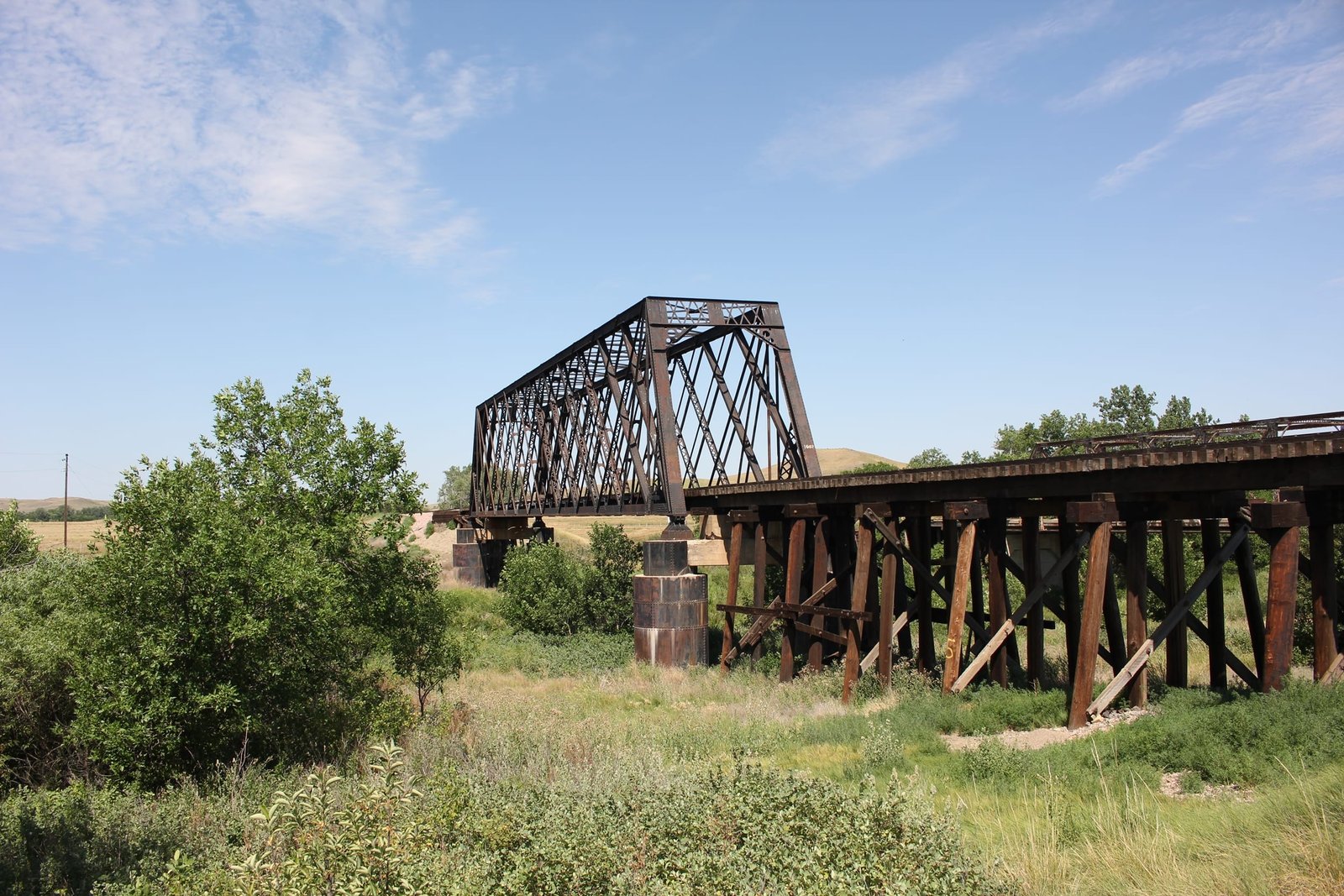


Click the photo to view the full-size version
| Name | RCP&E Bad River Bridge #7 Chicago & North Western Railway Bridge #1602 |
| Built By | Chicago & North Western Railway |
| Currently Owned By | Rapid City, Pierre & Eastern Railroad |
| Superstructure Contractor | Lassig Bridge & Iron Works of Chicago |
| Substructure Contractor | Bates & Rogers Construction Company of Chicago, Illinois |
| Length | 310 Feet Total, 159 Foot 8 inch Main Span |
| Width | 1 Track |
| Height Above Ground | 25 Feet (Estimated) |
| Superstructure Design | Quadrangular Lattice Through Truss and Timber Pile Trestle |
| Substructure Design | Steel Caisson and Timber Pile |
| Date Built | 1929 Using a Span Fabricated 1885 |
| Original Location | Bridge #708; Mississippi River Bridge; Winona, Minnesota |
| Traffic Count | 2 Trains/Day (Estimated) |
| Current Status | In Use |
| Chicago & North Western Railway Bridge Number | 1602 |
| Significance | Regional Significance |
| Documentation Date | 7/15/2017 |
In 1879, the Chicago and Dakota Railway (C&D) completed 46 miles
of new railroad from Tracy, Minnesota to Elkhorn, South Dakota. At
Tracy, the line connected to an existing railroad owned by the Winona
and Saint Peter Railway (W&StP), which was being leased by the
Chicago & North Western Railway (C&NW). At the same time, the
Dakota Central Railway (DC) completed an additional 25 miles from
Elkhorn to Volga, South Dakota in 1879. In 1880, 184 additional miles
would be completed by DC to Pierre. The C&D would come under
control of the Chicago & North Western Railway in 1881, and the
C&D, DC and W&StP would all be merged into the C&NW in 1900.
In 1905, Native American land west of the Missouri River opened to
settlement and development. The C&NW immediately began working on a
new line to reach the Black Hills. In 1906, 76 miles would be
completed from Ft. Pierre to Philip by the Pierre, Rapid City and North
Western Railway (PRC&NW), with 44 additional miles were completed by
the same company between Rapid City and Wasta that year. In 1907, the
bridge across the Missouri River at Pierre and 3 miles of track would be
completed by the Pierre & Ft. Pierre Bridge Railway, and the
remaining 44 miles would be completed from Philip to Wasta by the
PRC&NW. The PRC&NW and Pierre & Ft. Pierre Bridge Railway
were both funded and controlled by the C&NW, and would later be
fully incorporated.
The C&NW operated the route between Winona and Rapid City as the
main line of the Dakota Division, eventually operating the passenger
train the "Dakota 400" over the route. As the line became less
profitable in the 1970s and 1980s, the C&NW was considering
abandoning the route. In 1986, the line between Winona and Rapid City
would be sold to the Dakota, Minnesota & Eastern Railroad. The
DM&E would be purchased by Canadian Pacific Railway (CP) in 2008.
In 2014, the DM&E entered into an agreement with the Genesee &
Wyoming owned Rapid City, Pierre and Eastern Railroad (RCP&E) to
sell 670 miles of track. Today, RCP&E operates the segment between
Pierre and Rapid City, South Dakota as the PRC Subdivision.
Located near the ghost town of Capa, this bridge is the seventh crossing of the Bad River along this route. The first bridge at this location was a wooden Howe truss bridge, constructed when the line was first built. In the late 1920s and early 1930s, the C&NW invested significant capital into this line, replacing timber bridges with secondhand steel and iron spans. A new bridge was authorized at this location in late 1927, with work commencing the following spring. Replacement work continued through the remainder of 1928, and the new bridge was completed in early June 1929. Currently, the bridge consists of a 159-foot 8-inch riveted quadrangular lattice through truss span, set onto steel cylinder caisson piers and approached by timber pile trestle on either end. In addition, the truss span is constructed at a slight skew. The truss span was reused from one of five 159-foot 8-inch spans constructed for Bridge #708 across the Mississippi River at Winona, Minnesota. Lassig Bridge & Iron Works fabricated this truss span in 1885, while the Bates & Rogers Construction Company constructed the new piers. Railroads often reused steel and iron bridges, as it provided a cost effective way to replace bridges on branch lines. Often, these spans could be reused on branch lines with lighter traffic with minimal significant alterations.
Typical of mid-1880s quadrangular lattice through truss spans constructed for the C&NW, the span uses a combination of solid and built-up members with flat lattice portal bracings. The top chord is composed of a lightly built up beam, composed of two channels connected by thin plates. The bottom chord is constructed of two parallel L-shaped beams. The endposts use a similar design to the top chord, and are covered by a solid plate on the outside and thin iron plates on the interior. The diagonal members use a combination of L-shaped bars, rolled beams and tightly X-laced built-up beams. The floor system uses a standard design, with four stringers connected to floorbeams. These floorbeams use an unusual shape, which is deeper in the middle with the ends sitting on the bottom chord. Both the upper lateral bracing and the lower lateral bracing are constructed of L-shaped iron bars, which are riveted to the top and bottom chords. The portal bracing uses a flat topped-Lassig style bracing, with a solid vertical plate in the middle and three X-lattice bracings on either side. The heel bracing is composed of decorative flower shaped cutouts in an angled plate. The sway bracing of the span uses solid T-shaped iron bars, typical of spans from this era. Similar to many other bridges along this line, the piers are composed of two steel cylinders, connected by a concrete lateral bracing and filled with concrete. There are numerous secondhand trusses on the Pierre-Rapid City line, which were reused from the Winona bridge. In addition, there may have been up to five spans reused from Bridge #228 across the Cedar River at Cedar Rapids, Iowa. The Winona bridge utilized five 159-foot 8-inch spans, fabricated in 1885; as well as seven 142-foot 2-inch spans, fabricated in 1886. The Cedar Rapids bridge also used five 159-foot 8-inch spans. A majority of these truss spans remain intact and in use today.
Lattice truss designs are relatively uncommon throughout the United States. However, a few railroads preferred the design, such as the Chicago, Rock Island & Pacific Railway (Rock Island), the Chicago & North Western Railway (C&NW) and the Chicago, St. Paul, Minneapolis & Omaha Railway (Omaha Road). This design was initially perfected in the late 1870s, and the first generation of spans were mostly produced by the Leighton Bridge & Iron Works. The first generation of spans constructed for the C&NW featured an arched and pedimented lattice portal bracing, light sway bracing and laced members. After the Leighton Bridge & Iron Works closed, the shops were sold to the Alden and Lassig Bridge & Iron Works, which continued producing a variant of the first generation of spans with a slightly different portal. The second generation was nearly exclusively constructed by Lassig Bridge & Iron Works between 1884 and 1900, and featured heavier members and a heavier portal bracing. Early spans from this generation included a flat lattice portal and decorative cutouts, similar to this bridge. Later second generation spans had a pedimented lattice portal with similar cutouts. While the design fell out of favor for the Rock Island and Omaha Road around the turn of the 20th Century, the design remained popular with the C&NW into the 1920s. 19th Century versions of this design were primarily constructed out of iron, while 20th Century versions of this design used much heavier members and were constructed of steel. The C&NW preferred this design, as it was both strong and demonstrated great resilience in case of a derailment. Since the 1929 construction, the bridge has seen a number of alterations, including the addition of high-strength bolts and heavy repairs to the floor system. Currently, the bridge remains in regular use. Overall, the bridge appears to be in fair to good condition, with no significant deterioration noted. The author has ranked this bridge as being regionally significant, due to the age, relocation history and design of the superstructure.
Citations
| Build date, relocation information and builder (substructure) | Chicago & North Western Railway Authority For Expenditure (AFE) #A-18231 (1928) at the Chicago & North Western Railway Historical Society Archives |
| Builder (superstructure) | Journal of the Western Society of Engineers, Volume 8 |
| Railroad History Citation | ICC Valuation Information, Compiled by Richard S. Steele |