







Click the photo to view the full-size version
| Name | Racine Railroad Bridge Chicago & North Western Railway Bridge #1478 |
| Built By | Chicago & North Western Railway |
| Currently Owned By | Union Pacific Railroad |
| Superstructure Contractor | American Bridge Company of New York |
| Substructure Contractor | George W. Oakes of St. Paul, Minnesota |
| Length | 343 Feet Total, 247 Foot Main Span |
| Width | 2 Tracks, 1 In Use |
| Height Above Ground | 20 Feet (Estimated) |
| Superstructure Design | Double Intersection Warren Deck Truss and Deck Plate Girder |
| Substructure Design | Stone Masonry |
| Date Built | 1908 |
| Chicago & North Western Railway Bridge Number | 1478 |
| Union Pacific Railroad Bridge Number | 61.31 |
| Significance | Regional Significance |
| Documentation Date | 8/6/2016; 7/3/2022; 4/21/2024 |
In the early 1850s, several railroad companies began constructing
railroad lines radiating from Chicago. In 1855, the Chicago & Milwaukee Railroad (C&M) constructed a
45-mile railroad line, extending north from an existing railroad line at
Ashland Avenue and Armitage Avenue in Chicago to the Wisconsin State Line near
Kenosha. At the same time, the Milwaukee & Chicago Railroad (M&C) constructed an additional 40 miles north to Milwaukee. The two railroads would be consolidated into a new railroad known as the Chicago & Milwaukee Railroad (C&M) soon after completion, and would come under control of the Chicago & North Western Railway (C&NW) in 1866. The C&M was leased to the Chicago, Milwaukee and North Western Railway (CM&NW) in 1883. The C&NW acquired control of the CM&NW soon after. The C&NW had constructed and acquired a large network of railroad lines through the Midwest. This line formed a portion of the
principal north mainline of the C&NW, eventually extending to northern Wisconsin and the Upper Peninsula of Michigan. Due to increasing traffic
along this line, a second track would be constructed between 1890 and 1892.
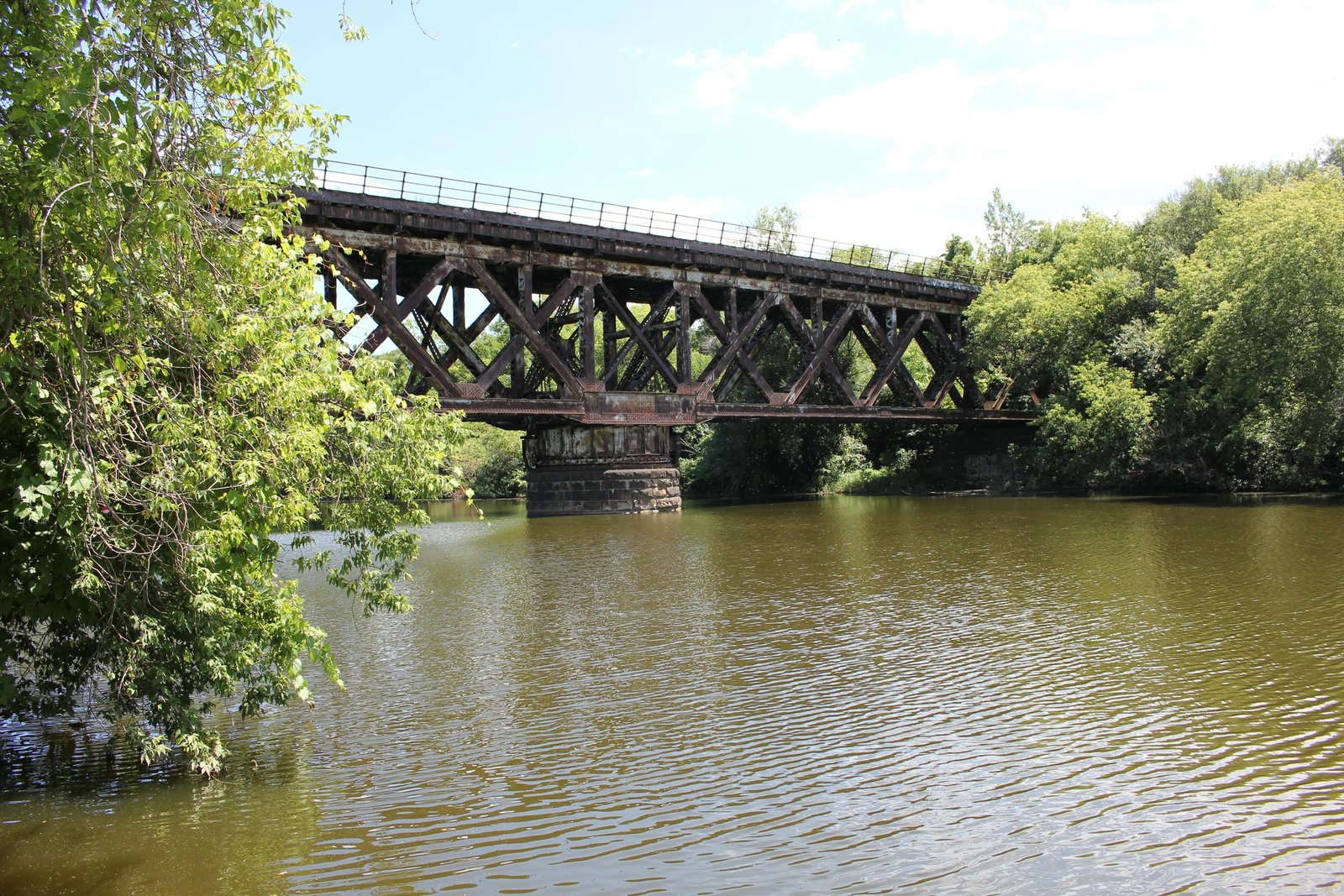
Located in Racine, this large deck truss swing bridge carries the former Chicago & North Western Railway mainline across the Root River. The first bridge at this location was a lengthy timber pile trestle bridge, constructed when the line was first built. It is unknown if this bridge contained a swing span, or if it impeded river traffic from navigating further upstream. In the 1870s, the C&NW invested significant capital into this line, replacing timber bridges with iron and stone structures. In 1875, a new iron deck truss bridge with a swing span was constructed, and the remainder of the timber pile trestle filled with earthen embankment. This bridge consisted of two light 8-panel riveted double intersection Warren deck truss spans on the north end, and a 16-panel riveted double intersection Warren deck truss swing span. The entire bridge was set onto tall stone substructures, and was constructed for a single track. The superstructure was constructed of mainly lightweight iron bars, which were riveted together. Photographs of the 1875 bridge indicate that it was an early version of a rim-bearing swing span, with the center of the swing span set onto an iron ring, which rotated via rollers placed onto a track. In addition, the bottom chords at the end panels were sloped, which allowed for rollers at the end. It is believed that Leighton Bridge & Iron Works fabricated this bridge, which was an early example of the double intersection Warren deck truss design. This company constructed several examples of lattice trusses for the C&NW between the mid-1870s and approximately 1881. Between 1890 and 1892, the C&NW double tracked the route between Chicago and Milwaukee. The Root River bridge was not double tracked, and the structure represented the only significant remaining bottleneck on the route. By the early 20th Century, the 1875-era ironwork and single track construction of the bridge had become obsolete for the increasing train operations on this line. In 1907, the C&NW began planning to replace the bridge with the present heavier double track structure, which was constructed in 1908. It is unknown if portions of the iron bridge were reused elsewhere.
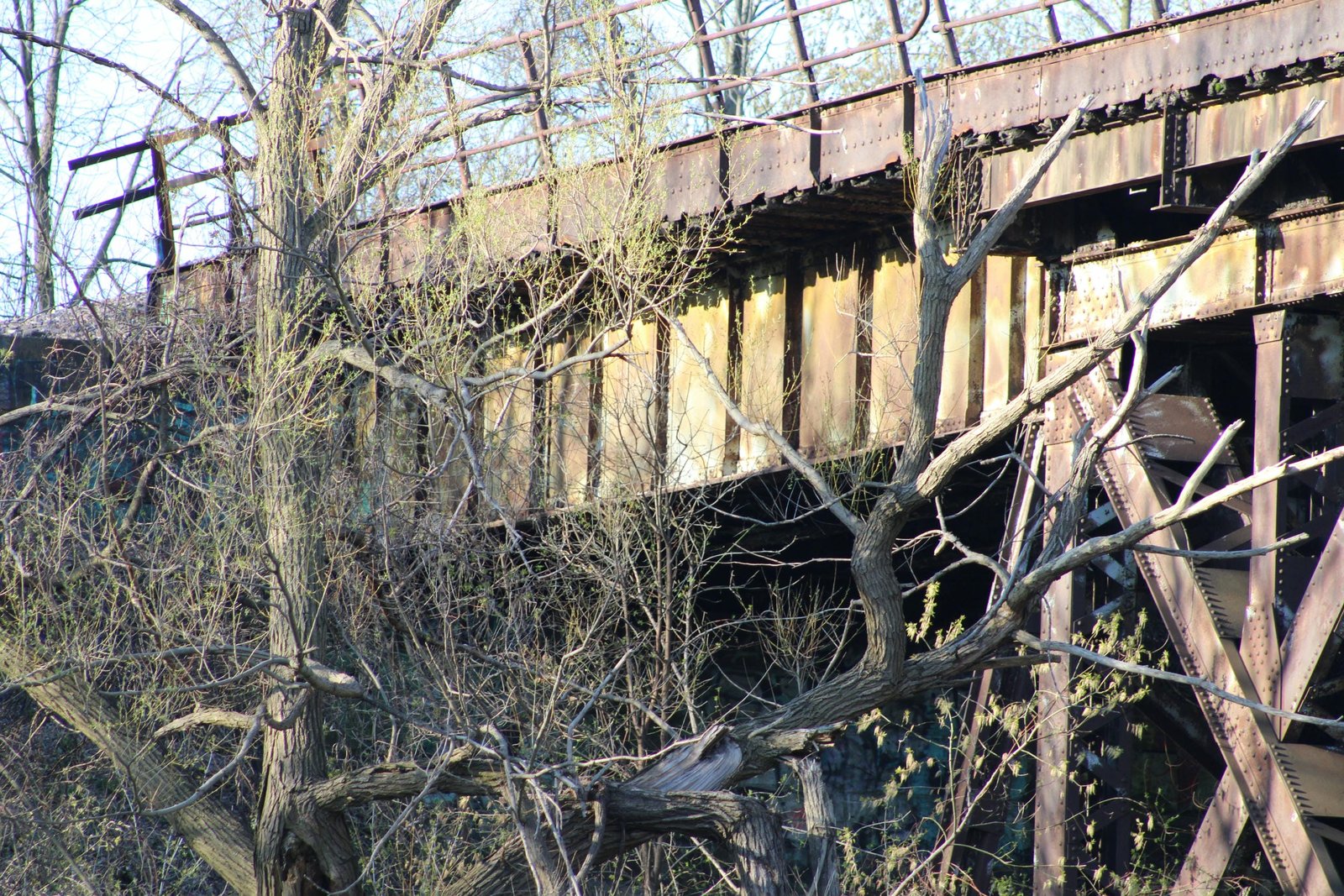
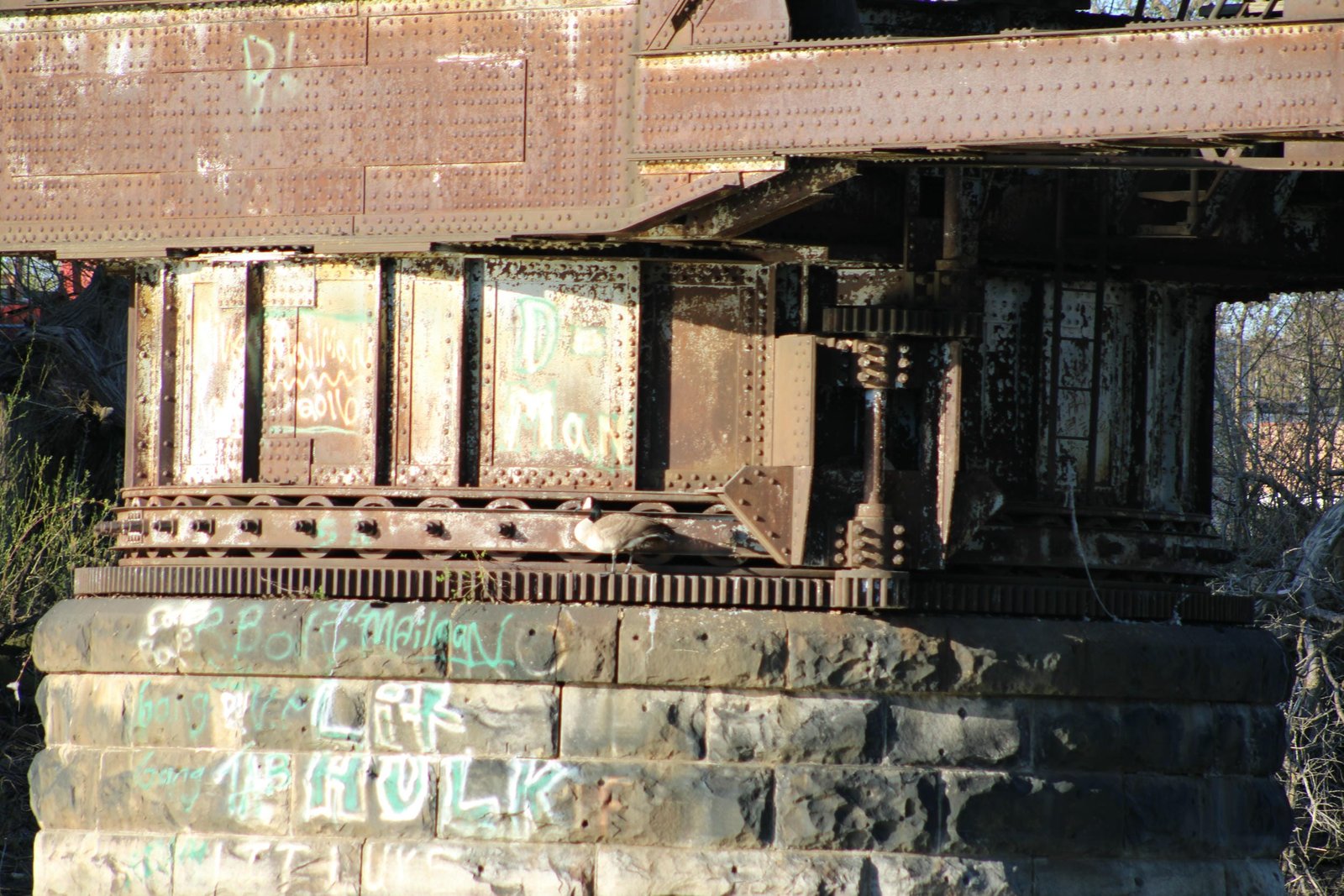
Currently, the bridge consists of a 247-foot, 11-panel, riveted double intersection Warren deck truss swing span, approached by a 48-foot deck plate girder span on either end. The swing span uses a rim-bearing design, where the superstructure is set onto a drum which rotates on a roller nest. The entire bridge is set onto stone substructures, which appear to be constructed of stone quarried at Ablemans (Rock Springs), Wisconsin. The truss span uses a heavily constructed variant of the double intersection Warren deck truss design, with massive members and additional vertical members connecting the center of the panels to the top chord. Large built-up beams are used for both the top chord and bottom chord, which are constructed with plates instead of a typical lacing. Three different styles of built-up beams are used for the diagonal and vertical members, which consist mainly of heavy V-lacing. The floor system uses a modified version of a standard design, with three I-beam stringers per track and large plate girder floorbeams. At the center pier, the bottom chord becomes thicker, using a large rectangular beam. This beam is set directly onto a tall metal drum, which is placed on a roller nest. The swing span was operated by a system of gears, which turned the drum by rotating on a circular gear track. The approach spans use a standard deck plate girder design, with two heavy plate girders per track. The entire superstructure is covered by a trough deck, consisting of transverse channels filled with asphalt cement and ballast. The substructures use a standard design, with a round center pier and abutments consisting of stepped wing walls. American Bridge Company fabricated the superstructure, while George W. Oakes constructed the substructure.
While lattice truss spans were relatively uncommon through the United States, the C&NW used the design extensively. Other railroads in the Midwest also occasionally used the design, although not as frequently. Engineers for the C&NW favored the design, due to its resilience and greater strength without sacrificing economy. Metal lattice truss designs were initially developed for railroad use in the 1870s, often using deep spans with numerous intersections. Through the mid-1880s, short to medium length spans were simplified into double intersection spans, as seen on this bridge. Later additions included vertical members at key points to increase loading capabilities and the improvement of the floor systems. Most lattice spans through the 1880s and 1890s were constructed by the Lassig Bridge & Iron Works, which produced a vast majority of iron and steel bridges for the C&NW during this era. The C&NW continued to use lattice truss designs nearly exclusively into the 1920s, and was among the only railroads in the United States still using the design into the 20th Century. Since the initial construction, the bridge has seen few significant alterations. Today, only the eastern track remains in use. It is unknown if the swing span can still operate, although much of the machinery remains intact. Overall, the bridge appears to be in fair condition, with no significant deterioration noted. The author has ranked this bridge as being regionally significant, due to the truss design.
Citations
| Build date and builder (superstructure) | American Bridge Company plaque |
| Builder (substructure) | Railroad Age Gazette; Volume 45, Issue 11 |
| Railroad History Citation | ICC Valuation Information, Compiled by Richard S. Steele |