






Click the photo to view the full-size version
| Name | WSOR Sheboygan River Bridge Chicago & North Western Railway Bridge #824 |
| Built By | Chicago & North Western Railway |
| Currently Owned By | State of Wisconsin (Operated by Wisconsin & Southern Railroad) |
| Superstructure Contractor | American Bridge Company of New York |
| Substructure Contractor | Unknown |
| Length | 150 Feet Total, 75 Foot Spans |
| Width | 1 Track |
| Height Above Ground | 15 Feet (Estimated) |
| Superstructure Design | Through Plate Girder |
| Substructure Design | Stone Masonry and Concrete |
| Date Built | 1905, Rehabilitated 2015 |
| Traffic Count | 1 Train/Day (Estimated) |
| Current Status | In Use |
| Chicago & North Western Railway Bridge Number | 824 |
| Wisconsin & Southern Railroad Bridge Number | B-824 |
| Significance | Local Significance |
| Documentation Date | 8/5/2016 |
In 1859, the Sheboygan and Mississippi Railroad (S&M) constructed 14 miles of new railroad, extending from Sheboygan, Wisconsin to Plymouth, Wisconsin. The following year, an additional 5 miles were constructed to Glenbeulah, Wisconsin. The S&M was foreclosed in 1861, and was reorganized as the Sheboygan and Fond du Lac Railroad (S&FdL). In 1868, the S&FdL constructed an additional 24 miles of railroad from Glenbeulah to Fond du Lac, Wisconsin; followed by 35 additional miles to Princeton, Wisconsin in 1871. The S&FdL was foreclosed in 1880, and became the Sheboygan & Western Railway (S&W) the same year. The S&W was consolidated into the Chicago, Milwaukee and North Western Railway (CM&NW) in 1881, which was sold to the Chicago & North Western Railway (C&NW) in 1883. In the late 19th Century, the C&NW constructed and acquired a number of railroad lines throughout the Midwest, eventually developing a vast network.
In the early 20th Century, the C&NW began expanding existing branch lines to provide greater connectivity throughout the system. The Princeton and North Western Railway (P&NW) was charted as a subsidiary of the C&NW, and constructed 86 additional miles between Princeton and Marshfield, Wisconsin in 1901. Later that year, the P&NW was fully purchased by the C&NW. This line connected a number of C&NW lines throughout central Wisconsin, and terminated at Marshfield, which was also the junction of another C&NW secondary line and a Chicago, St. Paul, Minneapolis & Omaha Railway (Omaha Road, a C&NW subsidiary) line. In addition, the line allowed the construction of branches from Bannerman, Wisconsin to Red Granite, Wisconsin and from Wisconsin Rapids, Wisconsin to Nekoosa, Wisconsin. As this route was mainly a connecting line, some segments were abandoned early on. The segment between Arpin and Marshfield was abandoned in 1937 in favor of trackage rights over the parallel Soo Line. The line between Plymouth and Peebles, Wisconsin was abandoned in 1954, followed by the segment between Fond du Lac and Peebles in 1969 and the Red Granite branch in 1970.
Through the second half of the 20th Century, the remaining route remained a secondary line, mainly carrying timber to paper mills in central Wisconsin. The segment between Bancroft, Wisconsin and Wisconsin Rapids would be abandoned in 1975, followed by the Ripon, Wisconsin to Bancroft segment in 1981 and the Wisconsin Rapids to Marshfield segment and the Nekoosa Branch in 1982. The final segment to be abandoned was between Fond du Lac and Ripon in 1987. In 1995, the C&NW was purchased by the Union Pacific Railroad (UP). In 2015, the State of Wisconsin acquired the Kohler, Wisconsin to Plymouth segment of this line, leasing it to Wisconsin & Southern Railroad (WSOR). Today, UP operates the Sheboygan-Kohler segment as the Kohler Industrial Lead and WSOR operates the Plymouth Subdivision between Kohler and Plymouth. A segment of the line in Peebles is used as part of the Peebles Trail, while the Fond du Lac to Rosendale segment is part of the Mascoutin Valley State Trail. An additional short segment has been reused as a trail near Ripon, and WSOR also owns a short stub of the former line in Ripon. The remainder of the line remains abandoned.
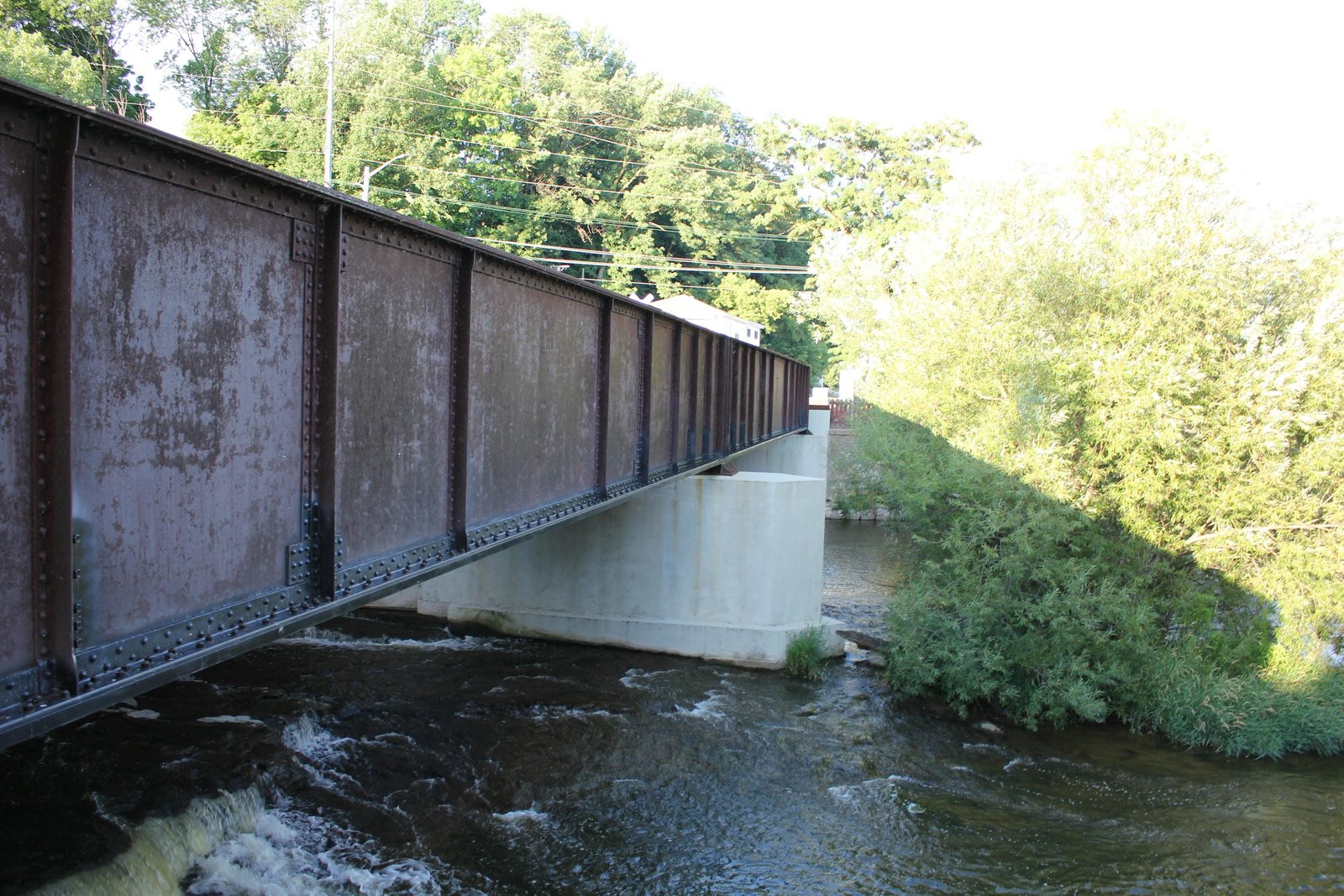
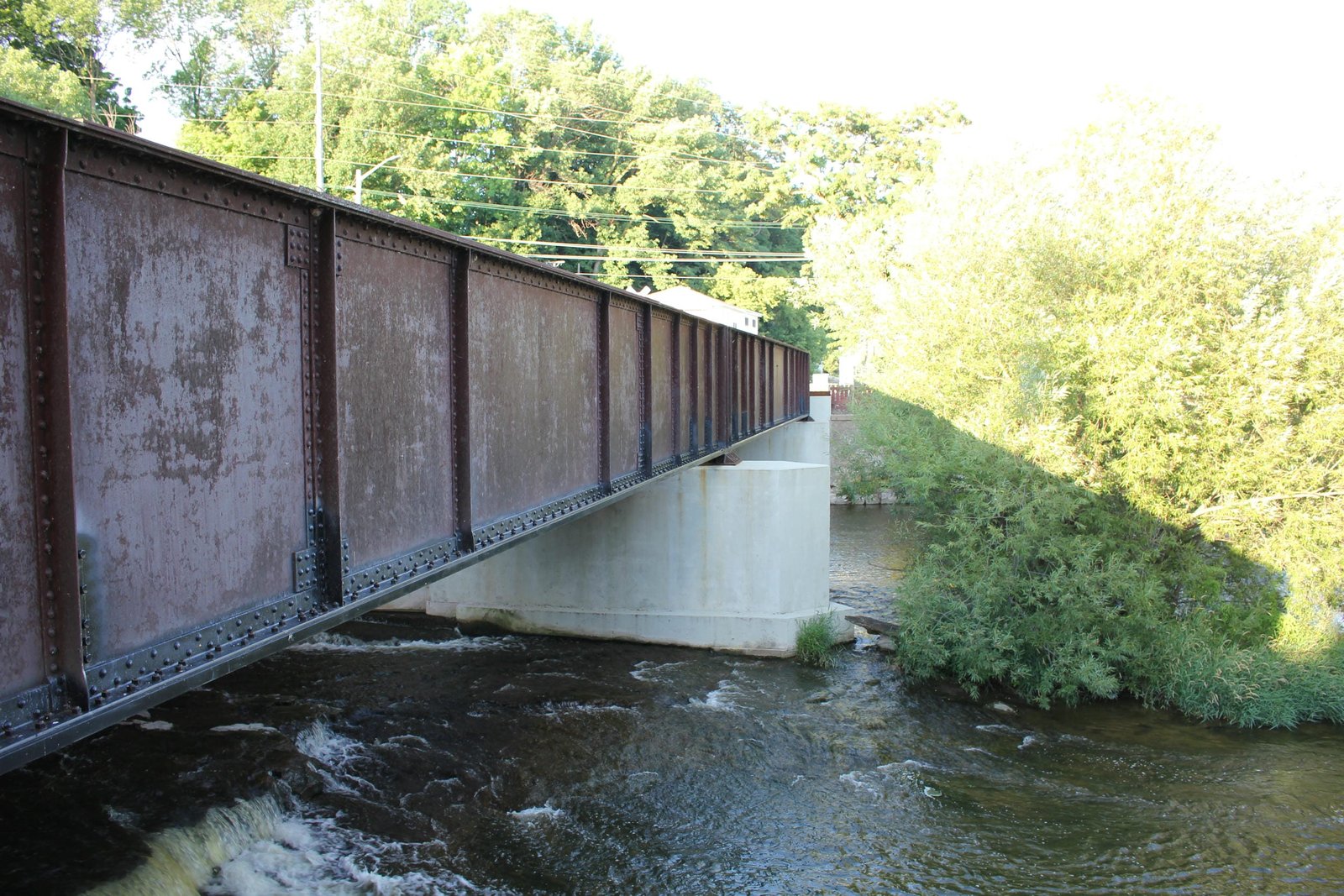
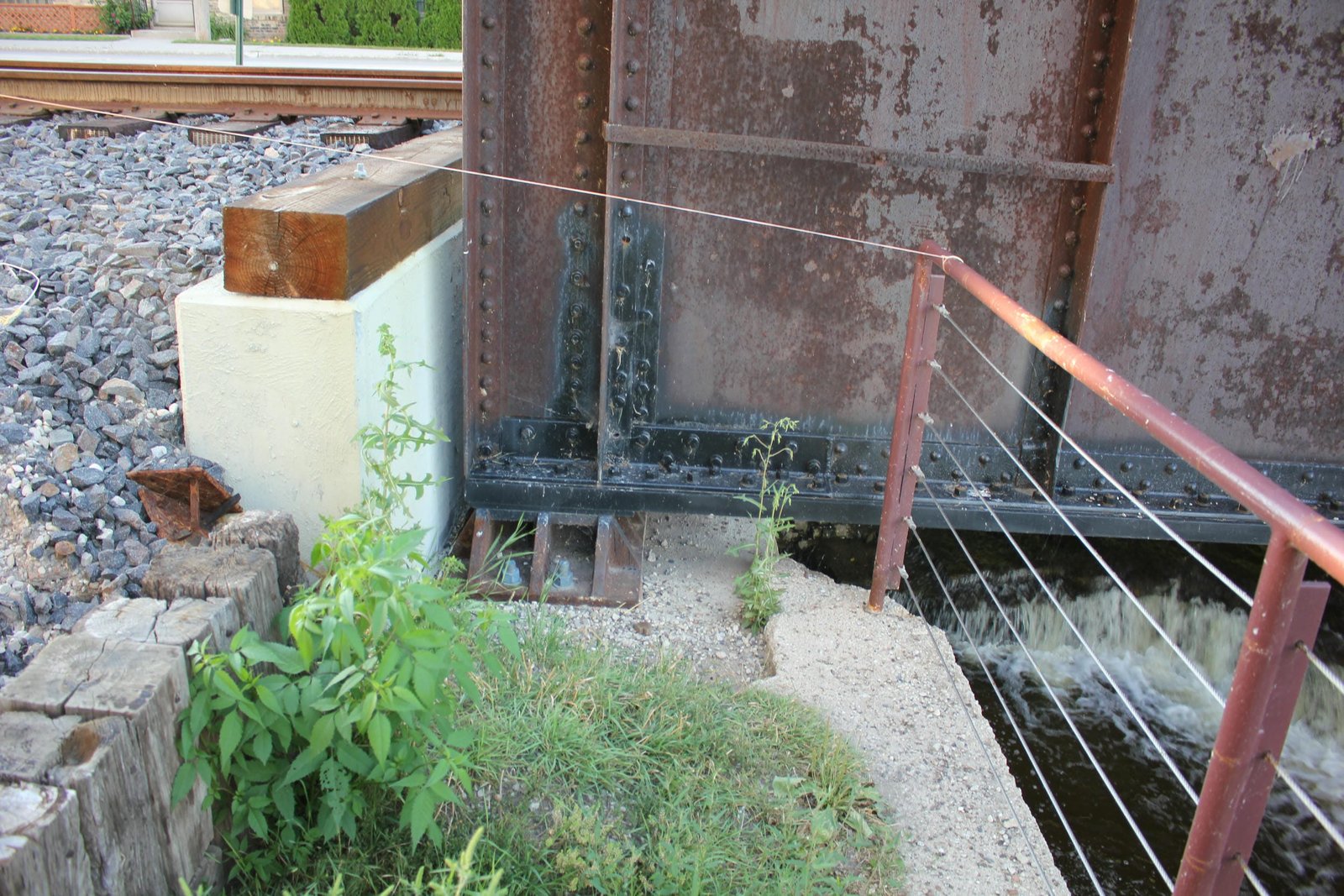
Located in Sheboygan Falls, this through plate girder bridge carries a former Chicago & North Western Railway branch line over the Sheboygan River alongside Monroe Street. The first bridge at this location was likely a timber pile trestle or a timber truss bridge. In 1896, this bridge was replaced a wooden Howe pony truss bridge, consisting of four 38-foot spans set onto timber substructures. By the early 20th Century, timber trusses became obsolete for almost all railroad traffic. In 1905, the bridge was replaced by the present through plate girder bridge. Currently, the bridge consists of two 75-foot through plate girder spans, set onto a stone pier and concrete abutments. The superstructure uses a standard design, with heavy girders, traditionally composed floor and square girder ends. The substructures also use a standard design, with a rectangular pier and stepped wing walls at the abutments. American Bridge Company fabricated the superstructure, while the substructure was constructed by an unknown contractor using stone quarried from an unknown location. Through plate girder spans were commonly used by railroads, as they were durable and easy to construct. After years of disuse, the bridge was extensively rehabilitated in 2015. As part of the rehabilitation, the original substructures were encased with concrete and the floor was partially reconstructed. Currently, the bridge remains in use. Overall, the bridge appears to be in fair to good condition, with no significant deterioration noted. The author has ranked this bridge as being locally significant, due to the common design.
Citations
| Builder and build date | American Bridge Company plaque |
| Railroad History Citation | ICC Valuation Information, Compiled by Richard S. Steele |