
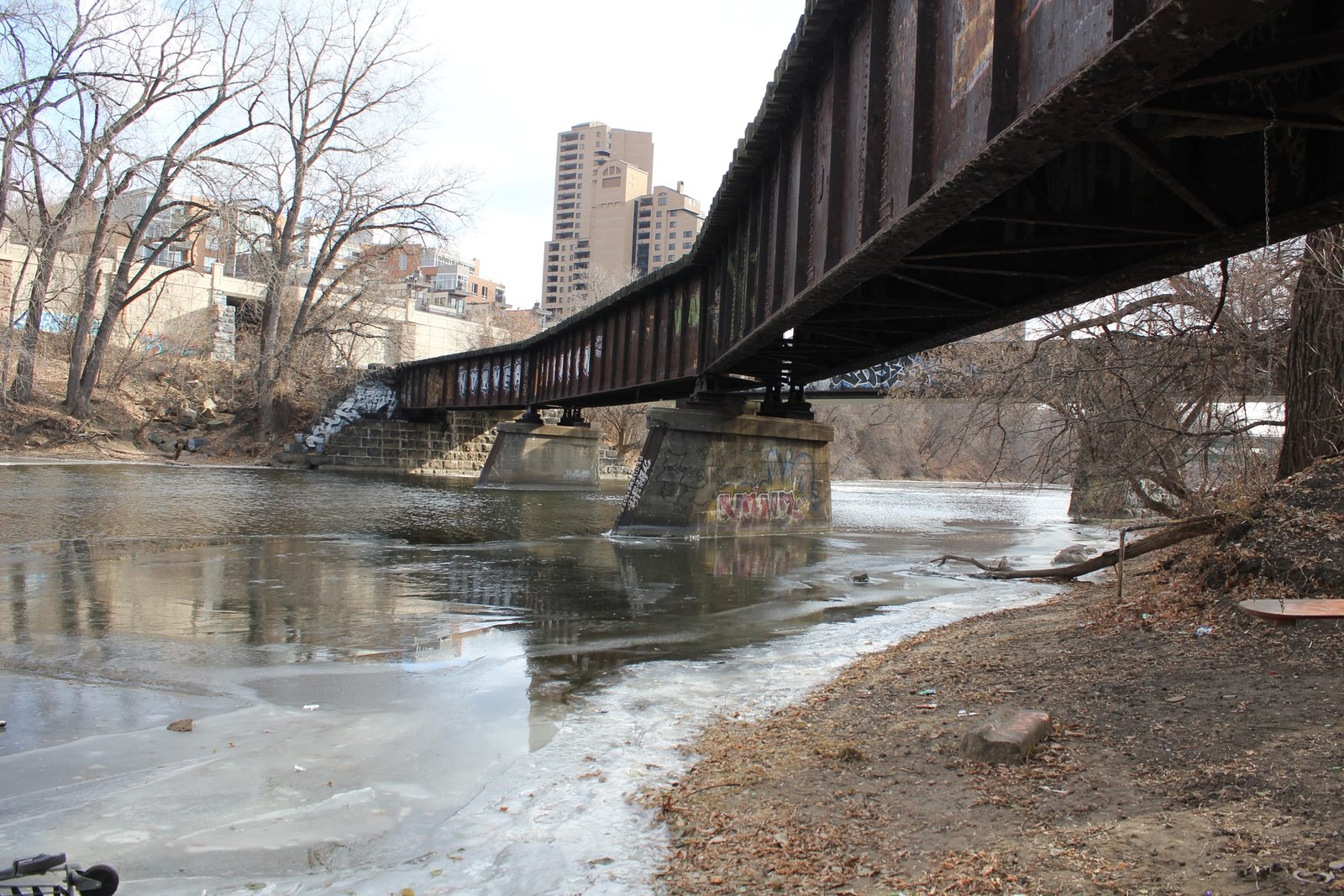


Click the photo to view the full-size version
| Name | Abandoned East Channel Bridge Chicago Great Western Railway Bridge #980 |
| Built By | Wisconsin Central Railway |
| Currently Owned By | City of Minneapolis |
| Superstructure Contractor | American Bridge Company (Lassig Branch of Chicago) |
| Substructure Contractor | Butler-Ryan Company of St. Paul, Minnesota |
| Length | 265 Feet Total, 90 Foot Largest Span |
| Width | 1 Track |
| Height Above Ground | 20 Feet (Estimated) |
| Superstructure Type | Deck plate girder |
| Substructure Type | Concrete and Stone Masonry |
| Date Built | 1901 |
| Traffic Count | 0 Trains/Day (Bridge is Closed to Traffic) |
| Current Status | Closed to all traffic |
| Chicago Great Western Railway Bridge Number | 980 |
| Significance | Local Significance |
| Documentation Date | 4/4/2015 |
Located on the north side of Nicollet Island, this deck plate girder bridge carries a former Wisconsin Central Railway/Chicago Great Western Railway branch line across the east channel of the Mississippi River between the north bank and Nicollet Island. In 1901, the WC began a series of terminal improvements in Minneapolis, including the construction of a short branch line to Boom Island, where a new railroad yard and roundhouse would be located. To reach Boom Island, trackage rights were utilized over the Great Northern Railway between St. Paul and the Mississippi River. From here, a curved deck plate girder bridge would be constructed over the east channel of the Mississippi River to reach Nicollet Island, and a truss bridge would be constructed between Nicollet Island and Boom Island. Both bridges were completed in late 1901. Currently, the bridge consists of two 90-foot and one 85-foot deck plate girder spans, set mainly onto concrete substructures and constructed on a heavy curve. The north abutment of the bridge is shared with the former Great Northern bridge, which was extended or altered when the bridge was constructed. The superstructure follows a standard design, with two heavy plate girders per span and an open deck. The substructures also follow a standard design, with rectangular piers and an angled nose. The north abutment uses stepped wing walls, while the south abutment uses sloped wing walls. Stone for the north abutment matches the quality and type of stone used for the original GN abutment, and consists of Kettle River sandstone quarried at Sandstone, Minnesota. American Bridge Company fabricated the superstructure at the Lassig Plant in Chicago, while Butler-Ryan Company constructed the substructures. Deck plate girder spans were popular for railroad use, as they were durable and easy to construct. Since the initial construction, the bridge has seen no significant alterations. The bridge was abandoned in the 1970s, and has stood abandoned since. Overall, the bridge appears to be in poor condition, with significant section loss and pack rust. However, the substructures of the bridge do not have the advanced spalling often seen on early 20th Century bridges. The author has rated the bridge as being locally significant, due to the common design.
Citations
| Build date and builder (superstructure) | American Bridge Company plaque |
| Builder (substructure) | The Minneapolis Journal; July 27, 1901 |
| Railroad History Citation | ICC Valuation Information, Compiled by Richard S. Steele |