


Click the photo to view the full-size version
| Name | CPKC Bridge #MA-324 Chicago & North Western Railway Bridge #MA-324 |
| Built By | Chicago Great Western Railway |
| Currently Owned By | Canadian Pacific Kansas City Limited |
| Superstructure Contractor | Unknown |
| Length | 10 Feet Total |
| Width | 1 Track (71 Feet) |
| Height Above Ground | 5 Feet (Estimated) |
| Superstructure Design | Stone Arch Culvert |
| Substructure Design | Stone Masonry |
| Date Built | 1901 |
| Traffic Count | 6 Trains/Day (Estimated) |
| Current Status | In Use |
| Dakota, Minnesota & Eastern Railroad Bridge # | MA-234 |
| Significance | Local Significance |
| Documentation Date | 11/5/2016 |
In 1884, the Wisconsin, Minnesota and Pacific Railway Company (WM&P) began construction on a new railroad line between Red Wing, Minnesota and Mankato, Minnesota. 84 miles would be constructed in 1884, extending from Red Wing to Eagle Lake, Minnesota. An additional 10 miles to Mankato would be completed in 1887. In 1894, the WM&P would be reorganized as the Wisconsin, Minnesota and Pacific Railroad, and the railroad would again be reorganized in 1897, retaining the name. By 1901, the railroad would be leased by the Chicago Great Western Railway (CGW). The CGW would be reorganized as the Chicago Great Western Railroad (CGW) in 1909. The CGW had acquired and constructed a modest railroad network throughout Illinois, Iowa, Minnesota and Missouri; connecting major cities in these states. The CGW was one of the smaller railroads in the area, and was late to develop lines. As a result, the railroad never saw the fortunes of other railroads in the area.
This line never developed beyond a secondary route, and the WM&P would be fully consolidated into the CGW by 1920. In the early 20th Century, the CGW was often surviving on razor-thin profit margins. In 1940, the CGW entered bankruptcy, and was again reorganized as the Chicago Great Western Railway. After the bankruptcy, the CGW became an innovative railroad, pioneering intermodal service and becoming one of the first railroads to completely switch to diesel locomotives. A capital improvement program was launched in 1949, which sought to rebuild and rehabilitate deteriorated infrastructure. In 1968, the CGW would be purchased by the Chicago & North Western Railway (C&NW). The segment between Benning and Mankato was abandoned in 1972, and the segment between Morristown and Faribault was abandoned the same year. The line was further reduced in 1976, when the segment between Waterville and Morristown was abandoned. In 1982, more of the line between Cannon Falls and Red Wing was abandoned.
The Faribault to Waterville segment would be purchased by the Minnesota DNR and converted to the Sakatah Singing Hills Trail, while the Cannon Falls to Red Wing segment would also be purchased by the Minnesota DNR and converted to the Cannon Valley State Trail. The C&NW retained operations over the Benning to Mankato portion of this route, and abandoned their parallel route. In 1982, the C&NW sold their mainline across southern Minnesota to the Dakota, Minnesota & Eastern Railroad (DM&E). In 1995, the C&NW was purchased by Union Pacific Railroad (UP). The DM&E would be purchased by the Canadian Pacific Railway (CP) in 2008, which in turn merged with Kansas City Southern Railway in 2023 to form CPKC. UP currently leases the Cannon Falls Industrial Lead to Progressive Rail, and CPKC currently operates a portion of the route as part of the Tracy Subdivision.
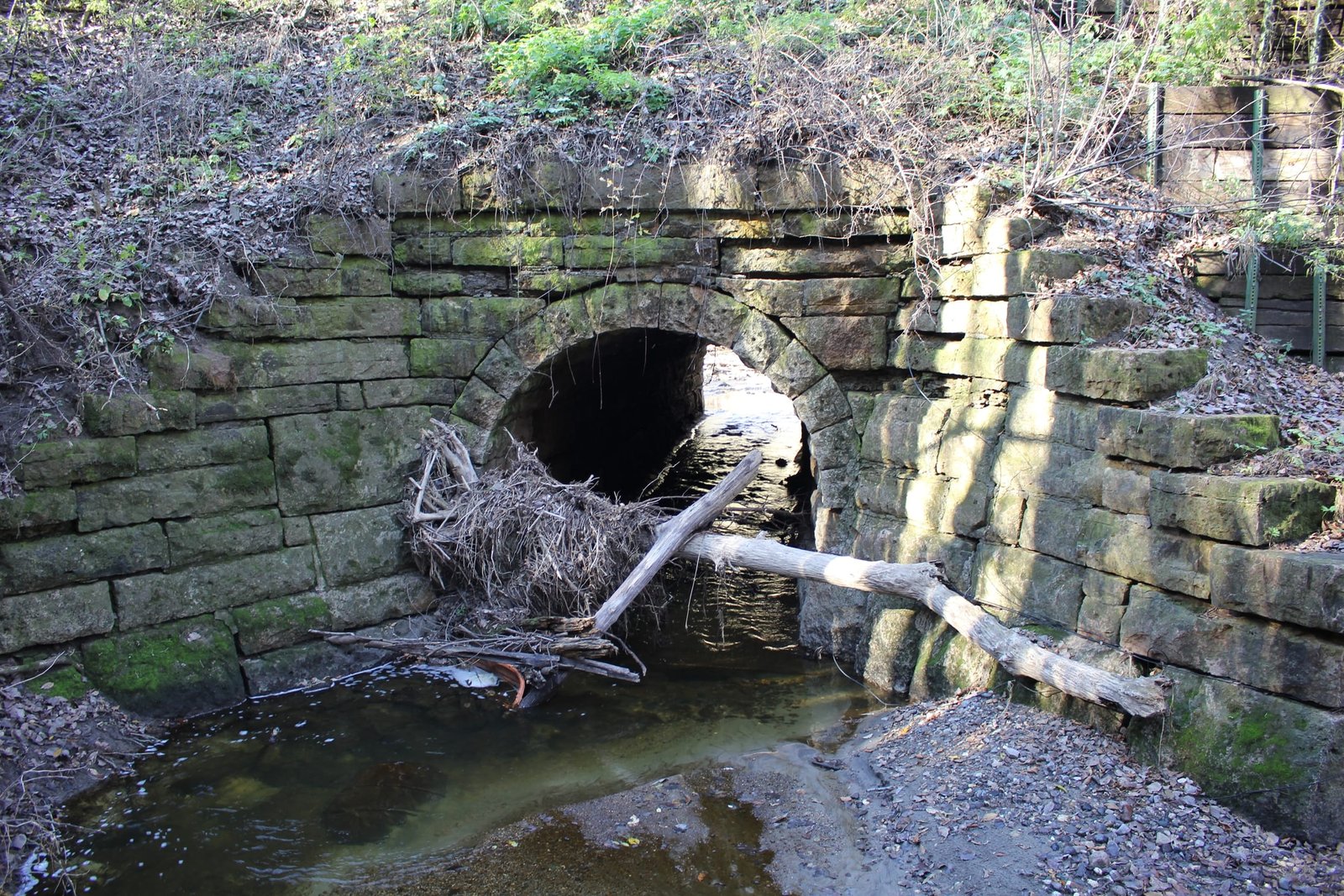
Located on the north side of Mankato, this small stone arch culvert carries the former Chicago Great Western Railway over an unnamed creek. The first bridge at this location was a timber pile trestle, typical of this line. In 1901, the CGW made a large investment in improving this line, filling and replacing 72 total timber pile trestles with various stone culverts. This culvert consists of a 10-foot stone arch culvert, constructed at a width of 71 feet. The culvert uses a standard design, with large stones, a semicircular shape and wing walls which extend diagonally from the structure. The CGW preferred to use local contractors, which were mainly based in the Twin Cities for construction of the stone culverts. It is currently unknown what contractor constructed this bridge. This style of structure was used extensively along the CGW, as it was a durable solution to fill large trestles. Overall, the bridge appears to be in fair condition, with some deterioration noted in the structure. The author has ranked this culvert as being locally significant, due to the common design.
Citations
| Build date | The Engineering Record; Volume 43, Issue 17 |
| Railroad History Citation | ICC Valuation Information, Compiled by Richard S. Steele |